

The UK imported 12,198 tonnes of fresh and frozen beef from Ireland in August, representing two thirds of its total requirement.
This is Ireland’s largest monthly share of the UK market so far in 2026 and while it is well ahead of the 58.5% share of the market in August last year, it is still well below the traditional 75%-80% share of UK beef imports historically supplied by Ireland.
Even though a trade deal has been in place since the middle of 2023, it was in the middle of last year that Australian and New Zealand beef grabbed a significant slice of the UK fresh and frozen beef market.
As Figure 1 shows, in August 2025 they both had around 10% of the market and the Irish share of the UK market had fallen to just over 58%. It should be noted that reduced supply from Ireland was also a factor in addition to the increased competition.
A significant increase in overall Irish beef exports in August this year, up by 23% or almost 7,000 tonnes on last year, also partly explains the increased Irish share for August 2026 compared with August 2025.
Year to date
Looking at the data for a single month in isolation can be misleading.
A better indication of the current direction of travel for UK beef imports can be obtained by examining the performance over the first eight months of the year and comparing it with the same period the previous year.
In Figure 2, we can see that the Irish share of UK fresh and frozen beef imports is running at 103,226 tonnes or 64.3% of all UK imports.
New Zealand is the next largest supplier with 15,943 tonnes, almost 10% of the market. This is a much higher proportion than its August market share which may be explained by the fact that it now has over 75% of its 2026 UK quota filled at this point.
In addition, the fact that both Australia and Brazil have used their 2026 quotas for China means that there is likely to be additional demand from that market for New Zealand beef in the latter months of this year.
Australia’s performance in the UK market over the first eight months of the year has been consistent with 9.7% of beef imports; a significant increase on the 4.8% share of the market that they had in the same period last year.
There has been a drop in Australia’s overall beef exports in the past three months and it will be interesting to note if its share of the UK market remains stable or increases in the closing months of 2026 as its out of quota exports to China now carry a 55% tariff.
As for Brazil, its year-to-date performance for both 2025 and 2026 is around 5% of the market and this had been expected to increase with the EU suspension of meat imports from Brazil which started in September. However, with the UK now carrying out its own inspection, there is a growing possibility that they may join with the EU in suspending imports from Brazil.
Position in UK market
At the end of last year, it looked like both Australia and New Zealand were making serious inroads to the UK market for imported beef.
With the overlap in the Irish and UK beef processing companies and the close cultural alignment between Ireland and the UK overall, Irish beef and food and drink in general have long been considered in a similar manner to domestic production by UK consumers.
This favourable perception combined with Ireland’s location meant that Irish production fits seamlessly into UK supply chains and gives a logistical advantage.
Conor O’Sullivan who heads Bord Bia’s UK office, explained this to the Irish Farmers Journal. “The UK remains our most important beef market and one in which we have increased our investment in recent years.
“For a shopper, awareness and preference for Ireland is much higher than other origins.
“For a buyer, the trust they have in our quality standards, our strength in sustainability, and the reliability of our supply chain are big structural advantages for Ireland. It’s a great base to build from and we are looking to reinforce that through our work.”
Bord Bia has just launched an autumn promotional campaign in a number of the main beef export markets in Europe including the UK. O’Sullivan explained: “In the UK our campaign has focused on promoting the core range of Irish beef as a source of natural protein to shoppers of the UK’s major supermarkets and promoting organic Irish beef with the UK’s leading premium online retailer.”
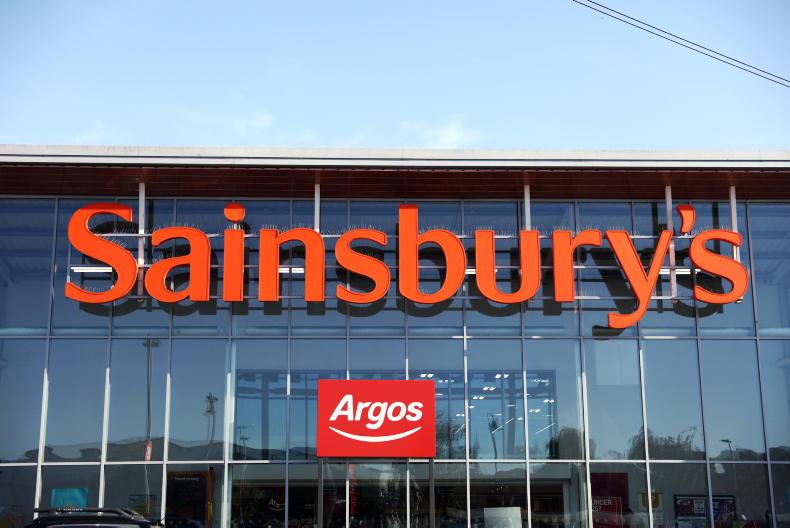
The three largest supermarket groups – Tesco, Sainsbury’s and Asda – all have a policy of offering their shoppers British and Irish beef as does the major burger chains. Online retailer Ocado, which is 50% owned by Marks & Spencer, offers Irish beef as part of its organic beef range.
EU suppliers squeezed
UK beef imports from Ireland have stabilised at around two thirds of the total market as opposed to three quarters previously. At least some of this reduction is due to reduced production in Ireland in 2025 and the first half of 2026.
Both Australia and New Zealand have now captured a significant slice of the UK market at around 10% each.
This has been mainly secured at the expense of Poland, Netherlands and France as well as Ireland. Previously these other EU countries had a significant share of the UK market .
Now only Poland remains as a top five supplier and its share had fallen to 5% in the first eight months of this year down from almost 8% in the same period last year. For supermarkets with a just in time supply chain essential for keeping shelves stocked, geographical location is of prime importance.
Combine this with a product that is identical to the domestic UK offering for all key characteristics and it means that Ireland will always be the import partner of choice in this segment of the market.
However outside the retail sector, frozen beef is more widely used and there are greater lead in times for supply chains, Australia and New Zealand will be significant players with further growth potential.