



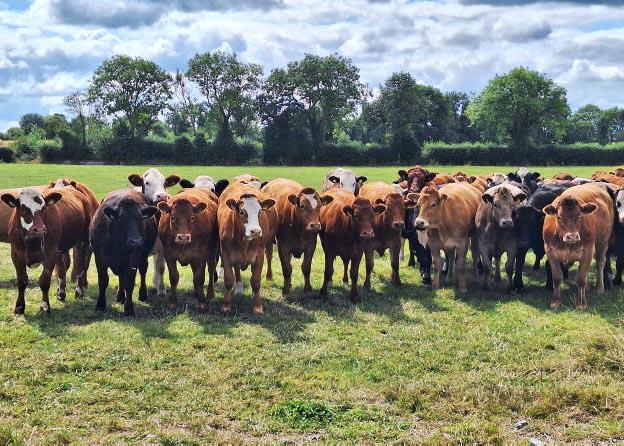
The consequences of ongoing drought conditions in Tullamore Farm are intensifying, with grass supplies close to being depleted.
This is leaving the farm with little option but to transfer most categories of stock onto supplementary feed.
The 65 cows with calves at foot are being supplemented with good-quality silage that is likely to be in the mid-70s for dry matter digestibility (DMD).
The silage is being fed in round feeders and cows are consuming about four bales daily.
Farm manager Shaun Diver reports that cows seem to be holding condition.
He adds however, that up until 10 days to two weeks ago there was some element of grass in the diet and as such cows are now entirely reliant on silage and may come under more nutritional pressure as time goes on.
The cows that Shaun is referring to are younger first calvers and a low number of cows that are in slightly lower body condition.
He adds that if there is a concern that the body condition of such animals will start to suffer then he will consider batching animals for priority feeding and possibly concentrate supplementation or, as time goes on, the earliest calving cows may be considered for early weaning.
The latter is an option that will come more in to the spotlight in early September if current conditions continue, as it will be extremely challenging to build grass supplies again without reducing demand.
Calves are being allowed access to the adjoining paddock via a raised electric wire and this is facilitating offering meal feeding in troughs.
Shaun says that despite the tough conditions, calves are slow enough to eat concentrates and are typically only consuming in the region of 0.5kg daily.
Shaun adds that in the past calves were quicker to enter adjoining paddocks with the lure of fresh grass.
However, as most swards are now burnt up with grass depleted, calves are spending less time away from cows as would be the norm at this time of year.
He has however, seen an increase in meal intake in recent days and expects this to now step up fairly sharply as more calves get accustomed to eating creep feed.
The batch of 36 in-calf and maiden heifers is located on the home farm where up until now there was marginally more grass available on some lower-lying or more marginal lands that held moisture better.
Demand was being reduced by offering heifers 1.5kg to 2kg concentrate supplementation daily along with a restricted supply of average-quality grass.
With grass now depleted there has been no option but to also introduce silage supplementation with in-calf heifers now receiving silage along with concentrates.
Shaun comments that he will likely maintain meal supplementation in the region of 1kg per head daily in the short-term to ensure performance is not compromised.
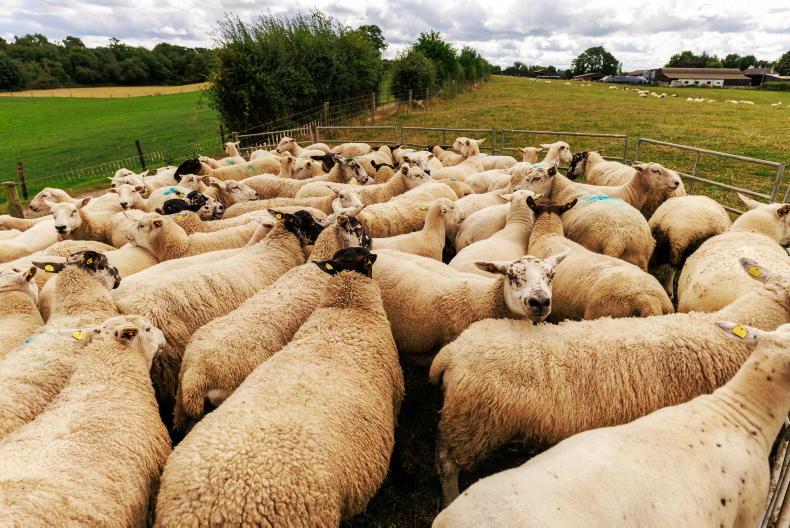
The management of lambs will also change significantly this week.
Up until now there were two batches of forward lambs numbering in the region of 100 lambs receiving meal supplementation of about 0.5kg per head daily.
One batch of about 50 was grazing a reseeded sward in a lower-lying area which had a small cover of grass.
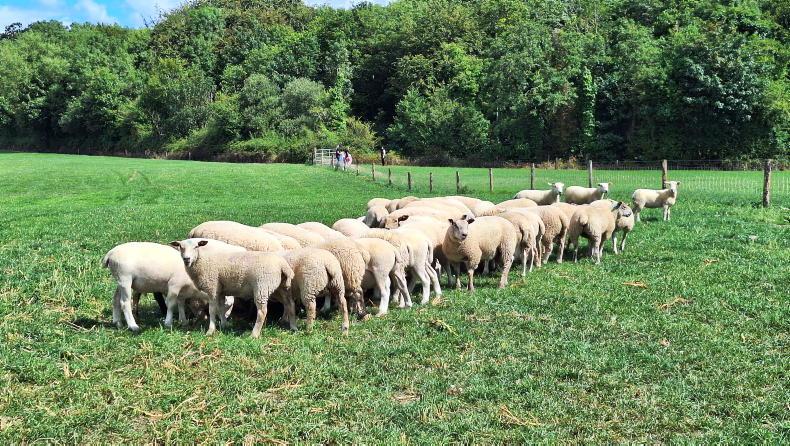
A total of 30 lambs have been drafted for slaughter on Thursday (46kg to 49kg) via the Offaly Quality Lamb Producer Group.
With grass reserves as good as depleted, all lambs will now have to receive concentrate supplementation.
Forward ram lambs weighing from 37kg to 38kg upwards will be batched together and will be built up to ad lib concentrates.
Lighter ram lambs will initially receive in the region of 0.7kg concentrates with the aim of keeping these lambs ticking along.
This level of concentrates should sustain a daily liveweight gain in the region of 150g to 180g per day and allow lambs to continue to develop a frame before being transferred on to ad lib feeding.
The same approach will be taken with ewe lambs destined for slaughter and those identified for breeding with an emphasis on ensuring such lambs achieve target mating weights of 60% of mature weight at time of joining with rams.
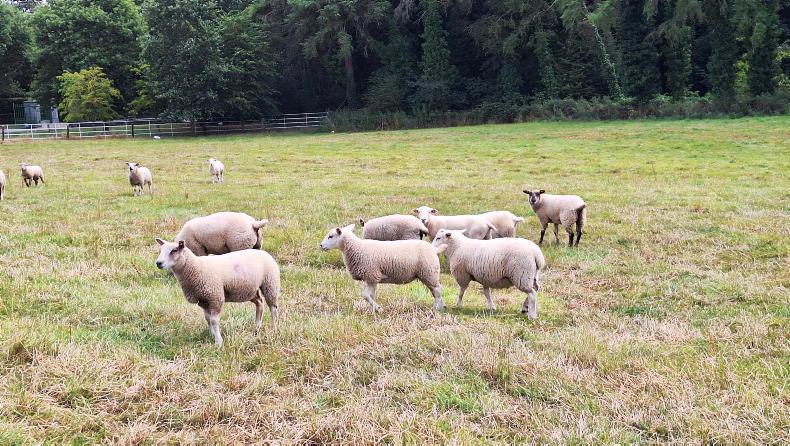
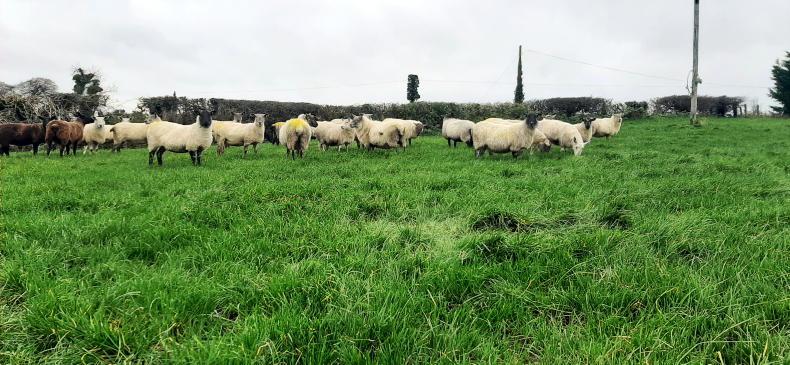
The main batch of mature ewes have up until now been sustained on average-quality grass and two bales of silage per week.
With ewes now weaned sufficiently, attention is turning to having ewes in optimum condition at mating.
Shaun estimates that in excess of 85% of ewes are currently in good condition with this also bearing true for two-tooth hoggets that reared lambs.
There will now be no option but to feed ewes to appetite with silage.
The batch of ewes under target body condition will be accessed in the coming week with a view to possibly segregating for preferential treatment and concentrate supplementation.
If concentrates are introduced it will be along the lines of Teagasc guidelines which are detailed in Table 1, where 100% of the forage component of the diet constitutes silage or hay.
Gaining one body condition score is equivalent to about 10% to 15% of ewe bodyweight with this influenced by breed, size and age.
Teagasc explains that this generally ranges from 7.5kg to 12.25kg liveweight for a ewe with a mature weight of 75kg.
Such a ewe would need to gain 10kg liveweight to increase from BCS 2.5 to 3.5. At a liveweight gain of 100g per day, this would take 14 weeks to lift one condition score, reducing to nine and a half weeks at 150g per day.
This will be challenging to achieve on drought-stricken farms and the best that may be achieved in some situations is to gain half a BCS.
It is important that when growth and grass supplies do recover that a portion of supplies are earmarked for high-priority sheep.
The current costs of contending with drought on Tullamore farm is in excess of €1,000 per week. This is mainly driven by suckler cows consuming four bales of silage a day which, if valued at €30 per bale, would equate to €840 per week or €1,120, if valued at €40 per bale.
The cost of feeding heifers was in the region of €23 per day based on 70kg concentrates fed at a cost of €330/t for a standard high-energy ration.
This will now increase marginally due to silage being introduced and concentrates being cut back. There is no cost built in to concentrates fed to calves as it is normal at this time of year to be introducing concentrates as part of preparation for weaning.
The cost of supplementing sheep has been low at about €100 per week thus far, but this will now jump significantly as ewe forage intake increases and concentrate feeding is extended to all lambs.
Costs will easily increase to upwards of €500 per week over standard costs for the time of year.
The fodder budget was showing a surplus of about 15% additional silage when completed in July. However, at this stage, it was not expected that drought conditions would have persisted as long. The fodder budget will be updated again over the coming week once a good grasp of intake is apparent.
Farm manager Shaun Diver knows that even if some rainfall comes, it will be very challenging to get back on track quickly and as such the management practices being introduced such as transferring lambs on to ad lib feeding and supplementing ewes with forage will be necessary for a prolonged period of time.
As already mentioned, the longer drought continues, the greater the spotlight will be on possibly weaning early-born calves sooner than planned.
Scanning is also taking place this week in suckler cows and it is likely that supplementary feed will be introduced to cows with the aim of having them in a position to move off the farm quicker.
Scanning for ovine pulmonary adenocarcinoma (OPA), which is a fatal lung disease in sheep, took place recently.
It was carried out by vet Kieran Mulvenna who works with Patrick Grant, The Sheep Vet who specialises in OPA scanning. It identified seven ewes with lung tumours/major damage.
One of these ewes was showing clinical symptoms and died a couple of days post scanning. The remaining six ewes were drafted for slaughter and averaged 32.2kg carcase weight and grossed €165 each at €5.10/kg.
Shaun says that there was no real sign of illness in these ewes with all achieving a fat score of three.
There were also seven ewes marked with signs of lung damage which looks as though it is caused by pleurisy, mycoplasma or lungworm related damage at a young age and could not be directly linked to OPA.
The farm’s vet, Donal Lynch, will be consulted to determine the next steps. Ewes marked can be scanned again to see if OPA is present.
The cost of scanning was €2.35 per sheep along with a £80 (€94) callout which averages at about €2.75/ewe.
*The Tullamore Farm open evening advertised last week for 27 August has been postponed. A new date will be announced soon.



SHARING OPTIONS