
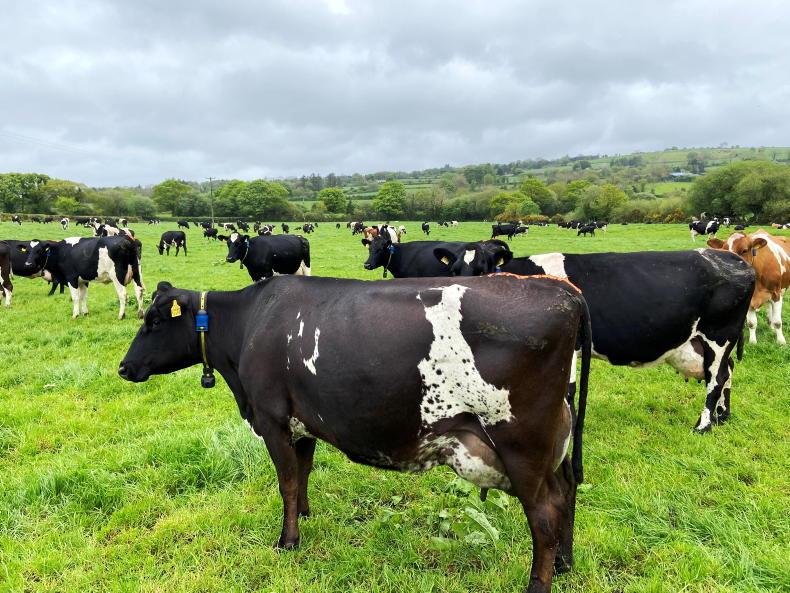
Collars have become a big area of investment for dairy farmers over the past five years, but how useful are they and what benefits can they really offer farms in terms of labour-saving?
Essentially, collars – or the heat-detection bolus equivalent – are purchased as a heat-detection aid.
During breeding, they identify cows in heat based on a number of metrics, the main one being spikes in activity.
Instead of the farmer having to observe cows four or five times per day or apply tail paint and scratch cards, the collars notify the operator of which animals are in heat.
They also outline what stage of the heat cycle the animal is at, which in theory provides an estimate of the ideal window for insemination.
With the rise in popularity of sexed semen, this technology should increase the chances of success, as decisions on whether or not to use a sexed straw on a cow that may be past the ideal window can be based on data rather than guesswork.
This is certainly working well on some farms, but the technology is never 100% accurate.
In fact, conception rates to first service in many Irish herds now using collars haven't necessarily improved compared with results achieved before collars were installed.
Advantage
A good operator achieving strong breeding results without collars won't necessarily be outperformed by an operator using the technology.
However, the big advantage is the time saved and the greater flexibility they offer.
Anyone working on the farm can draft out cows based on the information provided by the collars, whereas, previously, the owner operator may have had to work right through the breeding season to ensure cows weren't missed.
Other benefits
As well as heat detection, collars can help to identify potential animal health issues earlier than they might otherwise be picked up visually.
Alerts are generally based on a reduction in activity levels or a drop in rumination time, which can indicate that something is wrong with the cow.
Many farms will also use collars to help identify cows that are likely to be pregnant earlier in the year. This can be of benefit when selecting cows to cull during a period of drought, as was experienced earlier this year.
Cost
Collars and other heat-detection technology cost between €35 and €50 per cow per year.
Boluses are generally more expensive, but offer other advantages. Tail paint and scratch cards come at a very small cost in comparison; however, the real advantage of collars is the time saved.
At Dairy Day 2026, people specialist with Teagasc Moorepark Conor Hogan and local dairy farmer Niall Maloney will assess whether or not collars are worth the investment.
They will share their opinions and rank the investment against the other labour-saving ideas featured in the series. This rating will then be combined with an audience rating to decide the best labour-saving ideas overall.
To get your tickets for dairy day, visit here.