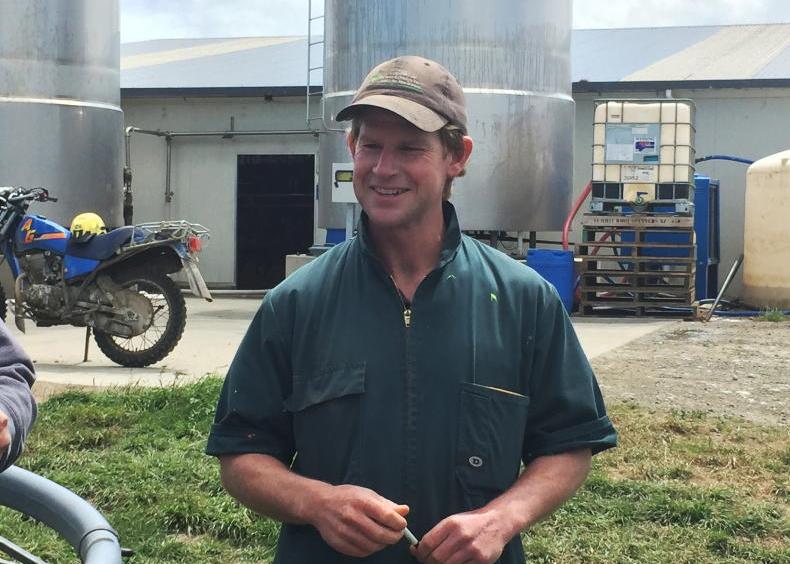

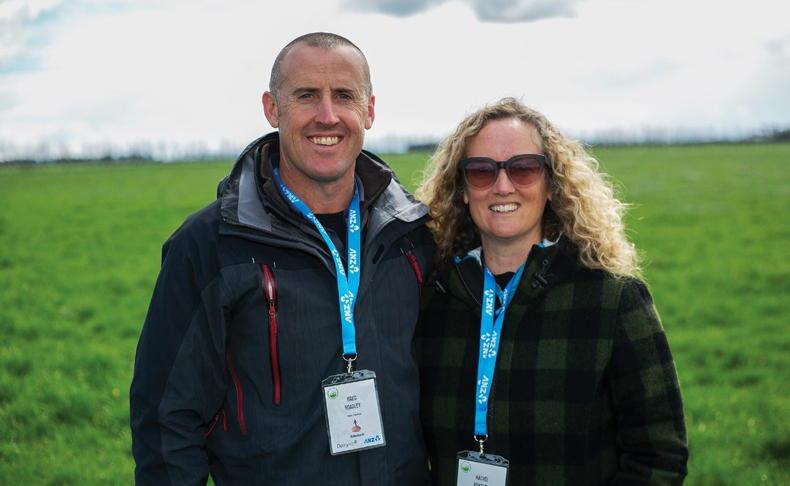
Greg and Rachel Roadley met while completing degrees in agriculture at Lincoln University. They always knew they wanted to run their own large-scale dairy business and now, alongside their children Mia (22) and Guy (21), they are doing just that.
Greg’s father, John Roadley, was something of a pioneer in low-cost, grass-based farming and was also well known for his contribution in the early days of the Fonterra co-op.
John was based in Taranaki, a traditional dairy heartland on the North Island, and put a big focus on growing and utilising grass, avoiding imported feed and keeping a real handle on costs.
Greg and Rachel have followed those principles ever since and have never strayed, no matter what the milk price was or how cheap feed got.
They manage all of their farms without any concentrates. Cows’ diets consist of grass, a very small amount of silage during the grazing season and fodder beet crops over the winter months.
Grass
Of the seven farms - with 5,300-cows - five are dairy platforms and two are outwintering blocks. All of the dairy platforms are irrigated, and this allows the Roadleys to guarantee growth rates through the summer months, unless there is a very drastic drought and rivers dry up.
The farm we visited was growing an average of around 17t DM/ha. The platform was stocked at 3.8 cows/ha.
The Roadleys pitch their stocking rate based on what they feel the farm can grow in the peak growing season. As the farm is irrigated, they can maintain peak growth for about three to four months.
The top growth rate in New Zealand is typically lower than in Ireland. The Roadleys budget for a peak of about 65kg to 70kg DM/ha per day.
At a stocking rate of 3.8 cows/ha, the herd can be allocated around 18kg of grass per day. Whenever there is a surplus, they will take it out for silage and feed it back in the shoulders of the year as a supplement.
They aim to make no more than 100kg DM of silage per cow on the platform during the growing season, and this 100kg is fed in spring and autumn. They also have 5% of the milking platform under fodder beet, which is used to transition cows before and after wintering them off-farm on fodder beet.
Most farms operating this type of system will open with a higher farm cover in spring of around 1,200kg DM/ha. This leaves scope for higher demand than on a typical Irish farm in spring, which is necessary with no supplement.
The land type in Canterbury is also much drier, with a gravel soil type that makes it easier to graze these higher covers in spring.
During the main grazing season, the cows will go into pre-grazing yields of 1,300kg to 1,400kg DM/ha. They will graze down to a residual of 3.5 to 4cm. The farm will carry an average farm cover of around 550kg DM/ha through the summer, keeping rotation length at around 20 to 21 days.
Any pre-grazing covers going beyond 1,500kg are skipped for surplus bales. There is no topping done on the farm.
As growth starts to fall in late summer, the Roadleys’ first port of call is to start culling any cows that appear to be still bulling.
The next step is using a small amount of silage to fill gaps in the wedge, but if demand is still too high, allocations will be reduced. If cows start to get thin, they will be dried off early.
Body condition is very closely watched on low-input farms in New Zealand. At any indication that a cow is starting to get too thin, she will be placed on a once-a-day milking programme. If she doesn’t improve, she will then be dried off.
The farm closes with a cover of around 700kg DM/ha. Overwinter growth in Canterbury is better than on most Irish farms.
Genetics
Production and genetics are not something that the Roadleys get hung up on. A good six-week calving rate is important, however, as the farming system is based on calving cows compactly and utilising as much grass as possible.
Empty rates on the farms are between 9% and 13%, with six-week calving rates in the high 80s.
Greg said on the day that he couldn’t be certain what the cows were producing or what they had produced in the previous year, and frankly, it didn’t bother him.
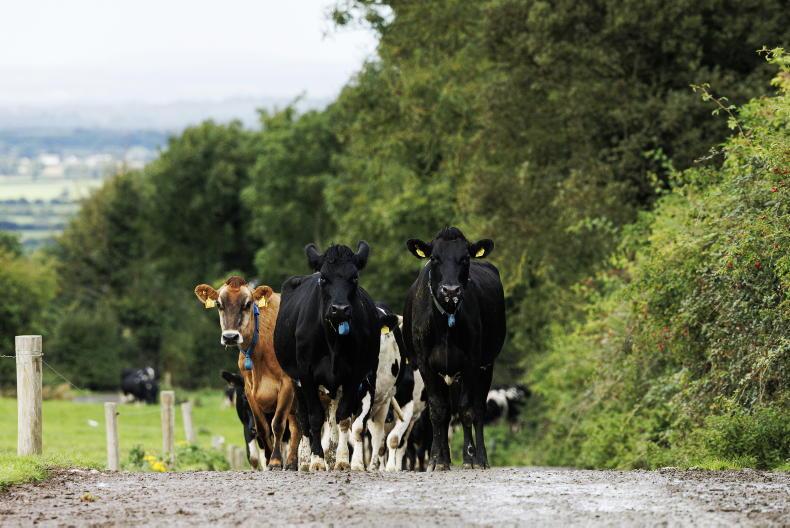
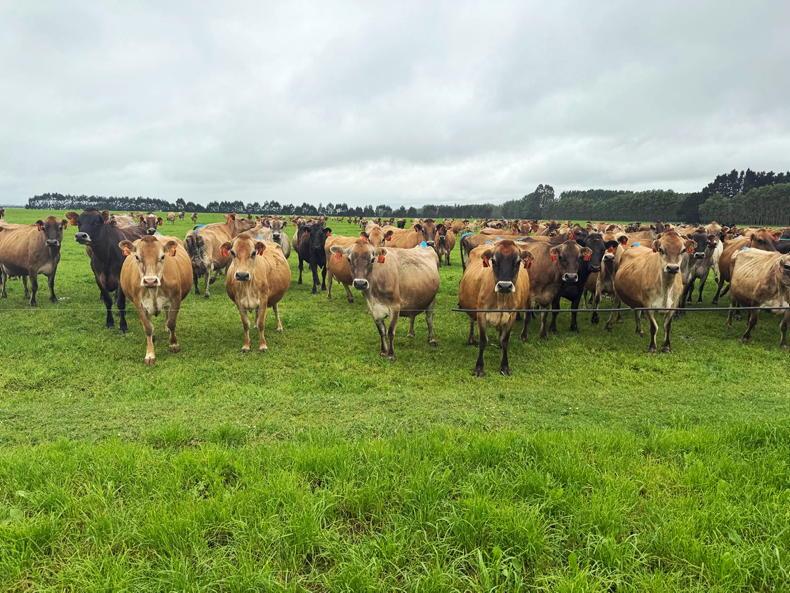
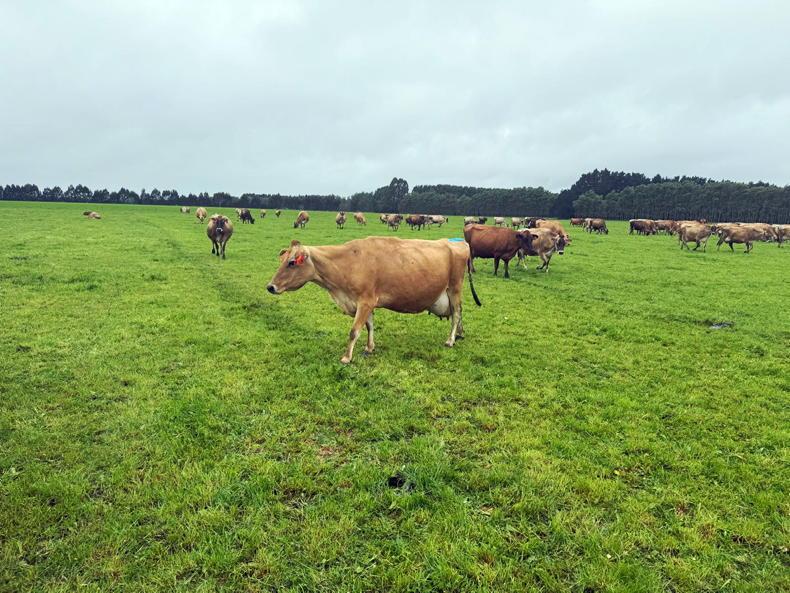
The level of output on the Roadleys’ farms is simply a consequence of how well the grass is managed alongside good genetics. All bar one of the herds are crossbred. The farm we visited was made up of almost entirely pure-bred Jersey cows.
Based on the Fonterra report, the cows on that farm produced 422kg MS/cow, and at the time of the visit, three weeks into breeding, they were doing 2kg MS/day at 5.4% fat and 4.8% protein.
The Roadleys are using sexed semen and are managing to sell the rest as beef-cross calves.
Budgeting
What separates the Roadleys from the majority of other dairy farmers is their attention to detail when it comes to budgeting and cashflow.
They have developed a detailed set of spreadsheets over the years, that allow them to compare each of their farms and drill into the detail of every cost.
The budget is updated once monthly, and cashflows are updated daily. Greg and Rachel look at the variances on one farm versus another, but also at each individual farm versus its previous year’s performance.
Based on the category of a cost, a certain level of variance is acceptable. That level is just a couple of percentage points, however. If the variance starts to creep up, Greg will go straight to the contract milker to dig into the reasoning for it.
Farm working expenses across the farms are equivalent to between €2.50 and €2.75/kg MS.
This includes interest, but doesn’t include capital repayments, tax or personal drawings.
The low level of inputs protects the business against most of the main rising costs, except for fertiliser.
While the farm may not produce as much milk as farms that are feeding more, the system is far simpler and there is very little exposure to volatility in either input costs or milk price.
Greg said he targets farm working expenses to be 50% of gross farm income.
If they can achieve that figure, he is confident the business will be highly profitable and sustainable.
This approach is also applied to investments on the farm. Is the investment going to generate a return that’s double the initial investment? If so, it’s worth spending money on. If it’s not capable of giving that return, it’s not worth allocating money to.
Strategy
When they first set out to go farming, Greg and Rachel set out a plan to enable them to build as much equity as possible by the age of 50 through a dairy farming business. They also wanted a scenario where the business required just 50% of their time. They’ve been successful on both counts.
But how did they achieve this? The first thing they spoke about was being good with their time.They broke down the time they spend working in the business to roughly one-third on technical farm matters, one-third on administrative work and one-third on growth and strategy.
They are also extremely disciplined in terms of their family and personal time. This time is protected at all costs.
To enable this, they rely on having good teams of people working for them, and to ensure that’s the case, they reward their teams well. All of the farms are run by contract milkers, who are paid a rate per kilo of milk solids, as discussed in one of my previous online articles.
The contract milkers are paid good rates, have accommodation on the farms and have regular contact with Greg and Rachel. They are expected to stick to the business policy around managing grass and supplementary feed, but after that, they are given the responsibility and freedom to manage the farms themselves.
The majority of the Roadleys’ staff have been with them long-term, which is a testament to how they communicate and manage people.
The Roadleys’ children, Mia and Guy, are also interested in farming, but they will be expected to work their way up through the business, starting at the bottom. Mia has already started this process, with Guy close to finishing his degree in agriculture.
Greg and Rachel feel that making them follow the typical New Zealand pathway will give them an understanding and appreciation of the business, but also an appetite and hunger to work hard themselves.