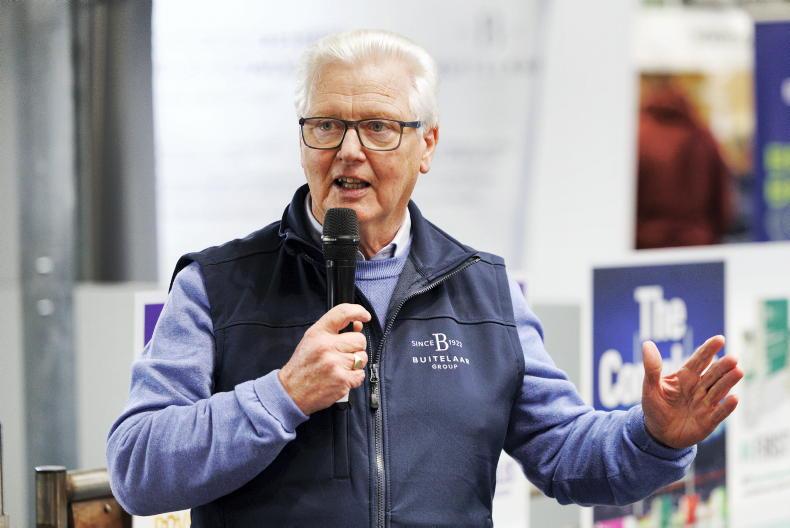

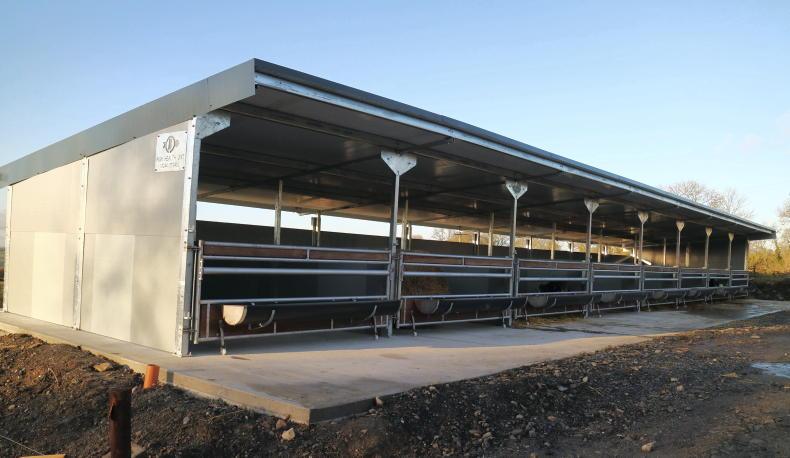
Buitelaar is more commonly known for calf purchasing, calf rearing and finishing animals through to slaughter, as Paul Matthews of the Buitelaar group pointed out.
“When they [Buitelaar] were developing this shed, it was developed for calves – quite a few sheds around the country are dual-purpose. They’re machinery sheds, they’re grain sheds – with Buitelaar, these sheds are used for calves 12 months of the year,” explained Paul.
There was no intention of selling the units, with all research and development being solely for the company’s own benefit to improve the calf rearing stage.
Trials on its own farm showed that calves housed in the high health unit used between 25% and 27% less antibiotics than calves housed in conventional buildings, with the same staff, same breeding and same nutrition gone in to them. Buitelaar also saw daily liveweight gains improve to the tune of 10-15% from calves being reared in the High Health Unit (HHU).
Moving to sales
“When Adam [Buitelaar] was putting these sheds up in the UK, it coincided a little bit with what’s happening here now in Ireland regarding TB. A lot of farms over there were hit with TB and calves had to be held. They had shed space for a finite number of calves.
“Adam saw the opportunity with these sheds, with no planning needed for these units. This was a fix for the TB herds in the UK, and what happened with a lot of them at the time was they paid for the units with calves after they became clear from TB. We’re a calf company and selling the HHU was about growing the calf business.”
Paul says the HHU has “revolutionised” the calf rearing on Buitelaar’s own units, with the UK bases rearing 55,000 calves per annum, with close on 20,000 reared through the HHU. The year-round calving pattern in the UK goes someway towards ensuring maximum efficiency of the units, with four to five batches of calves reared annually in each unit.
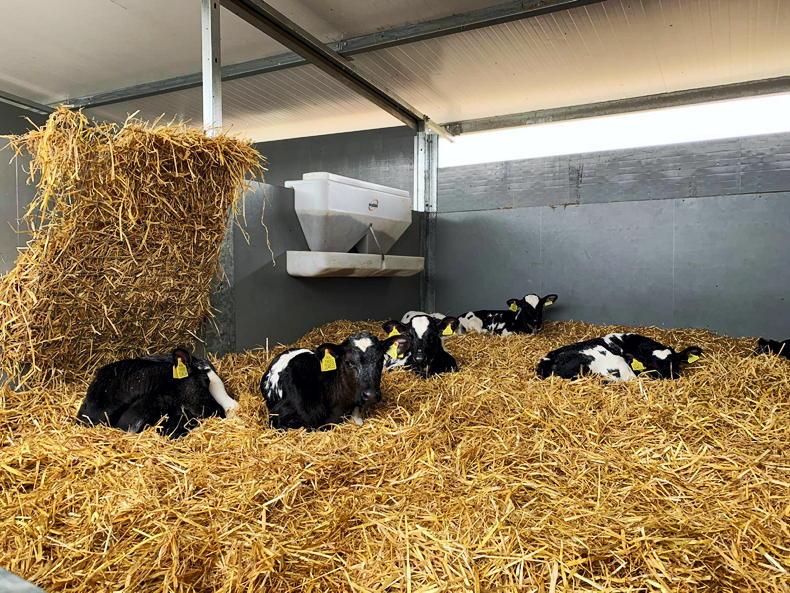
Designed for calves
Buitelaar states that the modular building is designed for calves, with no secondary function for the build. In the UK, 20,000 calves are reared annually on Buitelaar-owned farms in the HHU, with each pen seeing four to five batches of calves reared in it throughout the year.
The low roof is one of the most noticeable features of the unit, with the rear of the shed measuring just 2m in height, while the open front of the unit sits 2.5m above ground level. While it does limit the access to the pens, it is done specifically to improve air flow
“If you look at the stack effect in sheds, hot air rises and goes out normally through canopies. A lot of the time it has to go up to high, the air gets cold and comes back down before it gets out.
“With these units here, the air only has to rise about 3ft above the calf level and it’s taken out. The important thing with these sheds is the placing in the yard – that the prevailing winds are coming from the rear.“
Calf sheds remain the most difficult building to get right in the yard. It is next to impossible to create a shed that will hold a small number of newborn calves in early February with low temperatures outside, while at the same time performing efficiently in early April when at full capacity and warmer weather outside; the end result being a shed that is either too cold or too hot.
Buitelaar seeks to eliminate these issues through the fact that the stale, warm air needs only to rise 3ft before it is carried out towards the open front. A gap between wall panels and the roof can be increased or decreased, depending on site location and the outside weather.
Performance
In excess of 230 units (bays) were sold in the UK last year of the HHU.
“It’s not just a shed for TB [locked herds] – it helps an awful lot with the spread of disease. Calves, like ourselves, need X amount for maintenance with the rest used to thrive. If we can create an environment where a calf will thrive well where they are not too hot or too cold, more of that food is going to live weight gain.”
Calves from two to three weeks of age up to 130kg liveweight have consistently been hitting weights of 1.1-1.15kg/head/day in the groups HHU, according to Paul.
Buitelaar does not have specific sales people for selling the HHU; farmers contact them and the unit arrives in a flat pack, kit form. 99% of farmers will erect the unit themselves, or have their own builder to erect it, with Buitelaar having several trusted builders for the remainder.
Cleaning out is a cautious task, with Paul noting that the insulated panels on the side and rear of the units are “animal-proof not tractor-proof”.
On their own farms, pens are commonly cleaned out using skid steer loaders, with other farmers opting to use telehandlers and pull the spent bedding material back.
“Cleaning doesn’t stop there,” noted Paul. “The panels are the same type used in pig housing. They’re non-porous and they’re very easy to clean and disinfect. We find these units are very easy to wash and disinfect to get ready for the next batch of calves.
“We’ve all been at rugby matches or GAA matches standing up against a wall and you can feel the cold coming off it. You see here we have no concrete, and it is much easier to keep the calf warm in the HHU. We only use these for calves from two to three weeks of age, but we have farmers that are using these units for calves from three or four days old. If you have plenty of straw, it works well.”
Minimum orders for a HHU are three spans/bays/pens. Each bay measures 3m in width and 5m in depth, giving a pen spacing of 15m2, with a recommended stocking rate of eight to 10 calves per pen. Department specifications state a minimum of 1.5m2 per calf, with a recommended space allowance of 1.7m2.
A three-bay HHU from Buitelaar stands at €23,250 + VAT, with Paul noting that each subsequent bay, similar to a conventional shed, would be slightly cheaper.
At the above price, the HHU will be standing a farmer €775-€968/calf space, not including a concrete floor underneath the calves, or any plumbing or electrical work, with a 10-unit capable of holding approximately 100 calves coming in at €630/calf.