

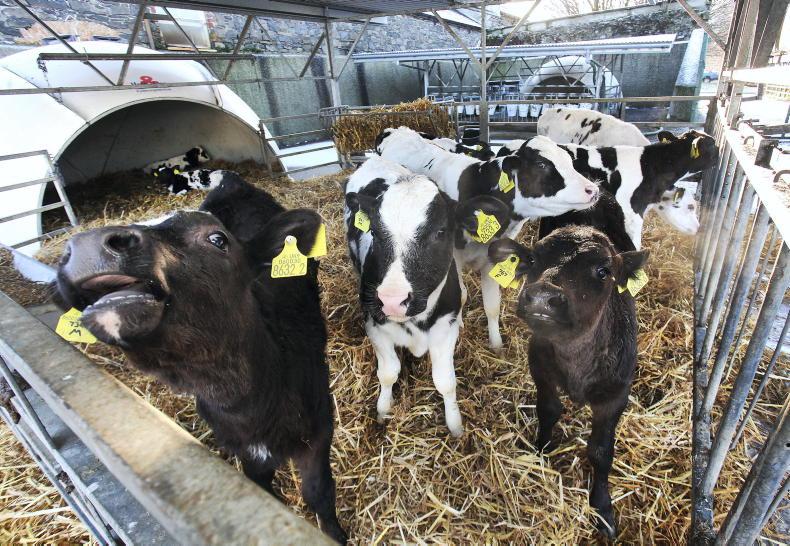
The decision to wean calves off milk should not depend on age, size, how it looks or the amount of concentrate the calf is now eating. Instead, it should be dictated by the total amount of feed consumed by the calf over its lifetime, a US researcher has said.
Speaking at an event organised by Thompsons Feeds in Portadown, Co Armagh, calf-rearing expert Dr Jim Quigley pointed out that most farm-advisory bodies base their weaning advice on concentrate intake at weaning. The recommendations vary from anywhere between 1kg and 2kg/head.
Surveys of farmers in Britain and Ireland, however, suggest that calf rearers also take into account body weight and age, with few actually measuring how much starter ration is being eaten.
Florida-based Quigley argued that the key consideration is how well the rumen of the calf has developed, and that is dependent on both the quality of the feed and the amount consumed.
When a calf is born, he explained, the rumen papillae are very small.
In the first couple of weeks, the calf relies on milk, but once it starts to eat a ration, the bacteria in the rumen will ferment this into volatile fatty acids such as acetate, propionate and butyrate. Propionate and, especially butyrate, stimulate the growth of the rumen papillae, said Quigley.
The volatile fatty acids are produced when carbohydrate is fermented in the rumen, however. Quigley said carbohydrate can be characterised into two forms.
Neutral Detergent Fibre (NDF) is the fibrous part of plants such as the cell wall. The likes of straw, hay and some cheaper concentrate by-products tend to have high levels. NDF in the rumen breaks down into acetate, so it does not encourage the development of rumen papillae.
Non-fibre carbohydrate (NFC), also known as non-structural carbohydrate, are the parts of the plant which are easily digested, such as sugars and starch, and which produce propionate and butyrate. Barley, wheat and maize have high NFC levels.
But it is not just about offering a calf-starter with a high percentage of NFC. Where calves are fed a lot of milk, they will eat less concentrate, so the rumen papillae will be slower to develop.
Where the papillae are under developed, any NFC consumed will not be digested to the same extent.
Quigley quoted from a number of studies across seven years, which looked at the digestibility of various components of the diet in calves aged between three and 16 weeks, with different levels of milk feeding – moderate (650 to 750g/day) and high (1 to 1.2kg/day).
At the time, a lot of the advice centred on getting more milk into calves but, in practice, producers were seeing “weaning depression” when milk feeding was stopped. “We saw that digestibility of the carbohydrates depended on how much milk they drank, how much starter they ate and how much rumen development occurred,” he said. His calculations, therefore, take into account the level of milk feeding, the NFC in the starter ration and the age of the animal.
“When this baby calf is eating the starter, it is not getting the energy intakes that our fancy ration-formulation systems are telling us,” he added.
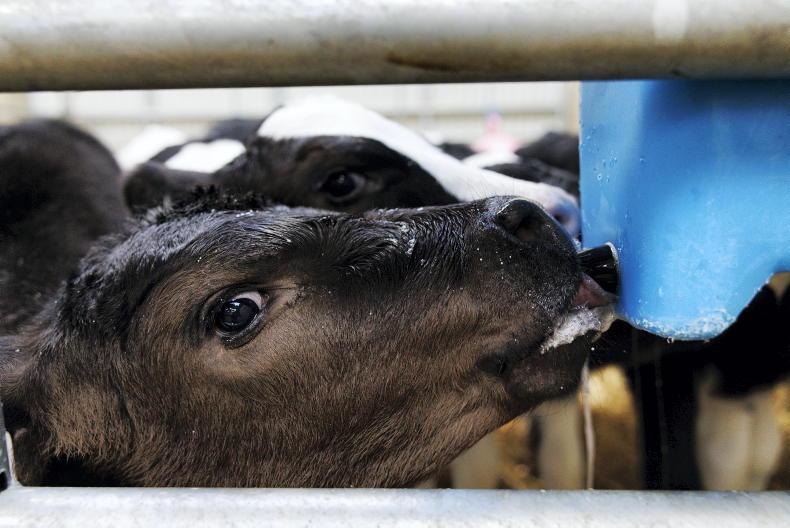
The culmination of the work showed that total NFC consumed was most important in dictating the age at which calves should be weaned, with the “magic number” for NFC intake at 15kg.
“When we used total NFC, that worked for us. At 15kg or more, the calf was ready to be weaned,” said Quigley.
If we assume a good-quality starter pellet has 38% NFC, and allowing for a conversion from dry matter to fresh material, that 15kg equates to 45kg of actual concentrate consumed.
What happens when weaning goes wrong?
Where calves are growing at 800g/day pre weaning, and this drops to 400g once milk feeding is stopped, it is a good indicator of “weaning stress,” said Jim Quigley.
His definition of weaning too early is when calves are yet to consume 15kg of NFC in their lifetime. When weaned, the calf will, naturally, consume more concentrate, but its rumen has not developed sufficiently to digest the feed. The pH in the rumen drops and acidosis is the result.
“We don’t want this to happen,” Dr Quigley said. “I see this especially when calves are being fed lots of milk or are being weaned over a very short period of time.”
Health-related issues at that stage are well known to have long-term implications, with research showing it will have a negative impact on yields from first-lactation heifers.
Quigley said analysis suggests this is due to cells of the mammary gland of heifer calves growing at a faster rate than the rest of the body, even in the first two months of life.
Tools available to guide farmers
The non-fibre carbohydrate (NFC) percentage in a starter feed is usually not included on the label of a bag, but it is something a feed mill could provide.
Alternatively, companies could look to tweak their rearing protocols to fall into line with the research.
There are also free tools available online, including on Jim Quigley’s website (https://consulting.calfnotes.com), where farmers can input their feed and management data to get an accurate assessment of when weaning should take place. But outside of all that, Quigley said his “rule of thumb” is weaning at around nine weeks, with this time period extended if a lot of milk is being fed.
His general advice leans towards a maximum of 8l being fed per day, with a three-week step-down to weaning.
“The closer you are to 15kg of NFC intake, the sharper this reduction can be,” he said.
About Dr Jim Quigley
Dr Jim Quigley has worked in calf research for over 30 years and served as an associate professor at the University of Tennessee.
He has authored over 110 peer-reviewed scientific publications and presented at conferences around the world on calf health, nutrition and management.
In 1997, he founded Calf Notes, which is a free educational platform available online.
Water and roughage in the calf diet
The development of the rumen in a young calf is not just dependant on concentrate intake, with water and roughage also vitally important, confirmed Dr Ronald Annett, a senior nutritionist at Thompsons Feeds.
Annett said chopped straw provides a good source of roughage, but there is also a balance to be mindful of, and if too much is being consumed, it probably suggests not enough starter feed is being offered. Ideally, at weaning time, calves should be consuming around 100g/day.
Calves must always be offered fresh water. Annett said he still goes into yards where farmers aren’t feeding any water because they think calves are getting enough fluids from milk.
However, when a calf takes in milk, the oesophageal-groove reflex allows this milk to pass over the rumen and into the abomasum. There, it is digested. “To promote feed intake and rumen development we need water going into the rumen,” said Annett.
Pellets
When it comes to a starter feed, some advisers prefer offering a course mix, while others suggest feeding 3mm pellets.
Annett said young calves probably tend to nibble at coarse feed before pellets due to the smell of molasses but, on balance, his preference leans towards feeding pelleted feed.
“The main thing is to have the meal in front of them and it is of good quality,” he said.
“Over the rearing period, you do find calves will eat more pellets; it is a more consistent feed and there is less opportunity for sorting,” he said.
He added that minerals are also important; rumen buffers have a role in reducing acidosis; and live yeast can help with fibre digestion.