
This week’s column is one of those topics that people are always uncomfortable talking about. At the same time, it’s really important that we chat about alcohol.
Before I begin, I want to say that I won’t be standing on a pedestal and lecturing you on the topic. Every now and again I can be seen sitting in Shanley’s or De Barras music pubs in Clonakilty, having a nice bottle of Stonewell cider or two, listening to a band over a weekend after a stressful week. I enjoy the taste of it and find it relaxing, but in moderation as part of a healthy lifestyle.
However, people’s knowledge of alcohol, recommended weekly limits and drink-driving regulations is incredibly poor – and especially since the terminology has shifted from units to standard drinks in recent years.
Ask the question
Try this question at the dinner table: ask your family or friends how many standard drinks are recommended over the course of a week? How many glasses of wine does that cover? How many standard drinks can you have before being over the drink-driving limit? Chances are not everyone at the table can answer the questions correctly.
It is incredibly confusing. We don’t use units anymore; now it is standard drinks. I find it fascinating that for something so important, the messaging is incredibly challenging, even for me as I research the column. Units, standard drinks and milligrams per one hundred ml of blood are just some of the terms used.
Any alcohol will put you at risk of health-related issues. The more you drink, the greater the risk. These include cancer, heart disease, fatty liver disease, stroke risk, mental health issues, obesity and a whole lot more. If you look up the Government websites, they recommend a low and moderate amount over the course of a week with several days of no alcohol.
HSE advise
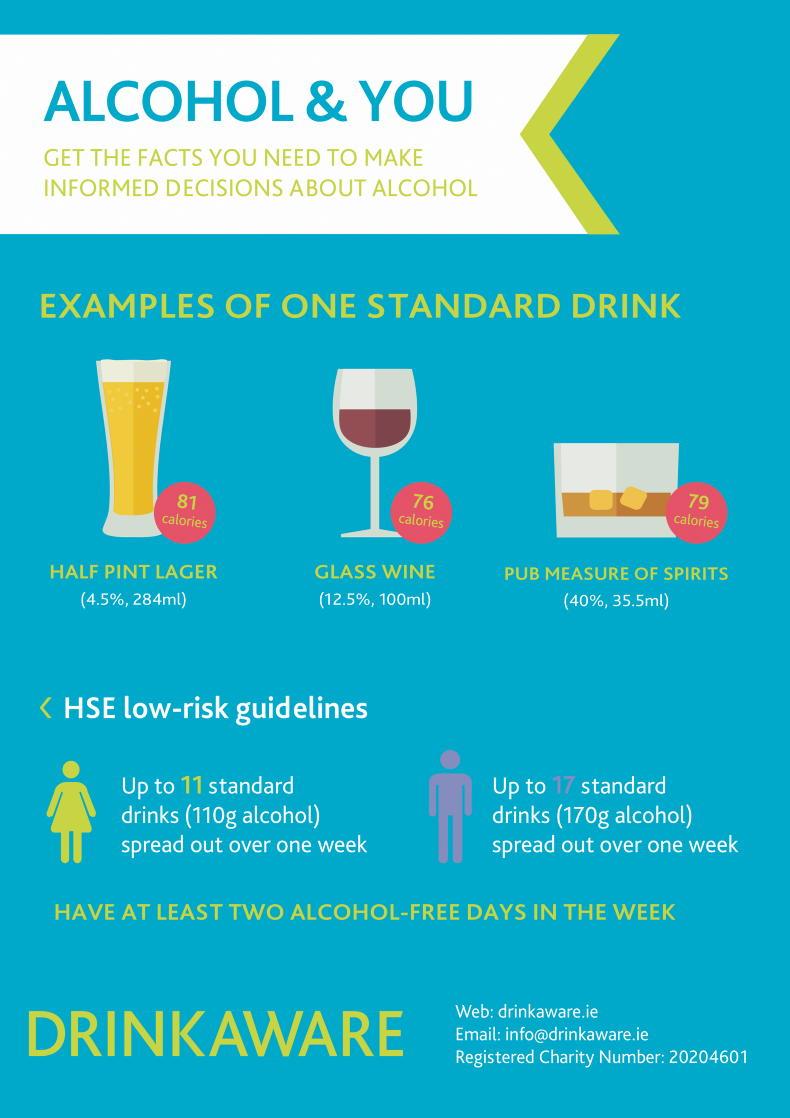
The HSE advice for a woman is 11 standard drinks a week, while a man can have 17 standard drinks.
If you’re unsure what counts as a standard drink – it’s roughly equivalent to a half pint of beer or lager, 100ml of wine or a single pub measure of spirits.
The number of standard drinks is based on the size of the drink and its alcohol strength, usually shown on labels as alcohol by volume (%ABV). The higher the alcohol strength, the higher the standard drink content.
I was surprised at just how many drinks you can actually have, according to the weekly recommendations.
Have a look at the table below and calculate your alcohol intake to see how you compare. How many standard drinks are you having a week?
Now, let’s talk about driving. To make things even more confusing, we are told it is down to the amount of alcohol in your blood.
The amount of alcohol in your blood depends on your age, sex, height, muscle and fat mass and several other factors.
I think the best advice anyone can have is to never drink and drive.
Have a good read of the numbers and educate yourself about the standard drinks, and chat about it at the dinner table and in the pub this weekend. I am not anti-alcohol; I am pro-education around giving everyone the facts. If you are the designated driver, stay with the soft drinks. Don’t ever drink and drive.
See drinkaware.ie or hse.ie You can download a weekly planner from drinkaware.ie/booklets.
Next week: Let’s talk about Christmas gifts.