



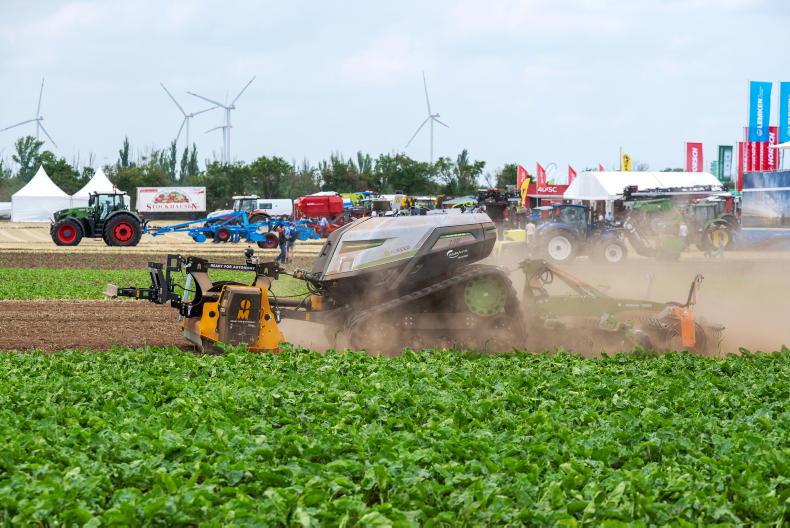
The German Agricultural Society (DLG) is best known for organising the biennial Agritechnica trade fair. This non-profit German organisation also conducts comprehensive tests and trials on behalf of its members.
In recent years, the DLG has run a field day event every second year in Germany which features a number of independent machinery demonstrations along with commercial stands related to crop production and expert seminars on a variety of crops and technology topics.
This year autonomy was one of the major focuses of the event. The Irish Farmers Journal attended to find out more about the latest developments being showcased.
Although the concept of autonomous, or self-driving, vehicles in agriculture has been around for 70 years, it is only in the last decade that the digital era has brought the capability to make it feasible. But there are many questions still to be answered:
Labour has been a key driver in machinery development, as bigger, faster and more efficient machines have reduced the manpower required to work every acre or tonne. But this has led to the use of very large and expensive machines that threaten soil damage and can be less efficient in small fields. Autonomous machines do not require an operator in the seat, so labour savings are possible. If self-driving systems became inexpensive and successful, then multiple smaller lighter machine units could be used, with less risk to the soil.
Eliminating labour from slow-speed operations like weeding high-value crops with complex automatic weeders is the initial target for most, as these may need to be operated 24/7 when crop conditions are right.
These weeders use either complex mechanical hoeing, around individual plants, or target-spray individual weeds. These machines already carry complex plant and weed identification systems which can easily live beside autonomous machine control.
But this is only one application; the big question is: where is autonomy likely to go in the future?
At the show we saw a range of autonomous applications: some in volume production, others more conceptual, but each showing a different development path or application. But ultimately autonomy must bring benefits in either costs, operating efficiency or both!
A few examples follow.
AgXeed T2 series 7
AgXeed showcased the latest version of its self-driving tractor unit. Unlike other commercial autonomous units, this is a full-size tractor unit capable of working with conventional implements.
This new T2 7 series model features a more powerful 170 kW (230hp) diesel engine powering the electric track drives, 9t rear linkage lift, front lift and both front (new) and rear PTO.
The track centres are adjustable from 1.5m to 3.2m and tracks of up to 910mm wide can be fitted allowing low ground pressures to be achieved.
This new model was shown with a front-mounted crop mulcher (for cover crops etc) and a rear mounted cultivator. AgXeed offer the option of the ISOBUS TCU (tool control unit) which allows implement sensors (eg working depth, component blockage etc) to feed into the tractor control unit.
Knowing what the implement is doing will be a key part of successful autonomous operation in the field.
This AgXeed T2 configuration maximises the potential of the self-driving unit by saving the weight and cost of a modern tractor cab. Also, the adoption of a clean-sheet design results in a very compact design.
AgXeed is produced by an independent company in the Netherlands and their activity in commercialising the unit will determine the role for, and market for, this type of machine.
There is always a question of size; if the autonomous component could become inexpensive, then smaller units may be kinder to the soil. However smaller units would be less suited to haulage work.
AgXeed now has four models in the range; two tracked units of 230hp and 156hp and a 75hp smaller unit in either three-wheel or four-wheel configuration.
Kubota M7 with autonomous kit
Kubota is very active in the autonomous tractor area and has shown a range of concept and development ideas across shows recently.
At the event, a standard Kubota M7-154 tractor was fitted with an autonomous kit to allow driverless operation. A full suite of sensors, vision systems and controls were fitted to the conventional tractor.
The roof module features a high-spec guidance (GNSS) unit along with LiDAR sensors which detect any obstacles. An additional suite of cameras augments the positioning and Lidar information for further safety and accuracy.
This system is still being evaluated and developed by Kubota and was shown being driven conventionally by a driver at the event.
This ‘add-on’ autonomy approach has been used by other tractor manufacturers and independent companies to develop the technologies and to apply them in relatively simple use situations such as vineyard operations.
Farming GT tool carrier
The German-built GT has proven a quietly effective self-driving weeder, on the market since 2020. It’s a diesel electric unit, with plug-in hybrid capacity.
Its footprint is approximately tractor sized being 4.5m x 3.0m but relatively light at under 2,000kg (for reference though an MF 135 was about 1.6t). The GT’s main function is as a weeder, and at the DLG event was fitted with a guided weeder where the position and size of every plant was determined by the camera sensors (NIR and RGB).
This allowed the mechanical hoeing elements to be moved in the rows and between the plants for effective weed control. It performed reliably in the demonstration.
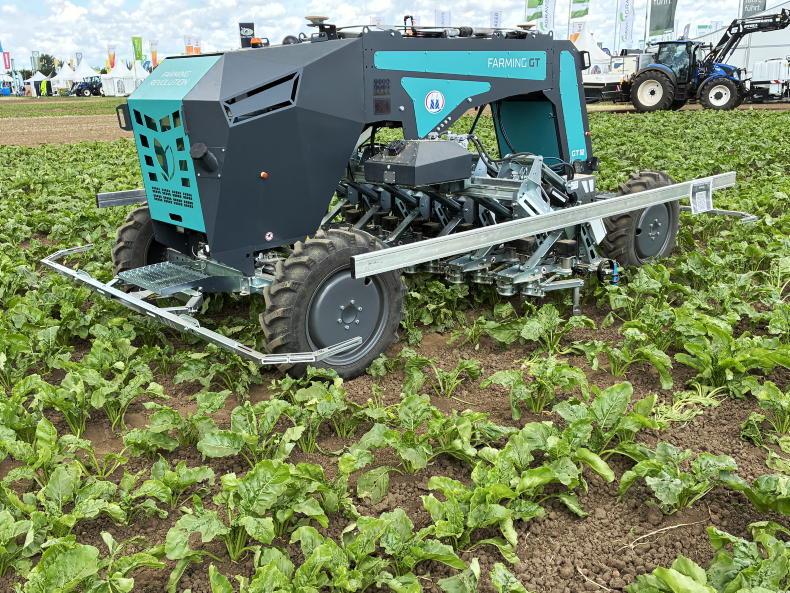
This unit is mainly targeted at high value vegetable or similar crops, particularly in an organic situation where manual weeding costs would be high. In work, the unit would be pre-programmed with the field dimensions and pathways, with the camera system guiding the unit when in the rows.
LiDAR is used for tool depth guidance with a range of safety sensors for autonomous operation. Work rate of the GT is typically 3ha in 24 hours.
Tipard 1520 tool carrier
The Tipard 1520 from Digital Workbench is another German-manufactured machine of similar size to the Farming GT unit and also uses a diesel engine, battery and electric drive system.
It is designed to carry a range of tools on the implement carrier frame and was demonstrated with a simple weeder.
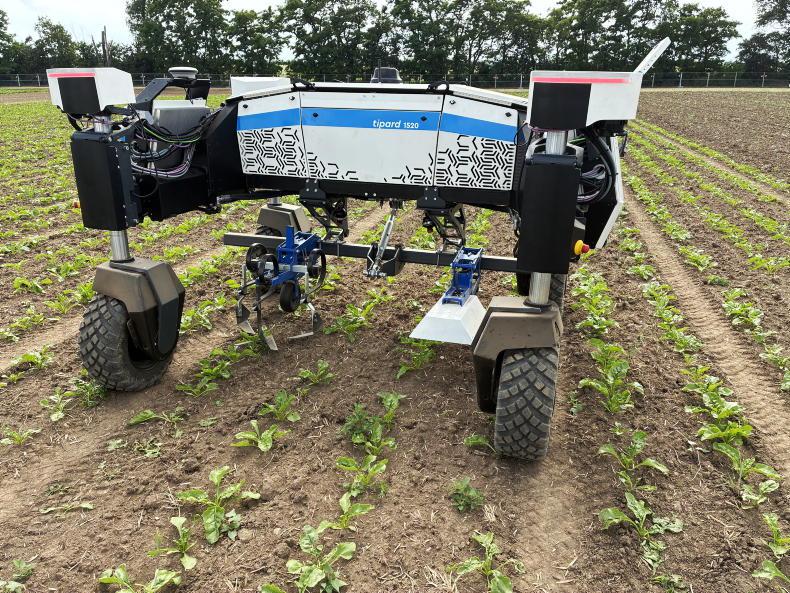
In operation it is a little like the more common Farmdroid unit, where a very accurate GNSS system is used to determine the position of plants at sowing, and this position is then used to protect those plants during the subsequent weeding operation.
This differs from row and plant guidance systems which sense the plant position in real time.
IQuus autonomy orchard kit
This kit from IQuus converts a standard Fendt vineyard tractor (211 V Vario) into an autonomous unit capable of working without an operator.
The kit provides a remote-control facility to set up the unit operated via a tablet screen. The kit incorporates optical and pressure (safety) sensors, Lidar and GNSS (GPS) to guide the tractor, to avoid obstacles and particularly to ensure safe operation.
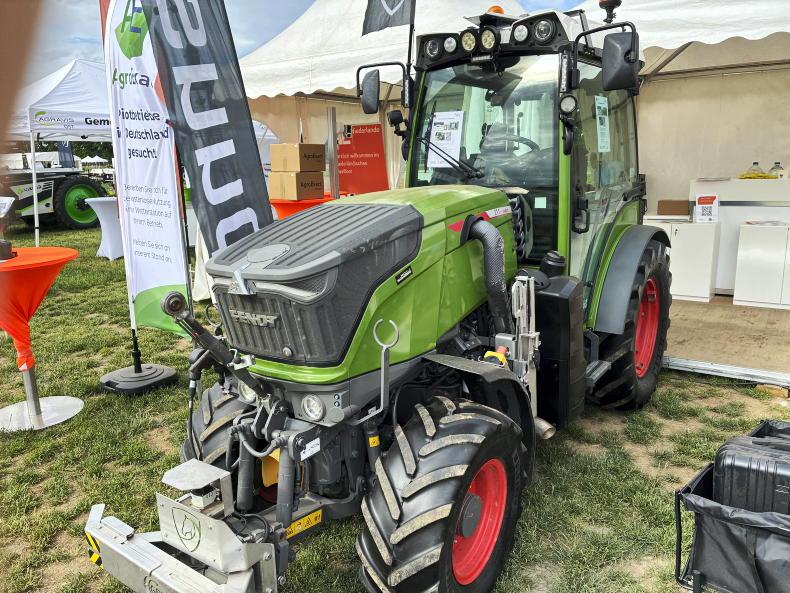
The vineyard operation is well suited to autonomy as tractors repeatedly work the well-defined permanent pathways. IQuus offer add-on autonomous conversions for a range of tractors.
Field robot competition
A key feature of the DLG field day is a competition across third level institutions which have robotic expertise. This, the fifth such event, attracted 16 teams from 10 countries.
They had to produce a field robot that could carry out four pre-determined tasks and an additional task of their choice.
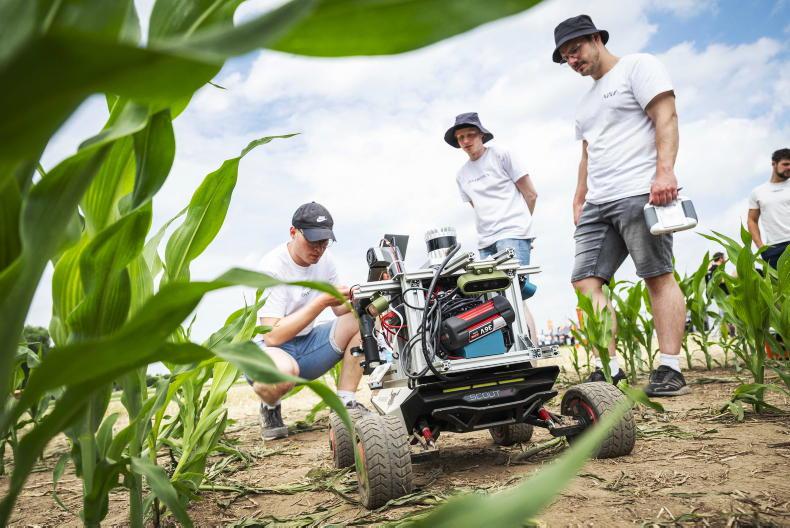
The tasks included:
The winning team, pictured above, were from Osnabrück University in Germany and developed the 22kg four-wheeled ACORN. The ACORN primarily relied on a 3D Laser scanner and two 3D ‘depth’ cameras to control movement.
The judges noted that AI had transformed the competition, allowing the formerly time-consuming programming to be carried out much more quickly, allowing the teams to focus on design and testing. This competition has allowed graduate participants to develop skills in high demand across agricultural engineering and manufacturing companies.



SHARING OPTIONS