
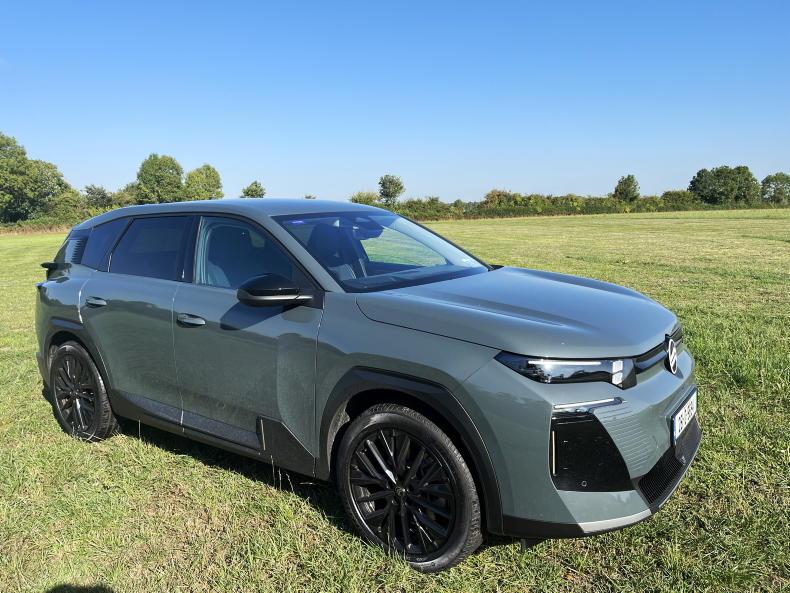
The Citroën brand has always had a reputation for being that little bit different. That unique feeling has carried through in the new C5 Aircross, where the term ‘Aircross’, created by Citroën, aims to bring together a combination of SUV design with a special level of comfort.
Aircross combines the concepts of air (signifying lightness, openness and comfort) and cross (signifying crossover, ruggedness and all-road capability).
Citroën wants this new C5 Aircross to be more than just niche, so the question is: does it broaden the brand’s appeal?
Citroën, like other brands within the Stellantis Group, is on a path to survival – where multiple brands are vying for attention and further investment.
This new C5 Aircross is a car that can prove its worth. It aims to be an SUV with more comfort levels than you might have expected. That part of the deal is delivered in the new Citroën C5 Aircross. It has 200mm of ground clearance, a match for many larger 4x4s, while providing driver and passenger comfort levels that will impress.
While some of the driving controls are similar to other cars within the Stellantis Group, such as the Peugeot 3008, the interior and exterior feel and look of the car are very different.
So, while the Citroën brand might be the poorer relation in terms of car sales in Ireland, when it comes to style it clearly has an edge, relative to Opel and Peugeot.
Under the skin of this car, the technical features are very similar to other cars within the Stellantis Group. Citroën offers three driveline options: mild hybrid, plug-in hybrid and full battery electric (BEV) drive, all at similar price levels. So price will not (nor should not) dictate your choice of driveline.
I’ve driven two models from the Citroën C5 Aircross range in recent weeks, the petrol hybrid version and the 73kW BEV model, to assess the options.

In a casual look, it’s hard to tell the difference between them and there is no external branding to confirm that. This means that this C5 Aircross is just a ‘normal’ car with new driveline choices.
Interior styling
The interior is very similar and, as both use an automatic gearbox, the controls are almost identical.
You can step into one from the other and it’s only when you power up that you can tell the difference between them. That’s a significant step forward in normalising electric-car choices and so too is the minimal price difference.
I did appreciate the interior design style – the sloping central screen coupled with buttons for the regular stuff, such as heating and volume control of the radio, and the seating is comfortable and high.

The C5 Aircross boot space is large (slightly smaller in the BEV version), with lots of quirky storage areas around the car.

Irrespective of drive system, each offers three driving modes: normal, eco and sport, and while I drove both cars mostly in eco mode, the power option from sport is noticeably impressive.
What is becoming a slightly annoying feature of many cars, including the Citroën C5 Aircross, is that the default mode is normal and the eco setting defaults thereafter each driving cycle.
The Citroën C5 Aircross has a four-star Euro NCAP rating and is considered to be a ‘corporate twin’ to the Peugeot 3008. Safety equipment and performance is identical between the two cars, so Euro NCAP says that this rating is based on an assessment of the Peugeot.
Experience
So, what’s the value difference between these two cars? The BEV version is powered by a 73kWh battery that delivers more brake horsepower and torque than the 1.2l turbo petrol three-cylinder engine in the hybrid version.

That converts to a faster car that has greater towing power and, of course, is cleaner to the environment and can be cheaper to run.
The BEV version comes with a potential range of 520km, while the 55l fuel tank on the hybrid version, which will cost you over €100 to fill, may give you 75% more range at over 900km. This is the choice and with smart overnight charging at home, the BEV running costs can be significantly lower. And how many of you drive more than 500km in an average day anyway?
The battery performance levels in the Citroën range are improving in more recent models and that’s giving drivers more confidence in terms of range. The C5 Aircross will have the option of a 97kW battery later this year with a claimed range of 690km.
But remember, fast charging at motorway stops is relatively expensive, so the real value can only be delivered with overnight home charging, backed up by solar panels.
My test-drive experience included adding 50kW loading of the car’s battery, on a public slower type 2 ESB Networks charger, and it cost me €22 to bring the battery from 30% to 85% that gave me an additional 350km of driving range.
Citroën in Ireland has pitched the entry-level YOU grade car price, for what is a sizeable car, at a reasonably competitive €39,300 for the hybrid and €39,939 for the BEV.
The price difference between the models is smaller in Northern Ireland. And for C5 Aircross BEV buyers Citroën are including a free home charger in partnership with Energia.

This is a sizeable car for that price, while the additional price for the higher grade ‘Plus’ models, with reversing camera and bigger alloy wheels, is about €2,500. The BEV is still the obvious choice for me and the Citroën comfort is standard.