



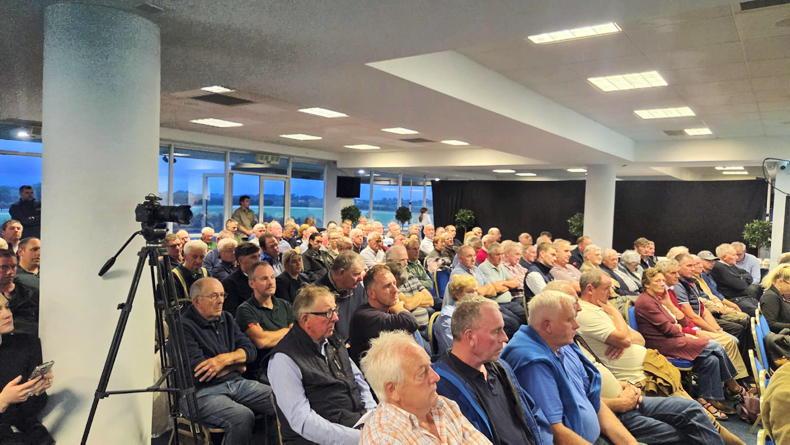
“If the budget stays as proposed, there'll be money for nothing,” Irish Farmers Association (IFA) president Francie Gorman told a Common Agricultural Policy (CAP) meeting in Limerick on Wednesday night.
The blunt statement captured the stark reality facing farmers under the current CAP proposals.
Gorman was speaking at the first of a series of meetings the IFA has organised around the country on the CAP reform process.
Farmers predominantly from Limerick, Kerry, Clare and north Cork were packed into a meeting room at Limerick Racecourse.
IFA policy specialist Shane Whelan presented the budget proposals from the European Commission. They include a 22% cut in CAP funding to €300bn, despite a huge proposed increase in overall spending to almost €2tn (trillion).
This would shrink CAP funding to only 15% of the overall EU spend.
A group of countries – 'the frugals', led by traditional economic powerhouses of the EU Germany, Netherlands, Denmark and Sweden – want a multi-billion euro cut in the overall budget, which would shrink CAP funding further.
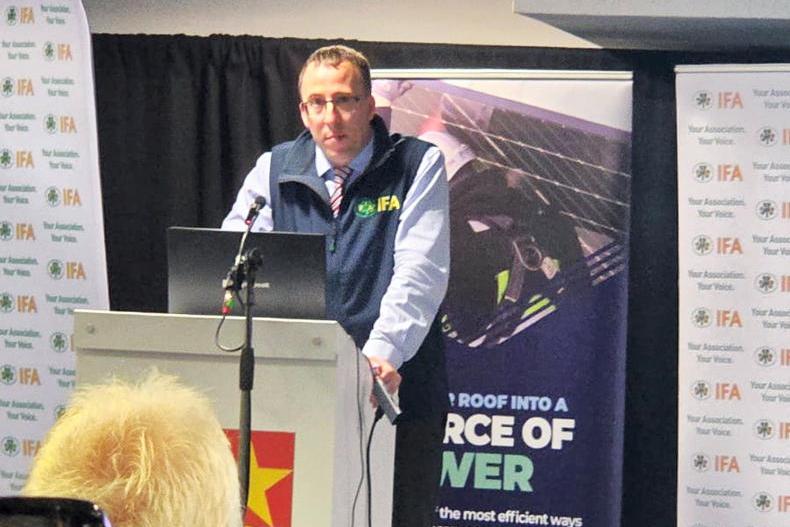
One key change this would bring is a much-reduced per-hectare payment for farmers. In a worst case scenario, it might be as little as €130/ha.
This would be a flat payment, meaning farmers on current higher payments would see their payments almost halve, not counting the €60 Eco Scheme payment or CRISS, both of which would evaporate.
“There is significantly more risk than opportunity on the table,” Shane concluded.
When the meeting was opened to the floor, IFA stalwart David Thompson from Limerick asked if the Commission wanted farmers to survive at all.
“I think they do want us to survive, but they want us to work for nothing,” replied Francie Gorman.
Payment gap
Kerry farmer Neilus O’Connor highlighted the gap between current payments and those from before the Ciolos reforms of 2014. He spoke of how his own BISS and ACRES payments were little more than half the corresponding payments a decade ago.
One woman spoke of how she was proud that her three children were all studying agriculture in third-level education, but that what she had heard at the meeting had “put the fear of god in me as a mother”.
“Every bill I pay is index-linked,” said another farmer. “It doesn’t matter whether it’s my phone, [electricity], but why not food? It’s isn’t a commodity we can turn on like a tap.”
TJ Maher from Tipperary spoke of how important direct payments are for farmers who have experienced the recent drought: “This autumn, without the CAP payments that are there, the cashflow crisis that would be on farms due to the costs incurred, people wouldn’t be able to pay their bills."
IFA European director Liam McHale joined the meeting by video link from Brussels. He outlined the intense schedule of political activity taking place during Ireland’s presidency of the EU, with a general expectation around the continent that an EU budget will be in place by the end of the year.
IFA director general Damian McDonald highlighted the work being done by the Brussels office – and the IFA’s Irish staff and voluntary farmer officers – across a range of issues from nitrates, Mercosur and CBAM, to CAP, the EU budget and nature restoration.
“It's like diving around the goal trying to keep the ball out,” he said.
Further meetings take place in Claremorris, Co Mayo; Rochestown, Co Cork; Cavan town; and Athy, Co Kildare.



SHARING OPTIONS