
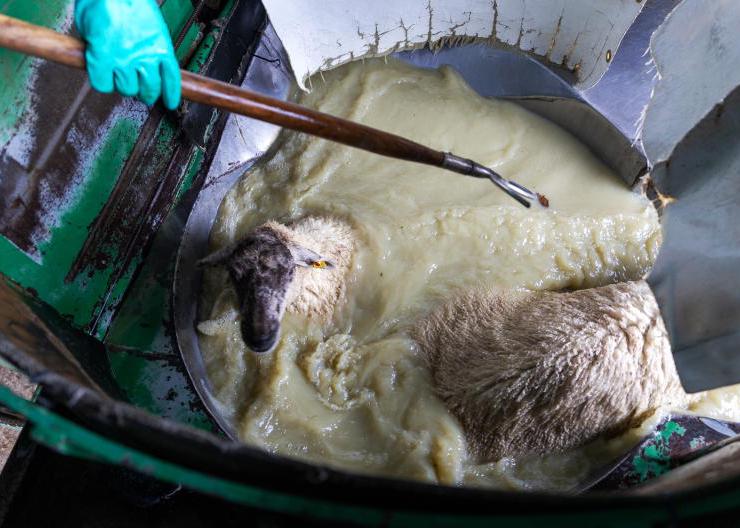
Unfortunately, the incidence levels of sheep scab seem to be increasing in recent years, with many farmers having more away from plunge dipping in favour of low labour pour-on products with a longer cover period of shorter withdrawal period.
As useful as these pour-on products are, only plunge dipping using correct methods will help to eliminate sheep scab, with many farmers opting to use pour-ons over the summer months (for fly strike protection) while completing dipping in the autumn on breeding ewes/ replacement and store lambs to ward off sheep scab.
Whether it be constructing a new dipping tank or upgrading an existing one, there are several areas that farmers can work towards to reduce labour and improve safety with dipping facilities, with water courses being a major consideration due to pollution risks.
The fundamental consideration when laying out a dipping tub is to consider the environment. Dipping tubs should not be located near watercourses of any description, nor should they be located in an area where spillage may flow towards a watercourse.
Again, with the environment in mind, it is best to source a precast concrete or plastic dipping tub as it is a difficult task to construct a fully leak-proof tub using blockwork and plaster.
Dip tubs should not be located under a roofed area for operator safety, nor should there an outlet pipe for emptying tubs at their base.
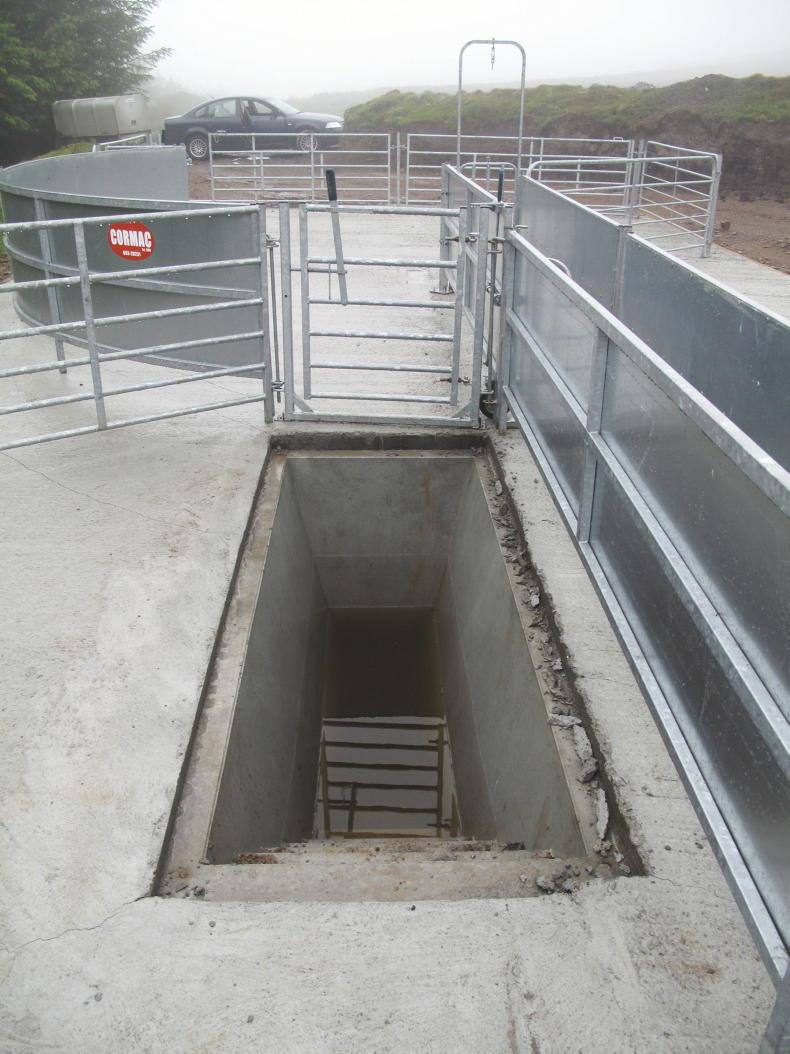
A forcing pen is near essential within a handling yard operating a dipping tub and should be located either in front of the dip tub or used to funnel sheep in to a race leading to it.
This pen can be circular with two gates hung on a central post, which allows them to revolve round continuously with latches at various points. For very small flocks a semi-circle or funnel shaped pen may be used. A space of 0.3m2 per animal should be allowed.
Dipping tubs should be 1.1m in depth. Dip tub size should be related to flock size.
A 1,050-1,250 litre is suited to flocks of 100-250 ewes, capable of holding 1 or 2 sheep at a time, while larger flocks of 250-500 ewes will require a tub of 1,818-2,000, capable of holding 3-4 ewes or 5-6 lambs at a time.
The Department specifications entail that the dipping tub be a minimum 2.25 litres/animal dipped.
Installing larger dipping tubs than is required will be costly to prime the dipping tub before commencing.
Long dip tubs that are 7.6-12.5m long work with the theory being that the sheep walk down the ramp, while swimming their way through the bath they are sufficiently dipped.
The long swim bath allows continuous dipping and reduces handling, although they are very expensive to build and fill. To justify their cost an output of 500 ewes per hour is required, ruling them out for nearly all Irish farms.
Whatever its size, the tub should be located to allow ease of access for a tractor and vacuum tanker to remove spent dip or replenish a tank with clean water, with spent dip diluted and spread as per manufacturers instructions.
With an average flock size in Ireland of roughly 100 ewes, the most cost-effective method in setting up a dipping tub is to locate the tub at the edge of a semi-circular forcing pen.
Sheep can then be manually placed in the tub, although this puts the farmer at greater risk from splashing when sheep enter the solution, meaning full PPE is an absolute necessity.
The exit should be stepped with a guillotine gate in place to allow sheep to exit through to a draining pen without the operator having to cross over/close to the dipping tub each time.
Two side-by-side pens are recommended, with 0.5m² required per ewe.
Flocks of 100 ewes should have 15m3 of draining pens, equating to 30% of the flock. Floors should be of non-slip concrete construction of 100mm depth, with a slope of 1:60 directing drained dip back towards the dipping tub.
The edges of the drainage yard should be tapered towards the dipping tub, with kerbing installed at gateways to prevent leakage.
In brief