



Various studies estimate the area of forest required in Ireland, along with timber production capacity, to achieve a viable forestry and forest products sector.
In 1996, the Government strategic plan Growing for the Future maintained that Ireland required 1.2m ha (17% of the land area) “with a consequent increase in annual timber output from the current 2.2m m³ to 10m m³”, by 2035.
Current forest policy and successive Climate Action Plans maintain that forest cover needs to be 18% by 2046, but they avoid a volume-production forecast.
In a way, the 1996 strategy answered the “when is enough enough?” question by referring to the volume of timber required as “critical mass”, which is the minimum production needed, or 10m m³. But that was at time when 80% of 20,000ha annual forecasted afforestation programmes would consist of productive forests.
This is in stark contract with recent averages of 40% productive forest in a 2,000ha programme.
While various policies are broadly in line, a number of major issues have intervened since 1996 in particular climate change. Forests as carbon sequesters in mitigating climate change received just a one-paragraph mention in the 104-page 1996 strategy, while wood energy and timber construction – including timber frame and engineered wood building – to displace fossil based materials weren’t mentioned. These are now central policy drivers, not just in Ireland, but globally.
Another major change since 1996 has been the performance of the Irish timber processing sector in meeting production targets.
Sawmill capacity
Back then, concerns were expressed about Irish sawmills achieving the capacity to process the increased sawlog supply, which was 1.4m m³, virtually all sourced from Coillte.
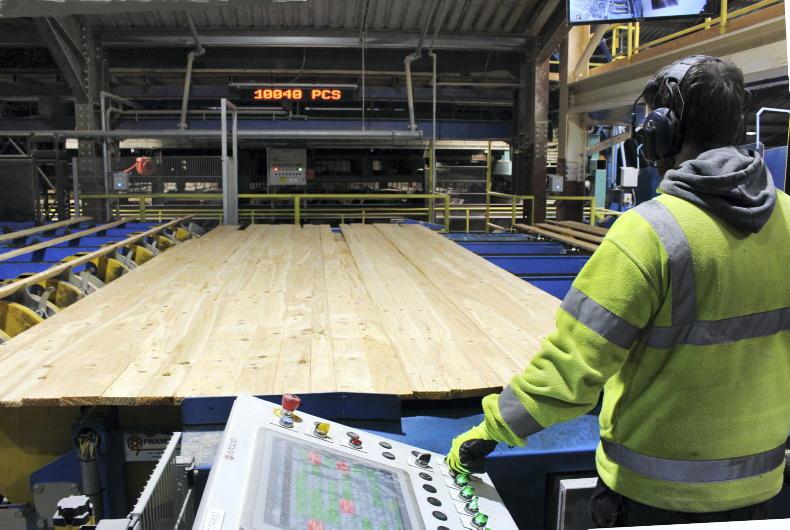
Annual timber production is now at 5m m³ – split between Coillte and private growers – which in a normal year would be processed by Irish sawmills, board mills and wood energy outlets with around 10% of logs exported. While log exports have increased significantly since 2025 due to windblow, Irish timber processors have the capacity to absorb most timber supply during a normal production year.
New concern
Now the concern is not that the timber processors have the capacity, but that long-term supply will not be available to meet their demand due to a major decline in production afforestation programmes from 2005 to 2018 and a near collapse since.
The historic fear that domestic and international timber markets might fail to meet demand for Irish timber and timber products have proved unfounded. Timber demand continues apace, especially in helping to decarbonise the construction industry, which is the biggest emitter of green house gas.
Getting more home-grown timber into timber-frame housing is a major challenge, but the first steps to gain access into this lucrative market are taking place. The recent collaboration between South Dublin County Council and Coillte to build 27 age-friendly timber frame houses in Melrose Court, Clondalkin, Dublin demonstrates the potential for Irish timber. The home grown Sitka spruce for these houses is prefabricated offsite by DTE Manufacturing, a subsidiary of Glennon Brothers Timber, Longford.
Timber-frame homes
Coillte, private growers and sawmills have much to gain by increasing the level of timber-frame homes constructed in Ireland from 25% at present to at least 80% by 2050, which is achievable as Scotland has surpassed this target. The opportunities here are huge as the recent Timber Construction Steering Group estimated that over 50,000 new homes are required annually.
Unfounded fears
Concerns that non-timber substitute products would decrease the demand for wood have also proved unfounded. For example, plastics, metals and composites once touted as substitutes for timber pallets have captured only 10% of this market. Irish pallet wood producers continue to grow this market, which is evidenced in the recent €6m investment by the CJ Sheeran Group to expand its timber-pallet facility in Mountrath (see below).
Other sawmills, board producers and energy outlets are also expanding their operations to cater for domestic and export markets. The challenge now is to achieve sustained afforestation programmes to match their output. So, the answer to the question “when is enough enough?” is 10m m³ annually, in the absence of better data.
But the answer no longer rests with Irish timber processors as they have proved they can deliver. Their future capacity is only ensured by achieving a sustainable afforestation programme as outlined in Ireland’s Climate Action Plan. This is the key challenge facing Minister of State Niall Collins.
Last week, the CJ Sheeran Group announced the opening of a new €6m logistics and storage facility at its HQ in Mountrath.
Niall Collins, Minister of State with special responsibility for forestry, welcomed the group’s investment programme, which includes a dedicated storage complex with sufficient space to store 150,000 pallets, along with a range of other investment at Mountrath and across the group’s nationwide plants.
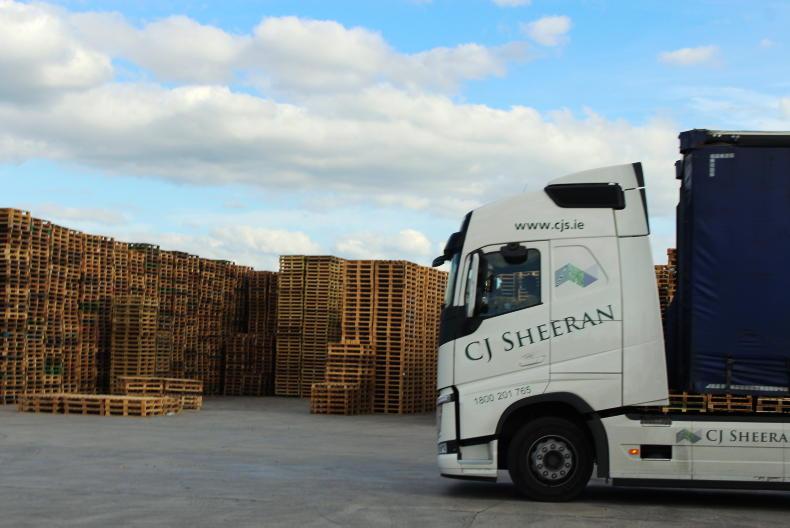
Recent investments at its Mountrath site also include a new automated pallet-production line, capable of producing over a half million pallets annually; a new 1.75MW biomass boiler; and two new high-capacity kilns with a further two kilns planned.
15 new jobs
The latest investment programme has created 15 additional jobs, growing the Sheeran workforce to 465 direct jobs.
“The recent investments are also expected to create further opportunities across manufacturing, engineering, logistics, warehousing, maintenance and business support functions as additional phases of development are completed,” said Mark Sheeran, MD and chair Forest Industries Ireland.
“As Ireland’s largest pallet manufacturer, we are proud of timber’s role in a genuine circular economy as pallets can be reused, repaired and remanufactured many times, extending their working life before the timber is ultimately recovered and recycled.”
“CJ Sheeran is a great example of how Ireland’s forests deliver large-scale employment in wood product manufacturing,” said Mark McAuley, director of Forest Industries Ireland.
“The forest sector underpins around 12,000 jobs and is worth €2bn to the Irish economy, but we need to keep planting new forests to secure our future timber supply so we can deliver sustainable timber products.”


SHARING OPTIONS