



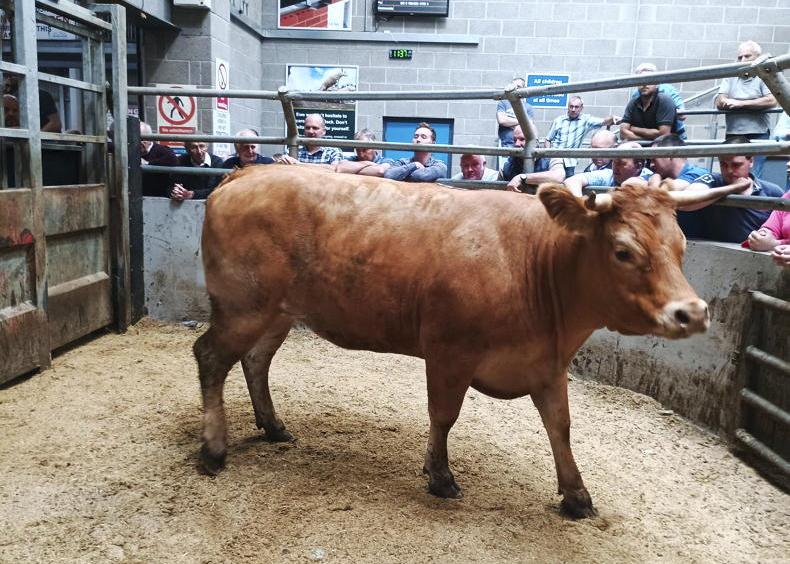
At the current prices being paid for forward stores in NI, the market for fat cattle will need to increase significantly between now and next spring if beef finishers are to secure positive margins.
It is a familiar scenario facing the sector.
This time last year, analysis by the Irish Farmers Journal suggested that prices of over 670p/kg would be required by April 2026 simply to cover feed costs, even after the £75 per head Beef Carbon Reduction Scheme money is included.
However, by mid-April 2026, the average price paid for steers had dropped to 620p/kg and by May 2026 it had dipped below 590p/kg, so huge losses wiped out any profits from the previous year.
Those lower beef prices have filtered through to the marts this autumn and in our calculations, we assume 550kg continental steers are currently bought at an average of 350p/kg (£1,925) compared to 400p/kg (£2,200) in September 2025.
Cattle are stored for 90 days, consuming 25kg of silage and 3kg concentrate per day at a cost of £35/t and £290/t respectively.
Those prices are up from £30/t and £270/t last year, taking the total feed expenses over the first three months to £157 per head.
During a 100-day finishing period, cattle eat 20kg of silage and 7kg of concentrate per day, which works out a feed cost of £273, leaving total feed costs at £430 per head, up from £390 last winter.
There are £20 of miscellaneous expenses added in for dosing, haulage etc, while an allowance of 90p per head per day is included to cover machinery running costs, shed maintenance etc.
Costs to finish are £621 per head and when the buying price is included, it is a total outlay of £2,546 per head.
The example assumes high level of management, with steers averaging 400kg at slaughter next spring and eligible to receive the £75 per head BCRS payment (worth 18.75p/kg on a 400kg carcase).
With that payment included, a price of 618p/kg is required to breakeven. Adding in a modest margin of £100 per head, this breakeven point increases to 643p/kg.
Sensitivity analysis
Over the whole period, each animal consumes 970kg of concentrate. A £10/t swing either way in this cost actually has little impact on the breakeven point (plus or minus 2.4p/kg).
However, if beef prices next spring continue at around 600p/kg, then to break even, these 550kg stores need to be bought for £1,854 (337p/kg).
To secure a £100 margin, this drops to £1,754 (319p/kg). Where there is no prospect of getting the BCRS money, this latter figure falls to just £1,679 (305p/kg).




SHARING OPTIONS