



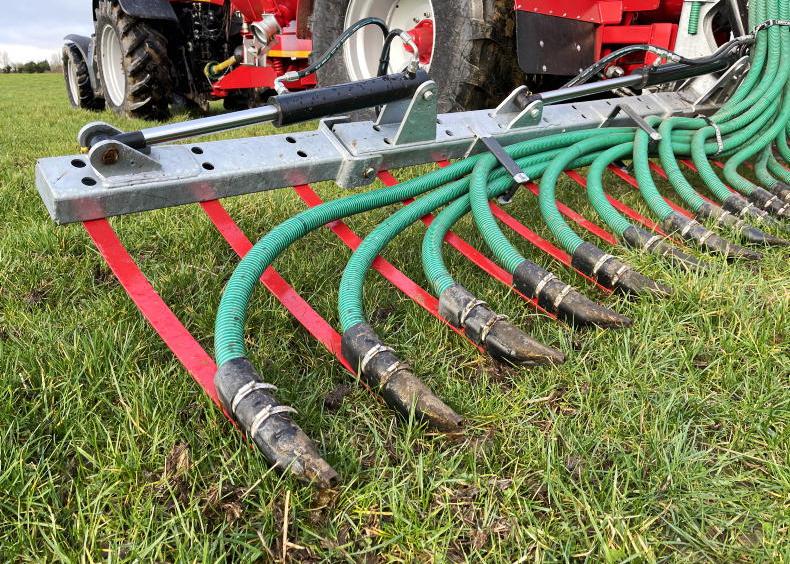
The Ulster Farmers’ Union (UFU) has put forward a number of changes to various rules and requirements relating to Low Emission Slurry Spreading Equipment (LESSE) in NI.
In its response to the DAERA public consultation on the latest Nutrients Action Programme (NAP) proposals, the union said it recognised LESSE has a role in reducing ammonia emissions, but also pointed to a number of issues of concern.
At present, farms with over 200 cattle livestock units (LU), as well as slurry contractors and large pig farms, are required to use LESSE.
The latest NAP, to apply from 2027 to 2030, sets out a timetable for around 6,000 additional farms to use the equipment. From February 2028, farms with over 100 cattle LU would have to use LESSE, extending to those with over 75 cattle LU and all pig farms from February 2029, and to farms with over 50 LU by February 2030.
According to the union response, its representatives on a NAP Task and Finish Group appointed by Agriculture Minister Andrew Muir, argued that the requirement for LESSE should not go below 75 LU. But either way, the UFU response is clear that LESSE should not be mandatory across all farms. “There would be a significant cost to farms should this be imposed in NI and this is unacceptable,” reads the UFU document.
Exemption
There remains an exemption in the latest NAP plan where splash plate spreading can continue “where it is not practical to spread on a field using LESSE due to slope.” The UFU suggest an exemption should also apply to “small fields”.
Where LESSE has to be used, there is 40% grant funding for the equipment available under the Sustainable Farming Investment Scheme (SFIS).
However, the union wants the grant rate to be “substantially increased”. Its response also warns that farmers potentially face a long wait between placing an order and receiving delivery – where a farmer can demonstrate equipment has been ordered, they should be deemed as being compliant with the rules.
One group unable to avail of grants for LESSE under SFIS are those who already have to use the equipment (e.g. over 200 cattle LU), with the department insisting that it cannot provide grants for something already required in law.
The union want this re-visited, pointing out there is a precedent, with farmers required to have safe cattle handling facilities under various pieces of legislation, yet cattle handling equipment is eligible under SFIS.
Definition
The other main LESSE issue raised by the union relates to DAERA plans to update a definition for LESSE to make it clear it is any method which reduces ammonia emissions by 30% or more, compared to an inverted splash plate.
Both dribble bars and trailing shoe systems meet that requirement.
However, amid ongoing concerns from farmers about lines of slurry in fields, the union want DAERA to provide a budget, allowing manufacturers and innovators to test tanker modifications or new equipment which could also meet the 30% minimum.
The maximum volume of slurry which can be applied during February and from 30 September to 15 October is currently set at 30m3/ha (approx. 2,700gl per ac) and the latest NAP proposal is to reduce this to 25m3 (approx. 2,200gl per acre).
In their response, the UFU said it has “no objection” to that change, but did reiterate its position that farming by calendar dates does not work and urged DAERA to revisit the current closed period for spreading slurry and manures.
MANY intensive farms rely on exporting slurry to stay below the annual limit of 170kg of manure Nitrogen (N)/ha.
Currently, farmers must keep a note of these movements and submit records to DAERA by the end of January in the following year.
The latest NAP consultation, suggests this system is not foolproof, so instead, an enhanced online system will be created. Slurry movements will have to be notified at least three times per year and verified by the importer by the end of the subsequent month.
Additionally, all exports of 15 miles or greater in a straight-line distance, will have to be notified within five days and verified by the importer within two weeks.
In their response, the UFU highlight significant concerns around the ability of all farmers to use online recording and the implications for an exporter if the movement is not verified by the importing farm. Given the complex proposals, the document also argues it is important that tolerances are built in and there is an amnesty in the first two years for genuine mistakes.
“It is vital that this new system does not deter farmers from importing slurry and therefore the redistribution of nutrients in NI,” states the UFU response.
Invalid
The latest NAP also makes clear that slurry exports to land deemed unsuitable (bog or upland grazing) will be “invalid”.
Where someone is found to have submitted false or misleading information, they will be subject to further controls, including notifying DAERA a day in advance of the movement and submitting geotagged photographs as proof it took place.
This latter requirement is “disproportionate to the scale of the concern,” notes the UFU document.
One of the most important changes set out in the NAP consultation is a new system of banding for dairy farmers based on milk yield.
At present, each dairy cow is assumed to excrete 100kg of nitrogen (N) and 19kg of phosphorus (P) per year.
The latest proposal is that milk yield data will have to be submitted annually to DAERA and be the most recent year’s average or a rolling average of the previous 3 years. Cows yielding under 5,000l will be assumed to excrete 77kg N and 11kg P each year, rising in a number of steps to 149kg N and 22kg P for those yielding over 12,000l.
The change is likely to push more dairy farmers over the annual 170kg manure N/ha limit and potentially result in lower milk supplies in the future, states the UFU. As a result, it wants the system of bands introduced incrementally to 2030.
Option
There is the option for farms to use their own milk yield and feeding data to work out a manure N figure, and while this is welcomed by the UFU, it does add complexity - significant resources will be necessary to help farms with the calculations.
New programme
Currently, grassland farms over the 170kg limit can apply for a derogation to operate at up to 250kg manure N/ha so long as a various conditions are met, including that a P balance of inputs to outputs remains at under 10kg/ha.
This derogation is to be revised and renamed a Nutrient Stewardship Programme (NSP), with a two-tier structure in place.
Tier 1 farms already meet the current derogation requirements and will be seen as lower risk and subjected to a 1% inspection rate.
Tier 2 farms can join the NSP even if they have a P balance above 10kg, however, they must commit to reduce it by at least 10% over four years, or get to the 10kg P balance requirement. Compliance could also be demonstrated through soil testing. These Tier 2 farms will be subjected to a 5% rate of inspection.
Farms which remain above 170kg manure N/ha, but don’t join the NSP will have a 10% inspection rate.
Concerns
In its response, the union notes that the NSP is “essential” to ensure compliance once new dairy bands are introduced and is a “considerable improvement” on the existing derogation.
However, it does highlight concerns raised by farmers currently in derogation, that they will be at a competitive disadvantage compared to Tier 2 farms.
There are a number of recurring issues highlighted by the UFU in its response to the latest NAP proposals.
Those proposals were effectively drawn up by a Task and Finish Group appointed by DAERA Minister Andrew Muir, following a backlash from farmers when an initial NAP consultation was published in May 2025.
Among the 16-person group, the UFU had four representatives.
The UFU response describes those May 2025 proposals as “totally unacceptable”, and what is now on the table is “significantly more practical and achievable”.
However, there is also an acknowledgement that “some members hold differing views on individual measures”.
Water quality
The main focus of NAP centres around preventing nutrient loss to water in NI and that is something everyone recognises is important.
However, the UFU document highlights on a number of occations that all sectors (not just farming) must do their part, especially wastewater infrastructure.
“Failure to adequately address these sources risks misrepresenting the effectiveness of agricultural measures and unfairly attributing responsibility to the farming sector for problems that originate elsewhere,” notes the UFU.
Planning
It also highlights that progress on NAP is highly dependent on changes to planning rules, as well as advisory and funding support.
Farmers must be given time to adapt to the new rules, with all new regulatory requirements accompanied by “realistic implementation periods”.





SHARING OPTIONS