



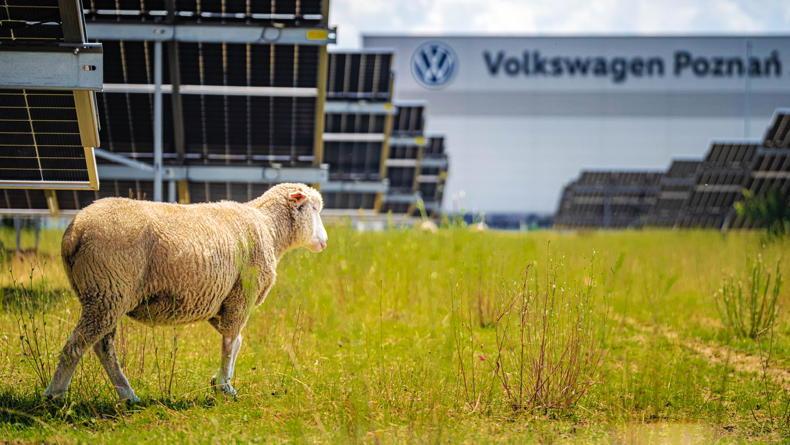
Mechanical lawnmowers are to be replaced by 100 sheep beneath more than 31,000 solar panels at the photovoltaic farm powering Volkswagen's manufacturing plant in Poland.
The photovoltaic farm is located at Volkswagen's manufacturing site and is one of Europe's largest on-site solar installations.
Built and managed by Quanta Energy, the 18.3 MW installation combines renewable electricity generation, biodiversity protection and scientific research, demonstrating how solar infrastructure can support both industry and nature.
On sunny days, it can meet the plant's entire electricity demand and supplies around 25% of its annual electricity consumption.
"Today, the photovoltaic farm delivers much more than green electricity. It has also become a place where we support biodiversity, local agriculture and scientific research. The sheep grazing project demonstrates that modern industry can work in harmony with nature," said Marzena Pillich-Gronska, director of the Volkswagen Poznan plant.
Energy infrastructure
"Our partnership with Volkswagen shows that industrial energy infrastructure can combine renewable energy generation and energy security with tangible environmental benefits. A properly designed photovoltaic installation can deliver energy, environmental and operational value," said Piotr Grzybczak, CEO of Quanta Energy.
The project is carried out in cooperation with Poznan University of Life Sciences and is among the first of its kind to be conducted at a utility-scale photovoltaic farm in Poland.
Scientists are investigating how sheep grazing beneath solar panels affects animal welfare, biodiversity, soil conditions and the local microclimate to better understand how renewable energy generation can be combined with agricultural land use.
New environment
The sheep will graze at the site until autumn under the supervision of experienced breeders, naturally maintaining vegetation beneath the solar panels without the need for mechanical mowing.
"The animals have adapted very well to their new environment. We can clearly see that the flock feels safe – the sheep naturally split into smaller groups and graze calmly in different parts of the solar farm.
"This is the best evidence that they have adapted well to these conditions, because a flock that feels threatened always stays together," Justyna Nowak-Gajek, owner of the flock said.





SHARING OPTIONS