



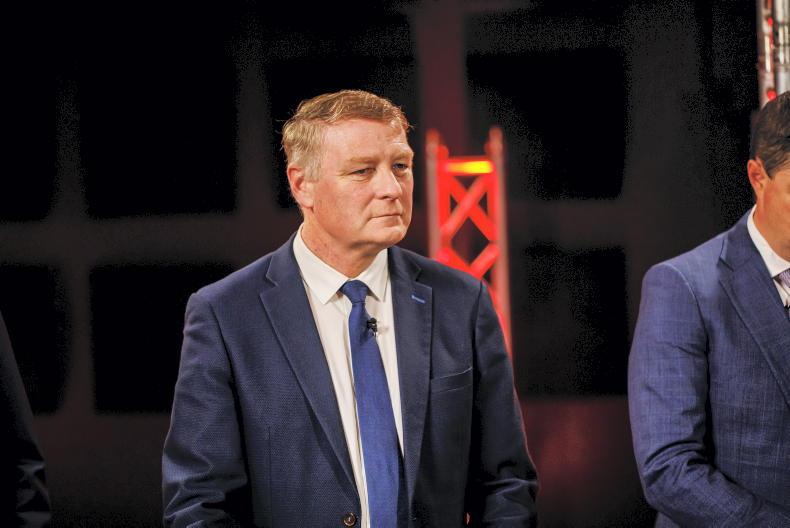
Sinn Féin TD Martin Kenny has said he is “absolutely convinced” that there is enough money in the food chain to pass more back to farmers.
However, he said, speaking to the Irish Farmers Journal, the problem is that the farmer that puts in all the risk and effort is “the one at the bottom that always takes the hit”.
“But everybody else still takes their cut equally whether prices are good, or prices are bad.
“A small little bit more to the farmer would make all the difference in their productivity.”
Agri Food Regulator
Aontú TD Paul Lawless said the quality of the food that farmers in Ireland produce is “second to none” and he believes this is being demeaned by “downward pressure” by food processors and retailers.
Speaking about the Agri Food Regulator, Lawless said: “The truth is, the food regulator was established a number of years ago but it does not have the teeth in order to truly investigate the supply chain and it is a fact that the farmers are the ones who are suffering from that inequality.
“We have a food regulator that doesn’t know what’s happening.”
Lawless said he recently had a meeting with the Agri Food Regulator where he asked them what powers they have.
“To be honest with you the powers that they have is to write an email to ask the processor, to ask the supermarket what’s happening, what’s the profit share, etc and that’s it.”
He said that the lack of powers of the regulator to obtain information from these players in the food chain needs to be addressed.
Price takers
Lawless said because farmers are price takers, they are expected to receive a price below the cost of production which he described as “damaging” for farmers and rural communities.
Lawless highlighted that post-World War Two, European policies were designed around the principle that food should be produced below the cost of production and that this income could be supported by CAP.
We also have in many areas another problem for younger people getting into farming... the cost of land
“We are now at a crossroads in terms of the reduction of CAP and what is going to happen... and that is why there is so much uncertainty in farming and a lack of confidence in relation to the next generation taking it on because of the volatility.”
Productive
Kenny also believed that if a farm was being farmed and productive, it should be recognised for that through support payments, whether the farm is big or small, full-time or part-time.
“In my part of the world in the northwest where the landholders are small and the land is heavy, there’s not many options, the small farmer there will have to have an off-farm job in order to survive.
“We also have in many areas another problem for younger people getting into farming... the cost of land.
“In some cases we have people who make money elsewhere, very wealthy people who want to pass on that land as a tax-free gift to their children, rather than pass on the money which they would have to pay tax on and using that loop-hole, if you like.
“It’s there for very good reason for the agricultural sector, but is being abused in the other sectors and that’s putting pressure on the price of land and pushing it up.”



SHARING OPTIONS