



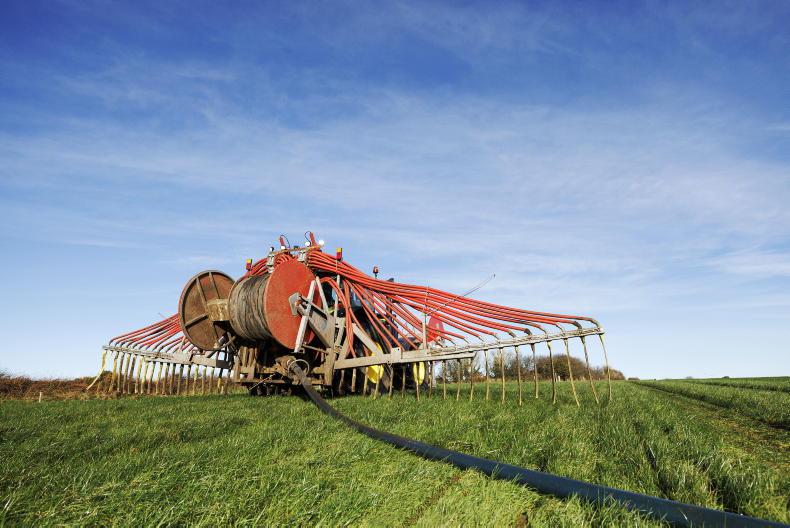
The Department of Agriculture has written to dairy farmers this week to inform them that if they are moving organic nutrients to outblock farms within their holding, or have already done so in 2026, then they must now declare such movements.
The movement must be recorded via the MyAgfood.ie platform or on the Department’s organic movement app.
Farmers must record three pieces of information:
The letter states that the LPIS parcels and their associated townland information as declared on the 2026 Basic Income Support for Sustainability application will be available to select when declaring the movement. The deadline for declaring such movements is 31 December 2026.
The requirement to record a movement of organic fertiliser to outfarm blocks is part of the Department’s monitoring of the new milking platform nutrient management or nutrient balancing. Farmers and advisers are still coming to terms with the rules introduced as part of Ireland’s sixth Nitrates Action Plan.
In simple terms the rules govern how much nutrients can be applied to the milking platform in a calendar year. This will be influenced by stocking rate and the movement of organic nutrients to outfarm blocks.
In general the higher the stocking rate on the milking platform the greater the requirement will be to move organic nutrients to an outfarm block. The less slurry that is moved, for example, the lower the chemical nitrogen allowance for that area will be.
This is looking at the rules in a simplistic view but it is important to note that it is a complex process that is now having to become part and parcel of the nutrient plan on farms.
Tighter controls
The Department is also using the correspondence to highlight that from 1 January 2027 farmers internal organic nutrient movements within a holding must be declared to the Department via MyAgfood.ie or the organic nutrient app within four days of the movement taking place. This requirement aligns with current rules requiring farmers exporting organic nutrients of their holding to declare them to the Department within four days of the movement.
Any such movements which take place from 1 July to 31 December 2026 must be confirmed by the importer by 14 January 2027. A failure to do so will void the movement and could have big implications for farmers relying on the movement to stay within certain stocking rate limits.
Soiled water
It is also a good time to remind farmers as to their requirements in terms of managing soiled water. As of 1 December 2025, all milk producers, irrespective of their system of production (spring or winter), must have had a minimum of 31 days soiled water storage on their farms.
This requirement is to coincide with the current prohibited application of soiled water on lands from 1 December to 31 December.
Soiled water is defined under the Good Agricultural Practice for the Protection of Water regulations as water from concreted areas, hard standing areas, holding areas for livestock and other farmyard areas where such water is contaminated by contact with any of the following substances:
What is soiled water
Soiled water does not include any liquid that has either:
All clean water in the yard must be diverted to a clean water outfall and prevented from entering storage facilities.
This means that all roof gutters and downpipes must be in place and fully functional to prevent clean water mixing with yard pollutants.
The regulations also state that there shall be no direct runoff of soiled water from farm roadways to watercourses.
With regard to general storage for soiled water and effluent, the Department have published a conditionality handbook which advises that “for soiled water storage facilities constructed before 1 January 2015, the required storage capacity for soiled water should equal or exceed the capacity required to store all soiled water likely to arise on the holding during a period of 10 days, or for a period of 15 days in the case of soiled water storage facilities constructed after the 1 January 2015”.



SHARING OPTIONS