



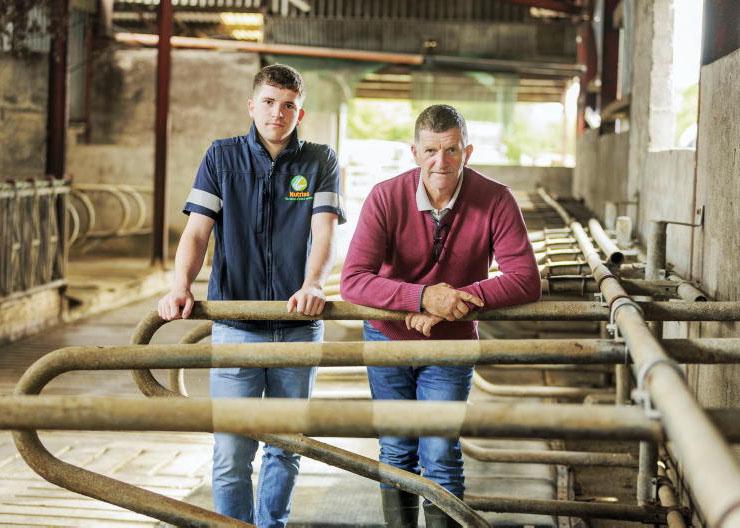
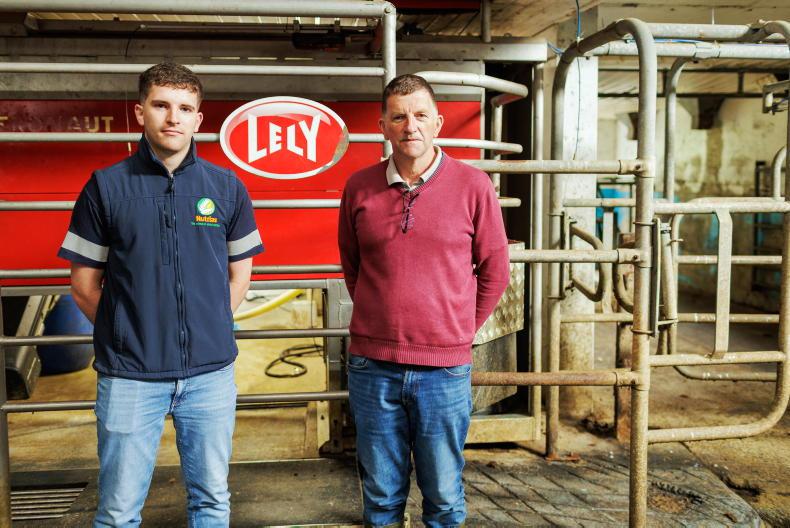
My farm is based in Tourlestrane in the foothills of south Sligo’s Ox Mountains. I took over the running of it from my father, Séamus, in 1990 when I was 25.
We moved here in 1970 with an initial holding of 28 acres, and cows were first milked on the farm in 1977.
Like many farms, ours is a family enterprise. My parents worked hard to develop it, and today, I farm alongside my two sons, Fergal and Diarmaid, ably assisted by my wife, Mairéad, and daughters, Sinéad and Orlaith.
Over the decades, we built a high-input, high-output system of 70 cows.
Operating on heavy soils meant winters were six months or longer, so we bred a cow with the genetics to milk well indoors, as well as outdoors. Because I worked full-time as a secondary school teacher, we operated a spring/autumn calving pattern to spread the workload. To keep the dairy enterprise viable alongside my off-farm job, we purchased a robot in 2012.
“It gave us flexibility, suited our higher-yielding cows – which were delivering 8,500+ litres and 650kg MS – and provided us with invaluable data.
For 40 years, we kept the dreaded disease off our farm. We hadn’t bought an animal in since 2017.
We were a closed herd in a region that isn’t exactly a bovine stronghold.
But when TB gets in, it’s in, and over the course of 10 months, it took absolutely everything.
It started on Tuesday, 28 October, 2025. Like most farmers on test day, I was eyeing the animals for lumps.
I noticed a few, but all was revealed on reading day when three cows went down.
My immediate priority was getting the reactors gone as quickly as possible. I arranged a valuation before the Department forms even arrived, and the animals went to the factory a week later.
We had a clear skin test in early January. We breathed a sigh of relief; calving was in full swing.
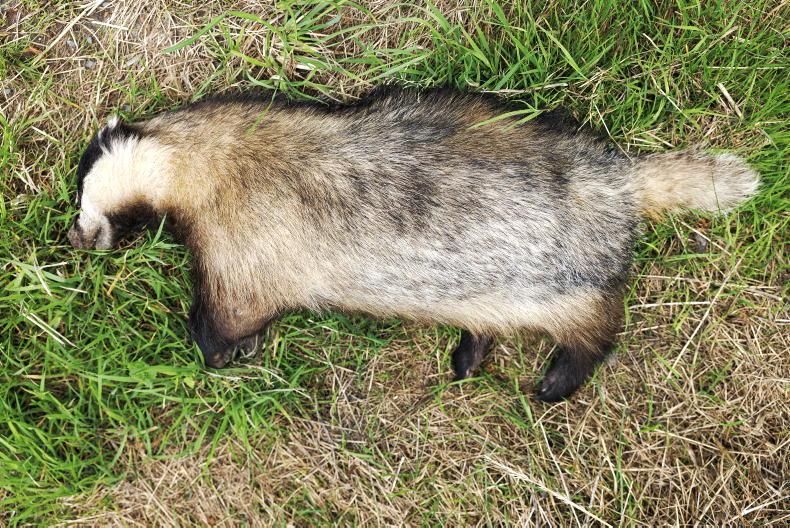
Four badgers were taken from a nearby sett, and the one that was tested came back negative for TB. We thought we had weathered the storm. We were wrong.
On the evening of 18 March, during our next skin test, I noticed lumps on the five-month-old, weaned calves. The next day, lumps appeared on the cows. By Saturday morning, 10 cows and three calves had TB. It included four red cows, two cows classified as excellent, and two daughters of Jerudo.
The stress skyrocketed. Suddenly, we were dealing with the practicalities of separating 10 cows and dumping their milk.
A high number of reactors meant phone calls from the co-op and a visit from a milk adviser to ensure the milk was genuinely being dumped.
Then came the stress of another valuation and removal process. A blood test was now inevitable. It was taken on 31 March.
The results arrived on Good Friday – though there was nothing good about it for me.
We had 23 more positives. These were the best cows in the herd, some milking over 50kg a day. Fourteen cows, four yearlings, and five calves went down.
One of those calves was only 59 days old.
Because they were too young to travel, the two youngest calves had to be put down on the farm.
Holding an innocent animal while it is put to sleep is not an easy job.
We were left with just 39 of our 70 cows to milk. I foolishly hoped the blood test had cleared out the disease and that our next test would be the start of a new chapter.
On 15 June, lumps started appearing again. Thirteen cows, two heifers, and seven calves went down.
Again, the calves were put to sleep in the yard. Two animals faced total carcase condemnation at the factory, triggering yet another blood test.
That test took 12 more cows and three calves.
With only 13 cows, 18 heifers, and 40 calves left, the herd was decimated. I asked about depopulation, and a decision was made by the Department to carry it out on 16 July. On Tuesday, 11 August, 2026, the final animals left the farm.
Years of pedigree breeding – cow families tracing back to Beechford, Clongowes, Lisselan, Lumville, and Rowantree - were wiped out. Two generations of work, including my father’s foundational input, were gone.
The sheer volume of unseen work in a TB breakdown is staggering.
It’s not just losing the animals; it’s the endless phone calls looking for information.
It’s sorting out missing pedigree certs and dealing with genomic registration issues to ensure animals are properly valued.
It’s organising permits and transport to the factory while simultaneously trying to manage the day-to-day running of the farm.
Emotionally, the whole experience was draining.
Initially, the worst part is the uncertainty – not knowing how many reactors you will have or when the endpoint will be.
Strangely, depopulation was somewhat of a relief because it stopped the suffering of repeated failed tests.
But walking the last of the animals out of the yard, knowing their endpoint and their complete innocence in it all, is a particularly difficult pill to swallow.
A job you’ve done your whole life is just taken away from you.
The daily tasks we did together as a family suddenly didn’t need doing anymore.
Financially, the hit is severe. We sold 50% less milk this year compared to last. We had planned infrastructure upgrades to modernise our facilities and upgrade slurry storage, but those have all been put on hold for now as we navigate the next few months.
Right now, the farm is in limbo. We are incredibly grateful for our health, but looking outside the door and seeing no cows is hard to take.
Like most farmers, we are eternal optimists. We recently reclaimed and reseeded ground, and it’s hard not being able to see the cows bear the fruits of that work. We want to go back into milk production – it is our passion, developed over 50 years.
But the uncertainty regarding the source of our breakdown looms large. We’ve been advised to try and make our sheds more badger-proof, and we need to sit down and assess how we can best, and safely, get back to milking.
If I have any warning for other farmers, it is to expect the unexpected. If a closed herd in Sligo with no TB in 40 years can be entirely depopulated in 10 months, it can happen to anyone. It is totally out of your control. While I hope new rules will help, the vectors of transmission require much more stringent control.
To anyone currently going through a breakdown or losing cattle: talk to people.
Seek help if you are struggling. It is a highly isolating and difficult period and keeping it to yourself will not improve the situation.
Having gone through the process, I believe the Department needs to make some immediate changes to how they handle breakdowns:
Hope is a word that comes up in many of our conversations lately.
Everyone hopes it gets better, hopes it doesn’t come to their doorstep, and hopes they never have to face the ultimate endpoint of depopulation.
Until the vectors are fully controlled, hope is unfortunately all we have.



SHARING OPTIONS