



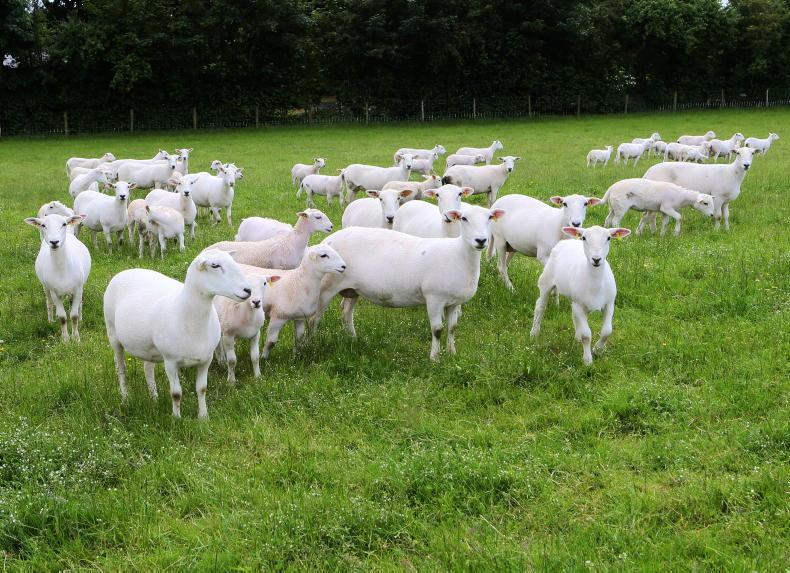
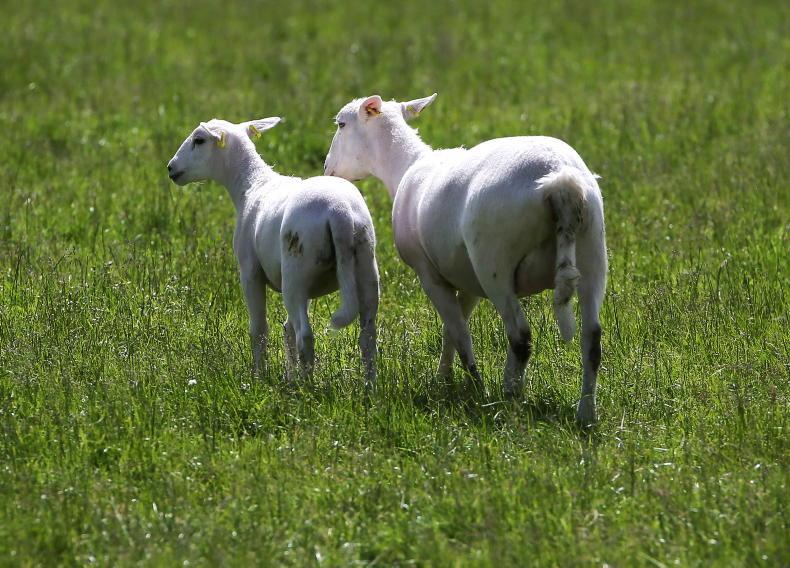
A highly-stocked sheep-only farm with limited labour is a good place to assess whether EasyCare ewes are able to deliver on their name.
Steven Johnston and his son Ewan run around 250 breeding females on a 50-acre farm outside Ballymena in Co Antrim.
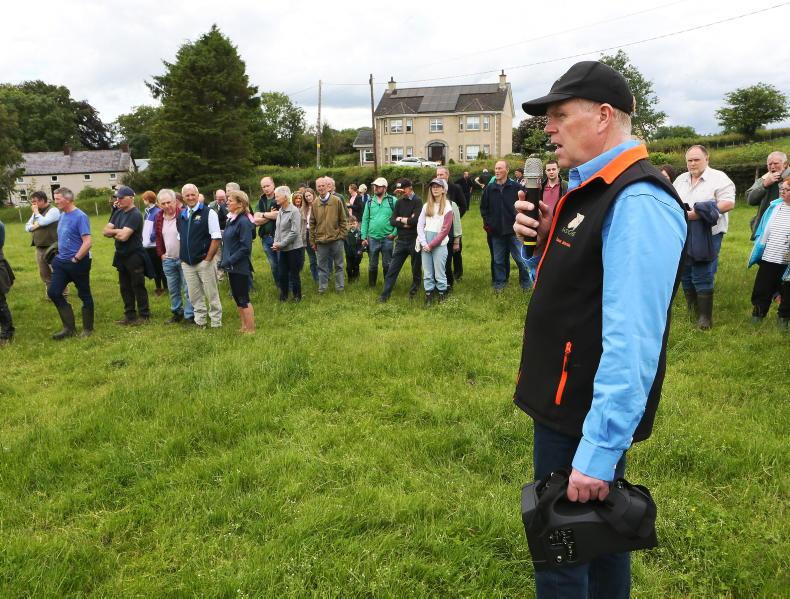
At an on-farm open day on Saturday 20 June, Steven said he had seen how fellow Co Antrim breeder, Campbell Tweed, had switched to the breed and decided to follow suit. The first EasyCare sheep came onto the farm in 2008.
“I had Suffolks and Texels and when you saw them lambing, you intervened. The biggest challenge with the EasyCare sheep was not intervening – I brought in 12 and they weaned 23 lambs,” said Steven.
He now runs between 170 and 210 ewes each year along with 50 to 80 ewe lambs. All sheep are recorded through Sheep Ireland and all routine performance data is collected using TGM Software.
Having started as a lamb producer, a significant part of the business is now selling ram lambs, with 35 to 40 sold each year. Rams have been sold across Ireland and Britain, with genetics from the flock also going to New Zealand, Australia and the US.
It is a closed flock, with six main family groups.
“I have daughters of 46 different rams in a flock of 250 ewes – that is important. I want diversity and want to keep hybrid vigour in the bloodlines,” said Steven.
While he did emphasise the benefits of having robust sheep on the farm, he also highlighted issues faced and areas that need to be addressed.
EasyCare sheep naturally shed their wool so there is no clipping done, however, he has gradually bred sheep with more hair than wool, which has helped minimise any problems from flystrike. Tails are left on lambs.
Ewes go to winter grazing at the end of October/early November and return at the beginning of March, ahead of lambing commencing from the middle of the month.
All ewes are lambed outside at a stocking rate of around five ewes per acre.
While most ewes lamb on their own, there are still problems to sort, especially in bad weather and Steven does take three weeks off work to get the bulk of lambing done.
Ewes are not pregnancy scanned as “there is no point recording data I’m not going to use”. There has been no EasyCare ewes lost to twin lambs, with the flock offered feed buckets designed for ewes pre-lambing.
“We record any issues at lambing, such as needing assistance – those ewes are culled. I also cull wild mothers/ones that have left their lamb – I like them staying attentive,” said Steven.
In 2025 there were 168 mature ewes put to the tup. Of these, 166 returned after winter grazing, with 160 in-lamb (3.5% empty rate). One ewe died pre-lambing, with 159 ewes lambed, producing 362 lambs (227% lambing).
“That lambing figure is too high – I have to do something about that. I have overcooked on the prolificacy side there,” said Steven.
There were 51 pet lambs (which are sold off the farm).
Across all ewes and ewe lambs, 4% (a total of 10) needed assistance at lambing. In the previous four years, that assistance rate varied from 4% to 8%, with the average settling at 5%.
Losses are on par with the industry average, said Steven, with 6% of lambs lost this year at birth or slightly after birth and at day 100, this figure stood at 10%. Last year, favourable weather helped ensure losses were down at 6%, but a wet year in 2024 saw it hit 17%.
Overall, it means that lambs weaned per ewe put to the ram normally stands around 1.6.
Minerals
The Antrim area is typically low in cobalt and selenium. Ewes get a bolus before tupping and also when they come back from winter grazing, while lambs get a vitamin injection at around 40 days. Ewes are vaccinated against bluetongue and clostridial diseases.
“I don’t substitute the sheep with income from anything else. They have to thrive under lower labour input – they aren’t mollycoddled – they have to be robust animals,” said Steven.
Steven and Ewan grow between 8t and 10t of dry matter per hectare each year from grass clover swards on the farm.
That growth is achieved without any artificial fertiliser, although some poultry litter is imported onto the farm. Lime is routinely applied to keep pH above 6.0, while grass is measured weekly and a rotational grazing system is operated.
“Rotational grazing saves me 3t to 4t of fertiliser per year – I can either put that effort in or go and buy fertiliser,” said Steven.
He told visitors that he used to move animals every three to four days, but found that too many moves unsettled the ewes, so he now works on a weekly shift.
Soil analysis shows fields have soil organic matters of 20 to 30%, so the land is rich, but is difficult during wet conditions, so it is important to have sheep with good feet. The average weight of mature ewes is around 73kg. Most lambs are finished off grass, although some concentrate might be offered late in season. In 2025, slaughtered lambs averaged 24kg, with 79% grading R.
“R3 is what I am after,” said Steven.
With only sheep being grazed on the farm for over 20 years, Steven describes his land as “sheep sick” due to pressure from the resultant worm burden and some resistance to white, clear and yellow wormer products.
Over the first 40 days, lambs are growing at an average of 280g/day, but this drops back to 235g/day in the period to weaning.
“I am held back by the parasite load – it is probably my biggest challenge now on the farm,” he said.
For the last five years Steven has been working alongside researchers at Queen’s University Belfast (QUB) to investigate options for parasite control and help avoid any more resistance building up due to blanket treatment of lambs.
Speaking at the event, Dr Christopher McFarland from QUB said the first trail in 2021 had split lambs into two even batches. One group within each batch were blanket treated based on faecal egg counts while the second were given a Targeted Selective Treatment (TST) based on individual weight gains. To do this the SmartWorm app developed by Kerry sheep farming brothers Jack and Nick Cotter was used.
“We saw a reduction in the overall number of treatments in the second group and no significant difference in liveweights across both groups,” said Christopher.
The following year, the trial was repeated, with over 100 lambs divided into a control group (blanket treatment when growth dropped below 300g) and those on the TST using the SmartWorm app.
“We saw a 58% reduction in treatments in the TST group. The control group got an average of five treatments. In the TST group some lambs only got one or two treatments,” said Christopher. At the start of the trial, lambs weighed 15.4kg and by the end the control group averaged 38kg, with those on the TST just 0.34kg behind.
Prediction
In 2023 and 2024 the QUB researchers looked at how they could predict the numbers of parasite larvae going onto fields. This involved collecting faecal samples across the season and also doing larvae counts in 6 fields every month from November 2023 to October 2024.
“What we observed was variable numbers of larvae across the fields at different times of year. It is very much determined by grazing history and when the field was grazed as part of the nematode life cycle,” said Christopher.
The aim is to develop a robust model, into which a farmer could input some basic data (such as a faecal egg count) which will then predict the subsequent parasite load on the farm.
During his presentation at the event, Dr Christopher McFarland from QUB outlined the differences between the three main internal sheep parasites.
The lifecycle of most of the gastrointestinal nematodes involves eggs being laid in dung which moult into first, then second and third stage larvae. It is the third stage (L3) when the larvae become infective to a grazing animal. In ideal conditions, the cycle takes 16 to 21 days to complete.
“However, the L3 stage can survive on pasture for months, if not years in some cases. The larvae can sit on the pasture and go up and down to the soil as well,” said Christopher.
The lifecycle of nematodirus is slightly different with this L3 stage developing in eggs shed on pasture and subsequent hatching dependent on temperature and rainfall.
Analysis of data from 25 UK farms, in collaboration with Zoetis, has shown there can be significant variability in when this mass hatch occurs.
“If you are basing your treatments on calendar dates, sometimes you will get it right, sometimes not,” said Christopher. The third issue is coccidiosis, with 15 species found in sheep, although only two are pathogenic. In some cases, lambs need treated, but they usually develop immunity quite quickly, he said.
His advice to sheep farmers is to keep an eye on forecasts (for nematodirus), regularly assess the presence of other parasites on farm using faecal egg counts and consider the likes of targeted treatments.
“We are getting into a scenario with sheep that we have five different drug classes and that is it – there is nothing coming down the line any time soon – we need to make sure that we are managing the efficacy of those drugs,” he said.
When bringing any sheep onto farm, consider a quarantine treatment using the likes of orange or purple wormers. On the Johnston farm, ewes are not treated for worms and any thin sheep are culled.
Farm facts




SHARING OPTIONS