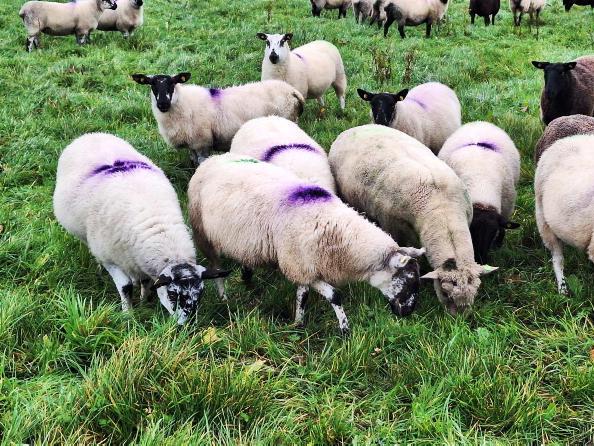

Breeding progress: Running rams in groups is a good way to reduce the possible effects of ram infertility or subfertility. It will not completely eliminate the risk – it is known that a dominant ram that may be experiencing fertility issues can impede another ram from mating with ewes.
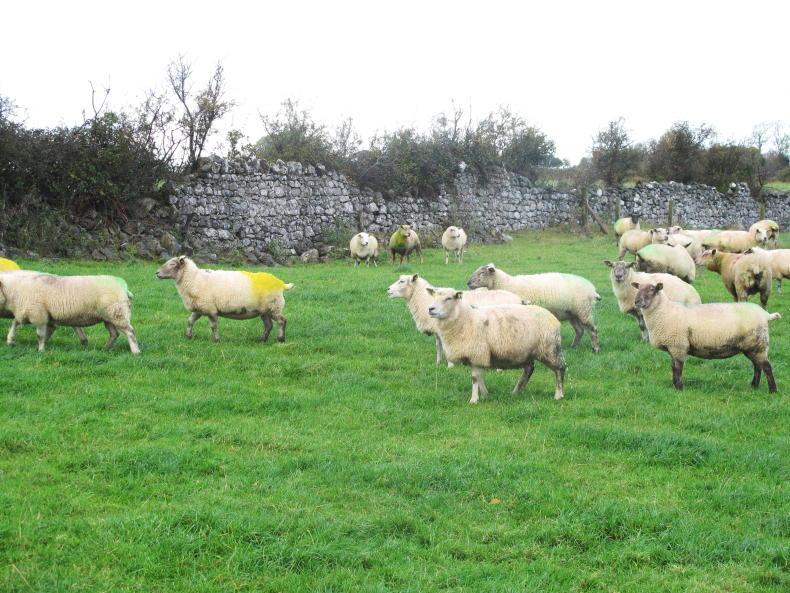
As such, raddling of rams remains an important management practice to quickly identify high repeat rates and sound alarm bells. If using harnesses, remember to tighten them after a few days, in particular new harnesses. If single-sire mating, switching rams between groups periodically will help to limit the consequences of fertility issues in rams.
As touched on in recent weeks, it is also important to ensure that young ram lambs are actually serving ewes correctly. False mounting is an issue often linked to overfed or overweight rams, which may have feet issues such as bad back pasterns.
For these rams, they can associate the final mount with an injection of pain from its back pasterns and end up mounting ewes but not actually serving them. It can appear that ewes have been mated as they will be raddled, but issues will emerge at the start of the subsequent cycle.
Scheme paperwork: Inspections are taking place under the Sheep Improvement Scheme (SIS) and the Sheep Welfare Scheme (SWS). Some of these carried out on the ground, while others are administration checks.
It is important to ensure that paperwork is up to date and that invoices for items purchased align with timelines for actions being completed.
Remember that, under the SWS, actions must have been completed by 13 October 2026 unless the later completion date of 24 November was selected at application stage. A guideline on how to complete the SIS action booklet is available online at gov.ie/en/department-of-agriculture-food-and-the-marine/services/sheep-improvement-scheme/.
Bluetongue vaccine: I was at a meeting during the week where many farmers in attendance were of the opinion that the bluetongue virus vaccine must have been administered in advance of the breeding season. While this is the optimum approach, the vaccine can be administered at any stage.
As always, vets encourage farmers to limit the handling tasks with sheep once breeding has started. However, given the risk profile, where flocks have made a decision to vaccinate, then its administration should not ideally be delayed. The vaccine must be ordered via your vet, so if in doubt consult with them regarding the vaccination programme.
Farmyard manure: The last day permitted for spreading farmyard manure is 31 October, with the prohibited application period starting on 1 November. The same rule applies across all zones and to farmers in Northern Ireland.
Farmyard manure cannot be field stored during the prohibited application period. It can only be stored under a roof or on a concrete slab/dungstead where channels are available to collect any run-off.
Any rainfall on such material is deemed as dirty water, which must be collected. Therefore, it is important to limit the size of these areas and to divert any clean water away from coming in contact with the material to also limit storage requirements.