



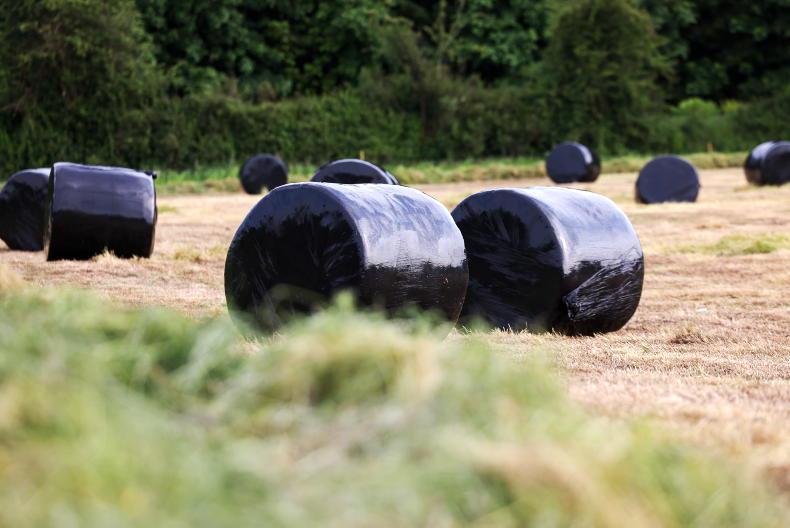
Fertiliser application: There has been a significant area of silage/hay harvested recently on sheep farms with more meadows in the Agri-Climate Rural Environment Scheme (ACRES) likely to be cut over the coming week.
It is important to take steps to replenish nutrient offtake in the harvesting of silage or hay. Teagasc analysis shows that on average a standard bale of silage weighing 800kg fresh weight or 200kg dry matter at 25% dry matter will remove in the region of 10 units of nitrogen, 1.6 units of phosphorus (P) and 10 units of potash (K).
A yield of five bales per acre will remove eight units P/acre (10kg/ha) and 50 units K/acre (62.5kg/ha).
Applying slurry, if available, is a good way of replenishing nutrients and at an application rate of 2,500 gallons/acre will supply in the region of 7.5 units P/acre and 53 units K/acre.
Where aiming to apply chemical P and K then it is important to ensure that you have an allowance to apply P. The level of nitrogen applied will depend on stocking rate and grass supplies. The general recommendation for highly stocked farms is 20 to 25 units N/acre (25kg to 31.25kg/ha) and for lowly stocked farms the advice is to apply 10 to 15 units N/acre (12.5kg to 18.75kg/ha).
Culling decisions: Relatively high cull ewe prices continue to offer an opportunity to upgrade the flock with younger replacements. There are some reports of ewes experiencing greater problems this year due to harsher weather.
Aged ewes and those with any mouth issues were particularly under pressure while the wet weather this spring also created some issues for ewes with pendulous udders.
The best opportunity to test for this where ewes are not identified is to check udders in the days following weaning.
Obvious issues such as lumps on udders, teats etc should also be identified at this stage. With regards to post-weaning management of ewes selected for retaining in the flock, once ewes have been sufficiently dried off they should be fed to a maintenance diet where their body condition score (BCS) is satisfactory or given preferential treatment where their BCS is below target.
Quarantine drenches: It was highlighted at last week’s Teagasc sheep conference that most new diseases enter a flock through the front gate via purchased sheep.
Anthelmintic resistance is becoming a growing problem and the advice is to quarantine drench using a new generation wormer such as Zolvix or Startect and a moxidectin-based product. Where this option is not feasible then the next preferred option is treatment with a moxidectin-based wormer and a levamisole-based wormer.
While Startect is not readily available in Ireland it is licensed for use and can be purchased by your vet from a supplier based in Northern Ireland. Zolvix is also only available through your vet.
The products are now also part of worm control programmes on some farms due to resistance to commonly used anthelmintics.
It is important that these are used strategically to safeguard their efficacy. A biosecurity control and parasite control programme operated under the Targeted Advisory Service on Animal Health (TASAH) is available to farmers and is operated by Animal Health Ireland (AHI).
This provides a free consultation with your vet but AHI reports that the registration process is currently paused due to a high level of applications.






SHARING OPTIONS