



Not too many tillage farmers would build a tower in the middle of their farm to store slurry. It’s a big move and a massive investment. That’s what Andy O’Donnell and his father Kevin did on their farm in Gowran, Co Kilkenny.
A Facebook Marketplace ad, 6,000 nuts and bolts, and countless hours later, the tank was built.
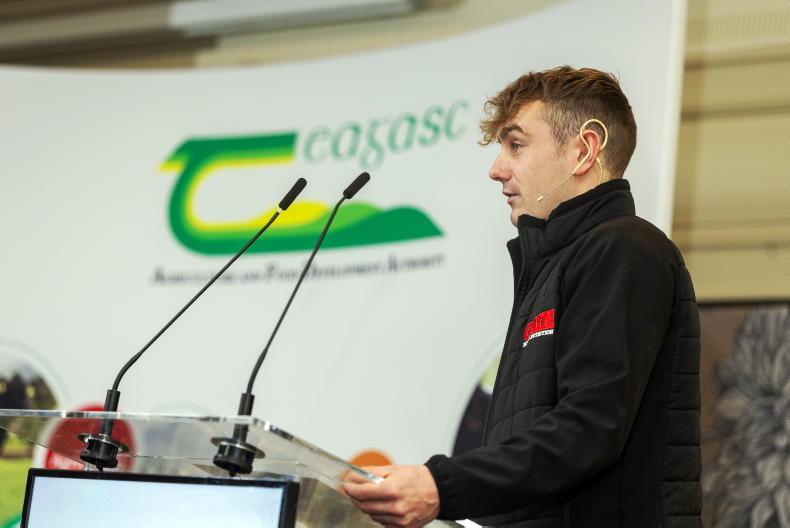
Speaking at the Teagasc Crops Forum, Andy said he wanted to utilise organic manures as much as possible, and having a 400,000 gallon tower allows slurry to be delivered throughout the year, in the closed period and in wet weather.
A tanker can drive in at any time and off load into the tower, allowing the O’Donnell’s to spread at a suitable time and helping the farmer under pressure for tank space.
Once it is in the tower it can be mixed, gives a consistent product and can be tested for dry matter and nutrients, so he knows what he is applying.
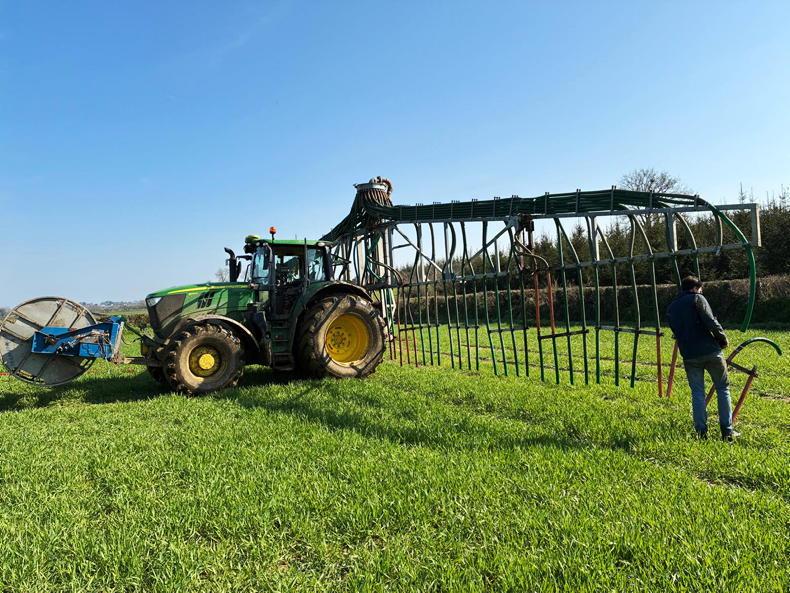
Application takes place with an umbilical system at 1,500-2,000 gallons per acre.
Andy’s neighbour also has an umbilical system and spreads the slurry while the O’Donnells hire a pump and a contractor’s tractor on spreading days.
The slurry is spread across the winter cropping area of winter barley, winter wheat and winter oats, and the rate is divided evenly. The other crop on the farm is spring beans.
Andy noted that weather is the biggest determinant on getting out onto the crop. Many farmers fear doing harm to crops when spreading slurry in a growing crop.
He said the biggest mark was left where the umbilical pipe was rolled out and back up, but this was spread across the field in a line, so was minimal. Wide tyres on the tractor meant that turning was not an issue.
He could see a slight ridge in the crop until booting, but it was not visible after this.
The O’Donnells are using plenty of organic manures across the farm from slurry to compost, farmyard manure, chopping straw and grazing sheep on a summer brassica crop.
Andy is an agronomist in his full-time job and has a big focus on the soil and improving soil to improve crop yields. His father is a big fan of organic manures and brought min-till into the farm over 20 years ago.
Reducing fertiliser costs
Andy is keen to emphasise applying slurry at the right time. He wants to apply slurry early in spring time to maximise the utilisation of nitrogen. His aim is to reduce fertiliser costs, which are the highest input cost on his farm and he wants to be able to apply that slurry in a cost-effective way.
The slurry tests last season showed an N-P-K content of 15-1-21 per 1,000 gallons and this is equivalent to a 50kg bag. A hydrometer gives an indication of dry matter content, but Andy said it is best to get the slurry tested. Applying in spring time, Andy thinks about 50% of the nitrogen is available straight away and places the value of the fertiliser at about €35/1,000 gallons. The cost of spreading is estimated at €10/1,000 gallons and Andy estimates a cost benefit of €25/1,000 gallons. The tower will be paid off in the next three or four years, and once it is, he has the potential to save about €10,000/year at current fertiliser prices.
Andy is working with Teagasc in the Soil Cycle project, where farmers across the country are trialling the use of organic manures on their farms.
Downtime at spreading increases costs
Adviser on the project, Sean Óg McCormack said logistics are hugely important when it comes to moving organic manures.
He spoke about how slurry needs to be flowing consistently for the contractor. Nurse tanks can help with this. Seán outlined that logistical inefficiencies added over €60/ha to the cost of spreading slurry in 2026. If there was downtime, the costs went up, so a nurse tank was a help in reducing costs. Seán estimated the cost of fertilising a crop of winter wheat with slurry and artificial fertiliser and with artificial fertiliser alone. The slurry was being transported on a 40km round trip, using 6,000 gallon tankers.
Where four 6,000 gallon tankers were used and the remaining needs were applied with artificial fertiliser, costs came to €588/ha. Using five tankers and applying the remaining artificial fertiliser, the costs came to €527/ha. Using a nurse tank and artificial fertiliser, the costs came to €475/ha. Where only artificial fertiliser was used, the costs came to €530/ha.
Ciarán Collins is heading up the Soil Cycle project. It is a European Innovation Partnership project. The project is investigating the use of organic manures on winter cereals, specifically in-crop applications. There are a number of farmers involved in the project, along with contractors and industry. It will run into 2029 and more results will be available as time goes on.




SHARING OPTIONS