



Brian Crowley
Ballycotton, Co Cork
The harvest is not yet over for Brian, as he has not had a chance to cut the rest of his beans since we were last talking to him. He says the moisture has been too high anytime there has been a dry few days and he is hoping to get the moisture down as they are for seed.
There was good weather in the forecast for early this week, but Brian says there was a fog on Monday which scuppered any hopes of getting the combine going.
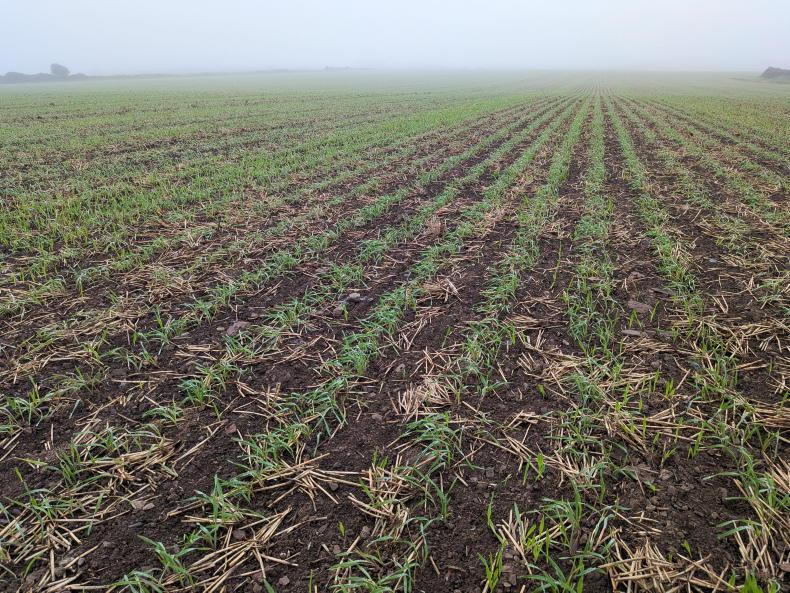
The LG Armada winter oilseed rape was planted on 1 September. It was strip-tilled and has emerged very well. There has been a good drop of rain on the heavy land it was sown in since drilling, but the ground has soaked it up very well.
A graminicide was applied to the oilseed rape earlier in the week to get rid of any volunteer cereals that had come through.
The fodder beet is really after coming back to life, according to Brian. It has swelled out a lot and Brian says it is a lot more promising than it was a month ago.
Sowing of cover crops for ACRES occurred in early September, with phacelia and vetch being the chosen mix. Brian also planted one field of forage rye and vetch.
If there is a demand for forage in the spring, he will be able to harvest the rye and vetch in April or May and sell it. If there is no demand for the crop or there is not much biomass on it, he will spray it off and incorporate it back into the soil.
There are no major changes to the crop rotation this year. The winter wheat and barley seed has been ordered and Brian is happy enough to plant from 5 October onwards.
Christopher Gill
Caledon Estate, Co Tyrone
The farm has been reasonably quiet for Christopher over the past couple of weeks, as he waits for the maize harvest and for winter cereal planting to begin.
He says it will be another week or two before the maize is ready. It looks pretty good, but Christopher says the weighbridge will tell the full story. The ground conditions are OK at present, and with the weather being quite mixed, Christopher is hoping it holds up over the next while.
The winter oilseed rape established quite well on the farm, despite Christopher feeling that it was slower to emerge this year. The winter rye is drilled too and is off to a flyer. It is already at the two-leaf stage and has been sprayed with a post-emergence herbicide and an aphicide.
Christopher is thinking of experimenting with his rye in the coming year. It was planted quite early, at the same time as the oilseed rape, because the land is quite heavy where it is located.
Therefore, he has the idea to mow the crop for silage early in the spring and see can he still take the regrowing crop to harvest. This will all depend on having good ground conditions in the spring too, so that there is not too much of a mess made.
The winter triticale will hopefully be planted in the coming week, after which Christopher will get started on the wheat. There is dung and slurry going out on ground at the moment before the closing date. Christopher comments that it is more and more difficult to make calendar farming work when the weather patterns are changing so much.
The last of the silage is being made on the farm this week too. The good growth in the past few weeks has allowed for crops to bulk up a bit more.
Martin Ennis
Naul, Co Dublin
The last month has been busy for Martin between finishing off the beans, spreading dung and getting ready for winter planting.
The spring beans were finished a fortnight ago. Martin was surprised with how they yielded, averaging 2t/ac and ranging between 1.9 and 2.2t/ac. He thought it was going to be quite poor, as he drilled the beans a bit too early in less-than-ideal soil conditions.
However, the heavy soil helped the beans to power through the drought and the beans weighed very well, leaving Martin delighted. The maize is nearly ready and the crop looks quite good. Martin says it got rain at the right times over the summer and he is hopeful of a good yield.
The winter oilseed rape is up nicely and is growing well in the warm conditions. It received a graminicide earlier this week to control the volunteer barley that was coming through. The dry conditions in July and August meant that any barley on the ground after harvest did not germinate until the rain arrived as the oilseed rape was being planted.
Martin started ploughing for winter cereals last week, and was hoping to start sowing this week. He is not ploughing the headlands of the field; he will leave that until the remainder is sowed. With the crop rotation in place on the farm, there will be slightly more winter wheat and slightly less barley this year.
Where the beans were harvested, Martin might just rip the ground and sow the winter wheat straight into it. He knows that soil conditions would have to be quite good and he will have to keep a very close eye on slugs, but he says it might be something that’s worth trying. Martin adds that the fertiliser markets are a worry coming into 2027. He says it’s impossible to know where prices will be and it is a huge cost on farms now.




SHARING OPTIONS