



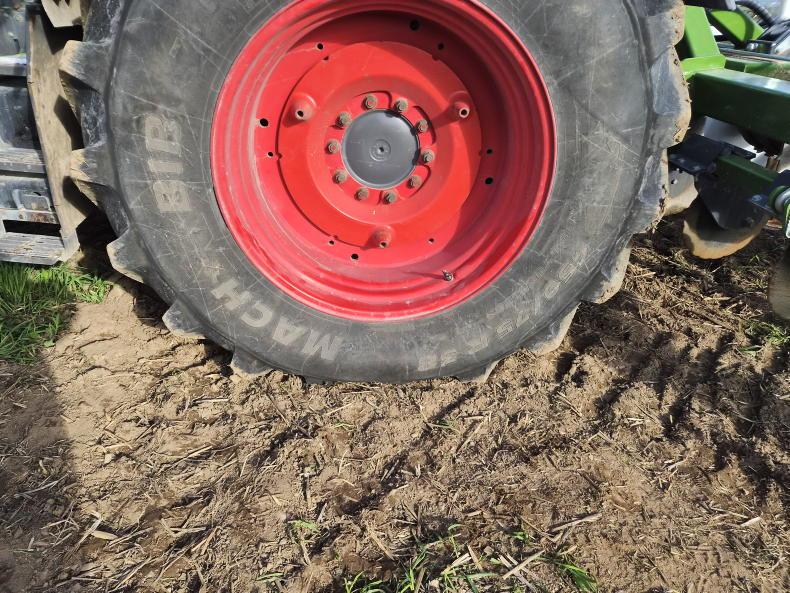
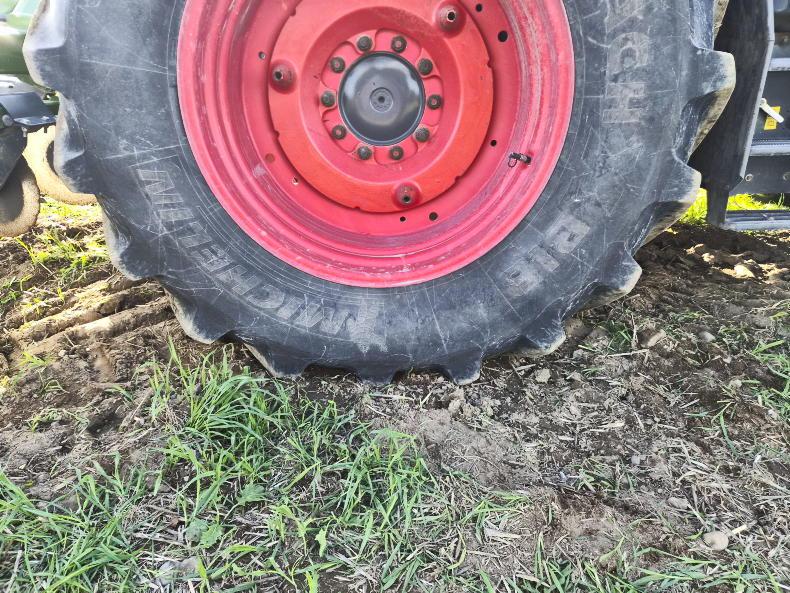
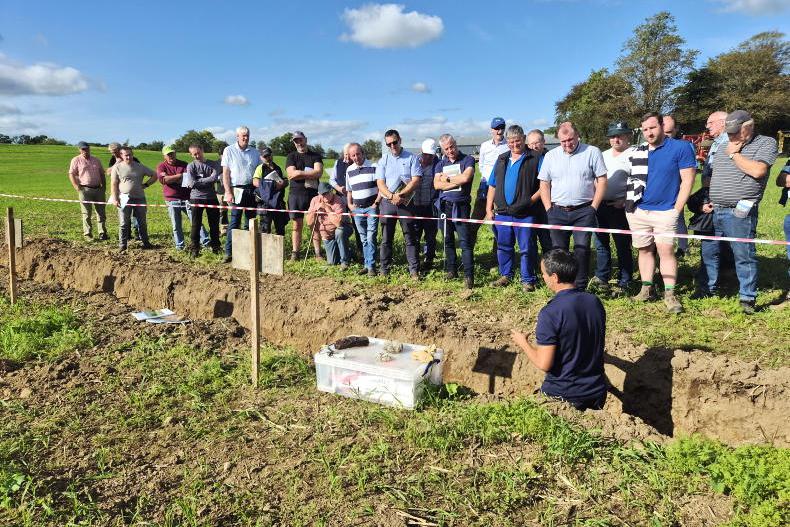
Farmers are being urged to check the tyre pressures on their tractors before starting fieldwork this autumn. Speaking at a farm walk as part of Teagasc’s Soil Health Week on From the Tramlines participant Hugh McDonnell’s farm in Co Carlow, Chris Eakin of Michelin explained a general rule of thumb regarding tyre pressures for fieldwork.
Three lugs should be in contact with the ground at all times. In a demonstration on the day, a tyre at a pressure of 25psi had less than two full lugs in contact with the ground, while the tyre at 10psi had three full lugs on the ground.
Chris explained that with three lugs on the ground, there is “more of a bulge, more of a footprint to spread the load wider.”
This helps to prevent soil compaction, but also has benefits in terms of fuel efficiency and tractor performance.
“If the tyre pressures are wrong on a tractor, the tractor’s not going to perform. It’s going to use more fuel and have more wheel slip.
“People worry that the tyres are too soft, but for fieldwork or short journeys it’s acceptable,” he commented. “The modern tyres are designed to be more flexible, to run with the bulging.
“People are generally afraid of it, but for fieldwork, don’t be afraid of a tyre bulge.”
Chris explained that this is especially true for VF tyres, which stands for very high flexion. These modern tyres can run at very low tyre pressures in many cases. However, Chris did warn that many VF tyres will only work up to a certain level of power, typically 200hp. Beyond this level, IF (increased flexion) tyres may be needed.
“When you get over 200hp, you do need a slightly stiffer tyre in many cases,” he said. Nonetheless, all modern tyres should have some capacity to flex, according to Chris.
Self-cleaning tyres
“If you have your tyres too hard, they’re not flexing, so they’re not getting rid of the soil. They will pick up soil and it will stay between the lugs. The tyres are meant to flex and get rid of the soil, and that adds to the traction,” Chris added.


SHARING OPTIONS