
Voters in the US head to the polls this coming Tuesday for mid-term elections to the Senate and House of Representatives, together known as the Congress.
Both have been under the control of President Trump’s Republican party, which is expected to sustain significant losses in the upcoming vote.
While the US president will continue in office irrespective of the results, should the opposition Democrats win control of congress, it would reduce his power on issues on which he requires Congressional approval.
Farmer votes
Farmers in the US have been among the most loyal of Trump's supporters. In the 2024 presidential election, he secured almost 78% of the vote in counties classified as being farming dependent by the United States Department of Agriculture (USDA).
In November 2025, 453 of those counties were concentrated in the centre and north west of the US, as shown in Figure 1.
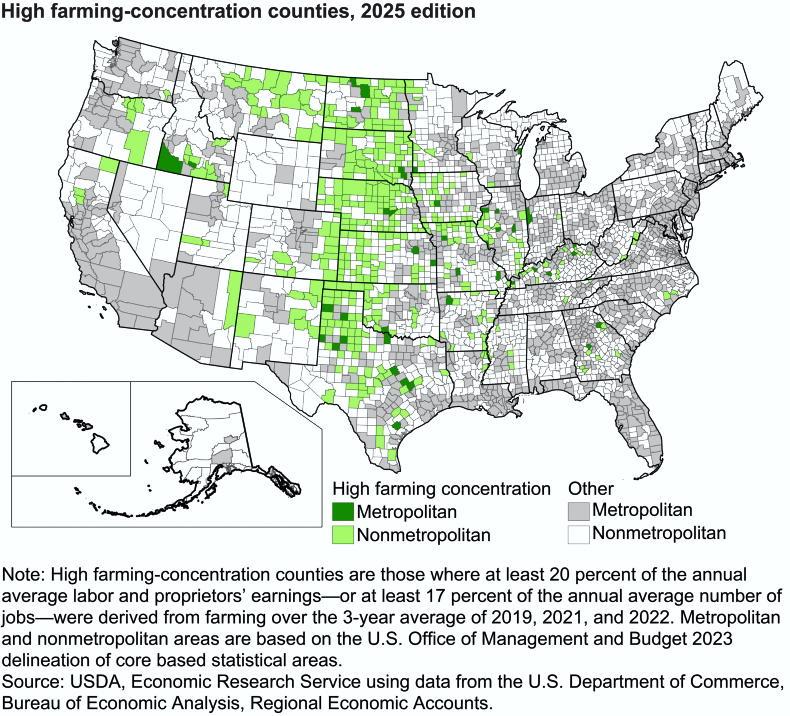
A high farming dependent county is defined by USDA as where “at least 20% of the county’s annual average labor and proprietors’ earnings came from farming or at least 17% of the annual average number of jobs in the county were derived from farming over the three-year average of 2019, 2021, and 2022.”
Farm impact of rising diesel prices
There has been much commentary ahead of the election about dissatisfaction among voters at rising prices.
Like their Irish counterparts, US farmers have suffered due to the sharp increase in diesel prices.
The American Farm Bureau (AFB), the largest farmer representative organisation in the US with 5m members, has calculated the financial impact of the increased diesel prices across a range of farm enterprises.
It has based its calculations on diesel being priced at $3.01 per US gallon (€0.72/l) in September 2025, which has increased to $5.61 per US gallon (€1.34/l) in September 2026, a jump of $2.60 per US gallon (€0.62/l).
This is the Illinois farm-diesel price reported by USDA Agricultural Marketing Service.
Impact varies depending on enterprise
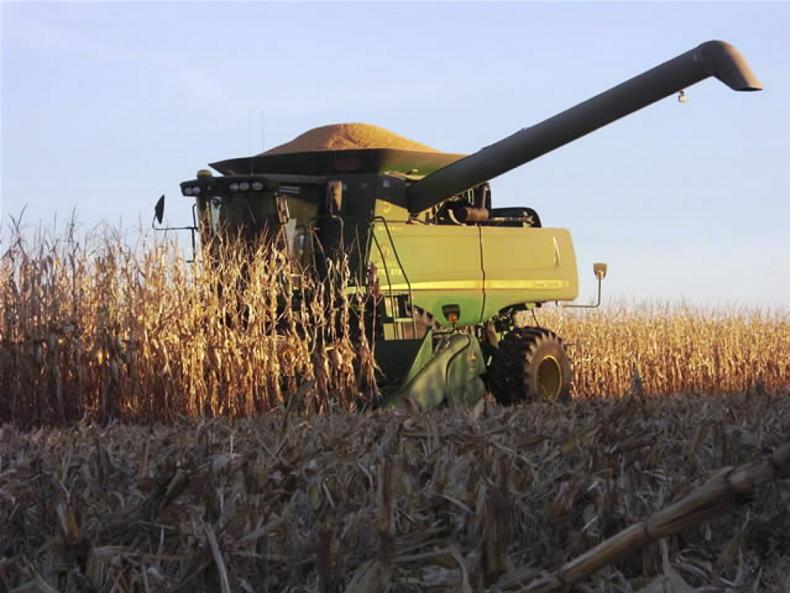
When the AFB applied this increase to an average 279-acre maize farm using an estimated 3.07 gallons of diesel per acre for all harvest-related activity, the 857 gallons of diesel used in total cost an additional $2,227 (€2,006) in September 2026 compared to September 2025.
There is a variation in diesel requirements and, therefore, cost between different farm enterprises. In the AFB calculation, speciality crops such as apples were the hardest hit, with an additional cost of $57.59 (€51.58) per acre, followed by almonds at $18.67 (€16.82) per acre and $18.23 (€16.42) for potatoes.
Cost-per-acre increase for soyabeans harvest is a more modest $3.60 (€3.24) per acre, and winter-wheat planting cost will increase by $2.60 (€2.36) per acre because of the higher diesel cost. The AFB highlighted that those increases are on top of record costs incurred during the 2025 farming year.
$8bn support package
With diesel prices soaring, the administration reacted by announcing an $8bn (€7.2bn) Harvest Fuel Relief program on 19 October.
This is intended to offset some of the losses incurred by US farmers and will be based on “proportional support” using a “uniform formula around planted acres, cost of production estimates and World Agricultural supply and demand estimates yields and prices.”
The announcement was welcomed by the AFB, though it was lobbying for support worth up to $20bn (€18bn).
Comment
While US farmers may be seen as aligned with President Trump, the reality is that their overall impact on the US elections will be small as they represent a modest percentage of the overall electorate.
Higher diesel prices have had an impact way beyond farmers as it is the road fuel most widely used by truckers that distribute the bulk of consumer goods across the US.
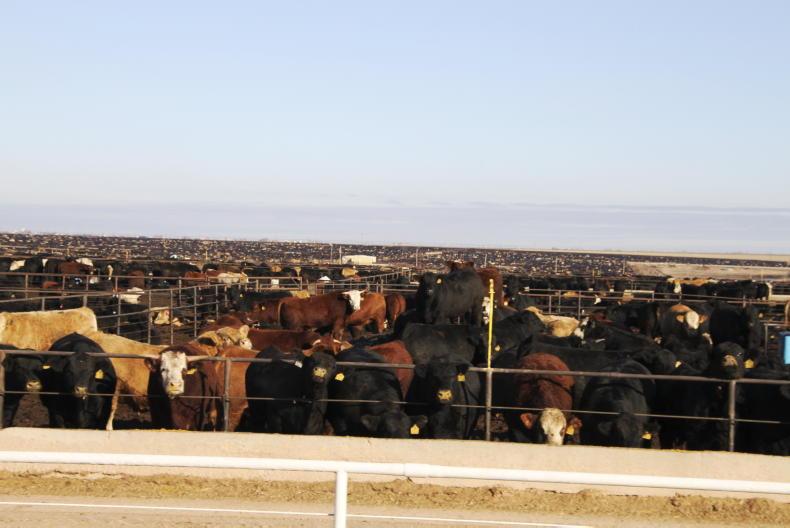
As well as diesel, another cost that has annoyed US voters in general has been the surging retail price of beef, particularly mince. The administration attempted to offset this by creating a 100,000t tariff-free quota per month for three months to enable cheaper imports.
This has aggravated US livestock farmers but has had little impact on the prices paid by shoppers in stores.
Farmers and wider society are unhappy, and the polls are suggesting candidates from Trump’s Republican party will take a hit on Tuesday. But as is always the case with elections, the only poll that matters is the one held on the day.