
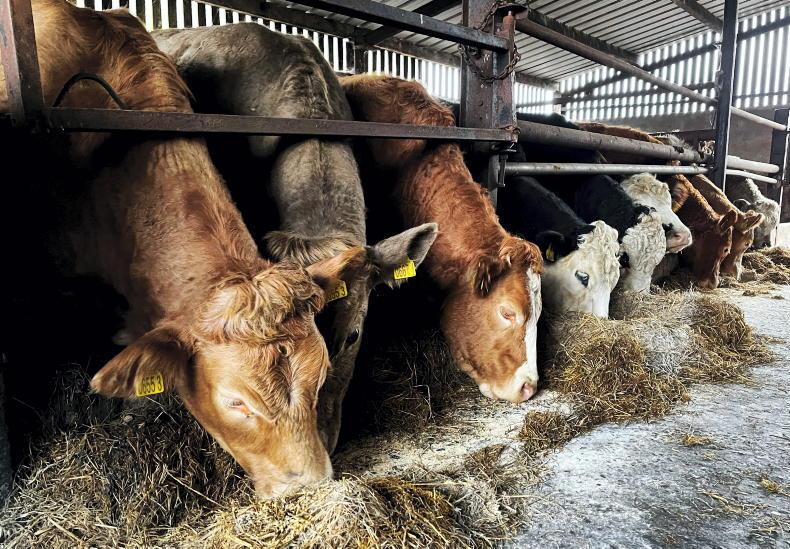
Feeding weanlings: Too often we see weanlings leave the shed in spring at much the same weight as they entered it, with the primary factor being diet. The first step is to get your silage tested, with this being an option under the Beef Welfare Scheme, and aim to feed the best-quality silage to your weanlings (70 DMD +) with a top-up of energy coming from concentrates thereafter.
The protein content within the silage and a discussion with a nutritionist will best be able to guide you as to the protein requirement in your feed purchase as well as the allocation of concentrates.
Teagasc’s work throughout the years on various farm programmes showed that front loading concentrates in the early stages of housing resulted in a better performance in weanlings despite the overall kg of meal being the same. Taking a 150-day winter, feeding 2kg a day for the entire period results in 300kg of feed per weanling.
If we are to split this into two halves, with 3kg/head fed for the first 75 days and 1kg/head fed for the final 75 days, increased weight gains can often be seen as opposed to feeding a flat rate throughout the entire winter.
This works as younger cattle have a higher feed conversion ratio, while a weaning off of concentrates ahead of spring turn out also being beneficial as cattle continue to perform at grass with no setbacks from being pulled from higher meal feeding levels.
Batching cows: With cattle now indoors in many places, it is worthwhile to take some time in batching cattle in a correct manner. Cull cows should be removed and placed on a finishing diet if going direct to factory. Older cows and first-calved heifers due to calve down next spring should always take priority, with these types possibly requiring some early intervention in the form of concentrates.
Ideally, these will have been weaned early and have some body condition put back on them, but if you find them still lacking in flesh then offering high-quality forage alongside circa 2kg of high-energy concentrates now will have a positive effect on body condition.
Delaying feeding thinner cows now until closer to calving will not only see very little condition being added to these cows, but will more than likely result in bigger calves and increased calving difficulty.
Autumn scanning: Scanning is probably one of the most useful tools on a farm. Autumn herds are now nicely into breeding, and some early bred cows can be scanned. More important is to scan any cows that have yet to be seen in heat, with early intervention required to prevent these falling out of sync with the rest of the herd.
A synchronisation programme can be used for these or any late-calving cows (that are calved greater than 30 days) to further tighten up the calving spread, with good conception rates generally seen with cows indoors and on a consistent feed of high-quality silage.