



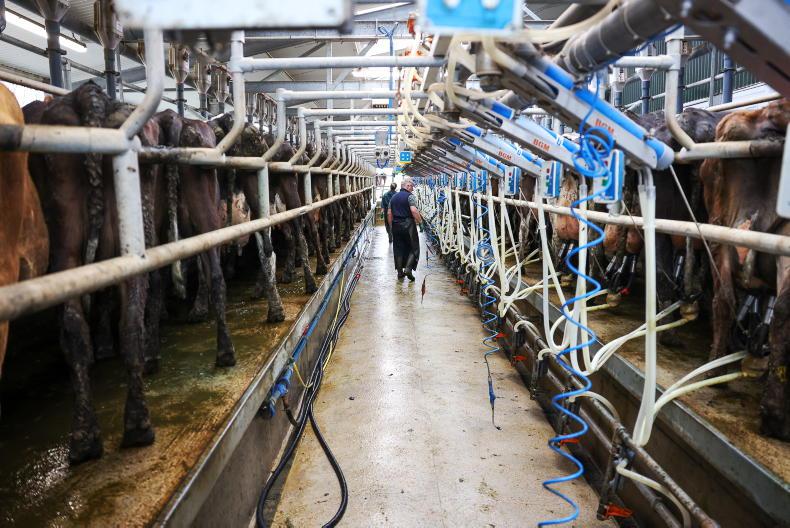
Milking is the most time-consuming task on a dairy farm, bar none. It takes up roughly one-third of the average farmer’s working day and even more on farms with poor infrastructure.
According to research by Teagasc, farms should be aiming for an average milking time of less than three hours per day.
In reality, many farms are spending closer to five hours a day milking.
Investment
If the number of rows of cows being milked is greater than 10, an investment in additional milking units should be considered to make the farm more efficient and a more attractive place to work.
The target should be seven to eight rows. Therefore, a 100-cow herd would require either a 12- or 14-unit parlour, giving just over eight rows or seven rows respectively.
At an average of 10 minutes per row, which could be considered longer than average, the milking time would be between one hour and one and a half hours.
Preparing the parlour and washing up will obviously take longer, but, from start to finish, the entire milking should be completed in approximately two hours, depending on cow flow and parlour layout.
As well as making milking more enjoyable for the farmer, it will mean less time spent by cows standing in the collecting yard and more time in the paddock.
The cost of upgrading a milking parlour can be a deterrent for some farmers. However, the time saving and improved cow flow in a modernised parlour can make the investment worthwhile, particularly where additional units can be installed without major building work.
An hour saved at each milking is two hours a day, 14 hours per week and, over a 300-day lactation, amounts to 600 hours per year.
At a labour cost of €15/hour, that's a saving in labour time valued at €9,000 per year.
That's just the labour element and doesn't account for the additional time available to make better decisions for the overall farm business or to spend on off-farm activities.
For farmers doing the milking themselves, the €9,000 won't necessarily be a direct cash saving, but the value of having an additional 600 hours available over the course of the year shouldn't be underestimated.
Faster milkings are also a far greater attraction for prospective relief milkers or family help.
Cost
The cost of upgrading a milking parlour will depend on the amount of work required. For some farms, it will simply be a matter of extending the existing machine by a number of units.
In that scenario, the cost may not be much greater than €15,000 to €20,000, depending on the specification of the equipment and the infrastructure already in place.
Where an extension can save an hour at each milking, the return on investment can be quite strong when the value of the labour saved is taken into account.
In milking sheds where a simple extension isn't possible, the parlour may need to be reconstructed or moved to a new greenfield site within the yard.
This will inevitably cost considerably more money, but for farms where the existing parlour is limiting efficiency, it may still be a worthwhile long-term investment.
The original milking machine may still be suitable for use in a new shed, although some farmers will opt for a completely new build.
A basic, low-spec milking machine with no additional extras will cost approximately €2,500 per unit.
Higher-spec machines, fitted with automatic cluster removers, dump lines and feed-to-yield systems, can cost up to €8,000 per unit.
The cost of the shed, ground works, collecting yard, concrete work and electrical work could see the total build cost reach anywhere from €150,000 to €200,000, depending on the scale and spec of the project.
At this level of investment, the payback period will obviously be much longer than simply extending an existing parlour.
Where this scale of investment is being made, it's important that the parlour is future-proofed for the number of cows the farm could potentially milk.
Building a parlour now for 100 cows when the farm could potentially milk 200 cows in the future should be avoided.
This investment, along with many more labour-saving ideas, will be covered in our live demonstration area at Dairy Day on Saturday 14 November in the UL Sports Arena.
There will also be a panel discussion on the 'Inside the Farmgate' stage, where three judges will rank the different investments from one to 10, with votes from attendees also contributing to the final result.
To get your tickets for Dairy Day 2026, visit here.



SHARING OPTIONS