



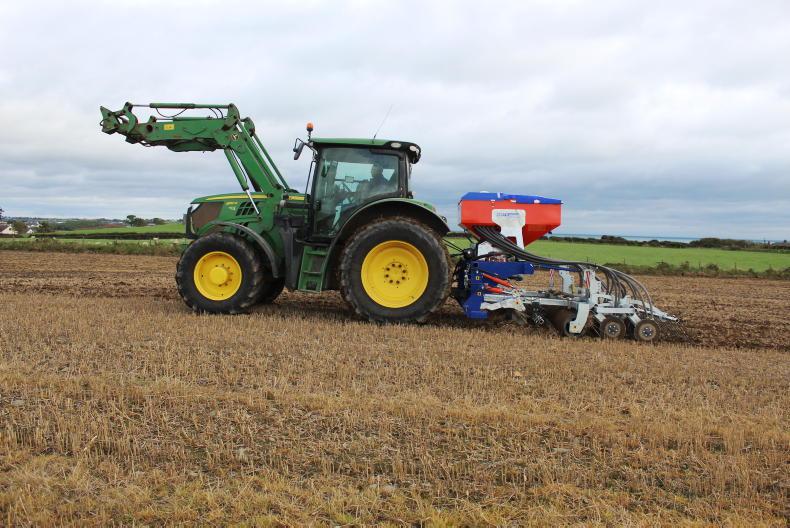
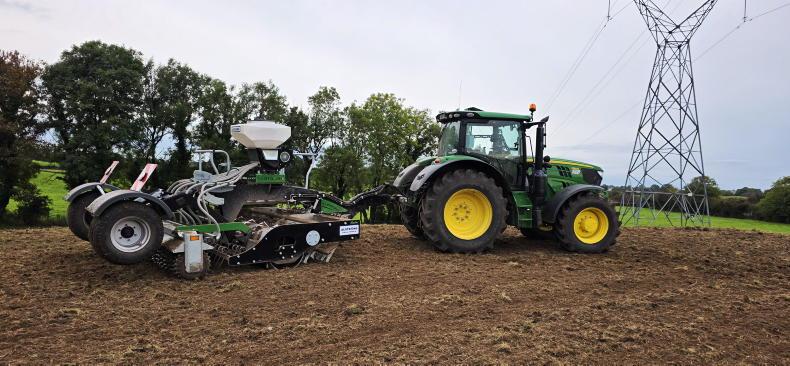
Down-based Erth Engineering is going on a countrywide demo tour with its new Panbuster Drill. The new machine combines the manufacturer’s two most well-known products: its Panbuster subsoiler and Agriseeder direct drill. The Panbuster Drill has been largely designed to sow cereals.
So how did it come about?
“Around 10 years ago, one of my Panbuster customers brought me to see some of his winter crops,” explained David. “That particular autumn was very wet and the crops on land where he had panbusted were streets ahead of where it wasn’t panbusted.
“That got me thinking and we toyed with the idea of building a simple drill, mounted onto a Panbuster. We built a prototype unit, but things were really busy and we pursued other products at the time,” he said.
“Roll the clock forward a few years, and market demand led us to develop a toolbar, using our Panbuster legs and hydraulic trip system as the foundation. The toolbar has been a great success and with margins on tillage farms tighter than ever, I was having regular conversations with growers about trying to reduce the establishment costs of crops.
“One such farmer was a Limavady grower, who purchased one of our first toolbars. He used it in front of his trailed disc drill. Wet autumns made it harder to sow, and he asked about building a lighter toolbar mounted drill. He actually bought the 4m prototype drill we had built 10 years ago and we made further modifications.
“From there, other growers became very interested and we have worked closely with three farmers over the past two years to develop the Panbuster Drill,” David said.
“To date, it’s all cereals we have sowed, but we will be starting our countrywide demo tour this week, sowing oilseed rape in Co Louth. We have successfully sown barley, oats and wheat with the drill. We find that the wheat and oats are tough crops, and can be successfully sowed into stubble with a single pass of the Panbuster Drill. We find that barley performs best when some light inversion is done ahead of the drill, such as a light run of a disc harrow,” he added.
“By using the Panbuster Drill on our three trial farms over the last two seasons, we have found similar yields to the traditional plough and one-pass system. The one point to note is that all of these trial farms are on light to medium soils. The main advantage of our drill is the low cost of establishment. And no matter what business you run, it all boils down to the cost of production. Our trials have shown that the wear on the Panbuster Drill is similar, if not less, to running a plough only. The main wear is on the legs and shins of the front Panbuster unit. Fuel consumption is considerably lower than a traditional ploughing system,” David said.
The design
The new modular machine combines design elements from both the Panbuster and Agriseeder ranges, which have 20 years of development between them.
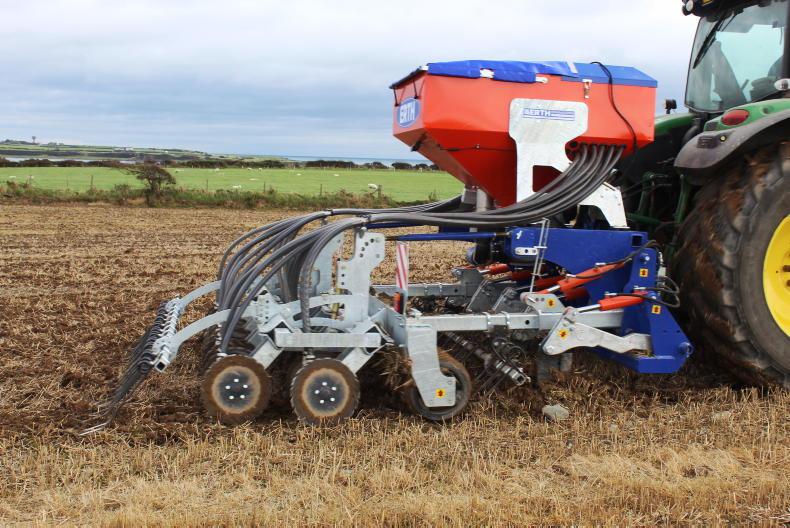
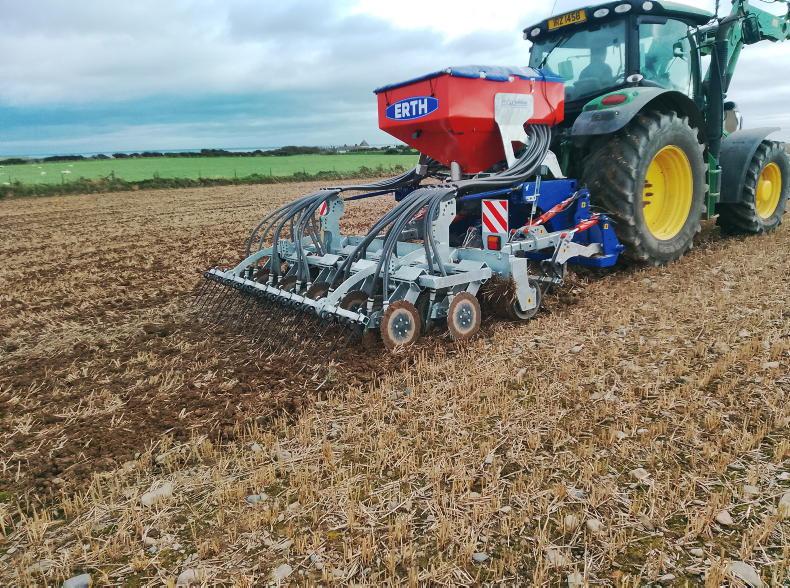
The drill features five main working elements, including an optional front-opening disc, followed by the proven Panbuster low-disturbance legs and a consolidation roller. At the rear is a familiar single-disc coulter system with 20 sprung discs and coulters. The seed is then covered over by a harrow.
Unlike the near-vertical subsoiler legs used by most competitors, Erth says its angled-leg design is key to maintaining a low draft requirement of around 150hp. Subsoiling and drilling depth are controlled via the roller unit. This allows the working depth to be changed, on the go. A depth control indicator allows the operator to see what depth the machine is working at from the cab. Erth claims most operators are running the Panbuster legs at around eight inches deep.
Legs and hydraulic breakback
Erth’s leg design incorporates a reversible wear shin, which hooks onto the leg. It sits into place and is held on by just one roll pin. The shin features a sharp profile top and bottom, to provide less disturbance and drag. Looking closer at the auto-reset system, Erth’s hydraulic system incorporates an accumulator with a secondary bladder accumulator for a fully enclosed auto-reset system. This hydraulic reset allows break-back pressure to be varied to suit the conditions at hand, with the pressure set hydraulically by pressurising the accumulator. Alongside lifting the leg, the legs have the ability to swing sideways to both the right and left by 150mm, which helps to reduce stress on the machine and to prevent bringing up stones.
Spacings
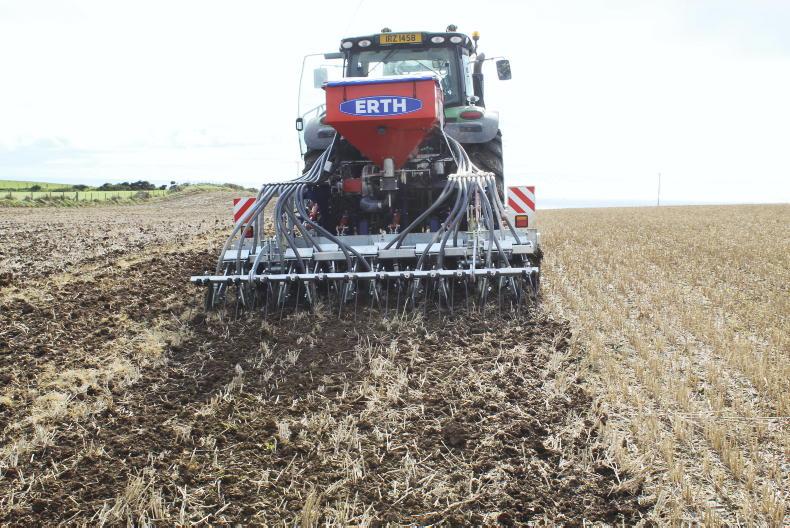
The five legs across the 3m unit are spaced at 600mm apart, while the disc coulters are configured to offer 150mm row spacings. The unit is configured so that no coulter runs directly in line with a leg. Erth explains that the furthest distance between a leg and a coulter is 225mm, to allow for sufficient drainage for the crop to establish. If you compare this to its earlier pre-series drills, it says this spacing was as high as 600mm.
The fundamentals of the seeding unit come from the firm’s Agriseeder, including the Kverneland Accord metering unit. This is married up to the in-house designed E-Drive vario system. The seeding unit runs on a parallelogram linkage. Erth is using serrated single discs which are sourced from Forge De Niaux. These 400mm discs run at a slight angle, with the galvanised coulter placing the seed to the rear side of the disc.
Output and fuel consumption
“Across our three trial farms, we have noted a considerable variation in output and fuel consumption,” David said. “In light land with big fields, fuel consumption ran at 4l/ac, varying up to 8l/ac on hilly ground.
“Similarly, output varied from three to five acres per hour, depending on field size and land type. We have operated the Panbuster Drill on a range of tractors and find that as low as 150hp is very capable of operating the drill.”
Currently only in available in a 3m working width to begin, Erth says a 4m unit will be available in spring 2027. The 3m drill weighs in at 2.7t. It is fitted with a 1,250l hopper as standard, which will hold in excess of 600kg of cereal seed.
Buyers have the option to upgrade to a 1,500l hopper. The hopper is positioned directly above the legs to keep the weight close to the tractor.
Optional extras include an 85l secondary hopper; a choice of rear rollers; a front opening disc; bout markers and tramlining.
The secondary hopper provides the option to facilitate the sowing of two products together or one on surface and one down slot, such as micro fertiliser, or a companion crop. The secondary hopper features its own metering unit and uses air from the drill’s main air stream. It costs an extra €4,000 plus VAT. The specification of the drill is constantly being tweaked, but the drill is priced in the region of €60,000 plus VAT.
Specs


SHARING OPTIONS