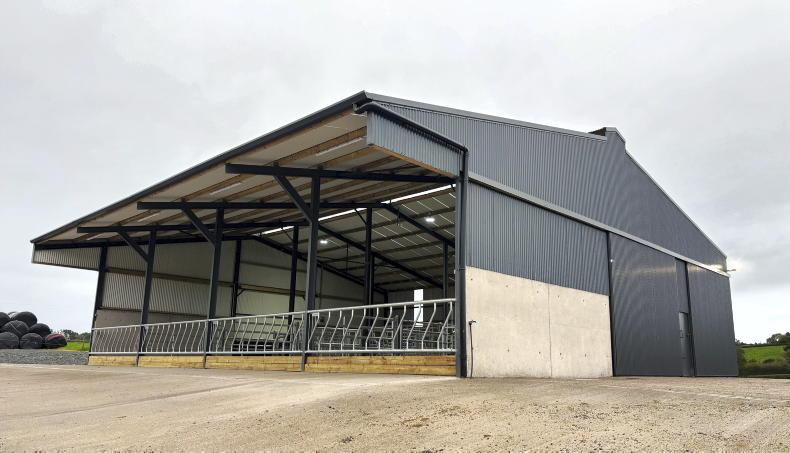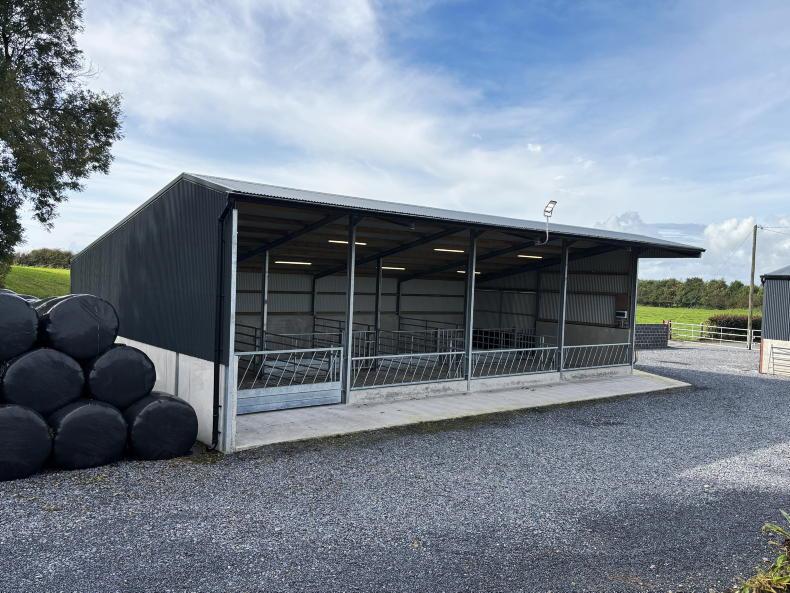

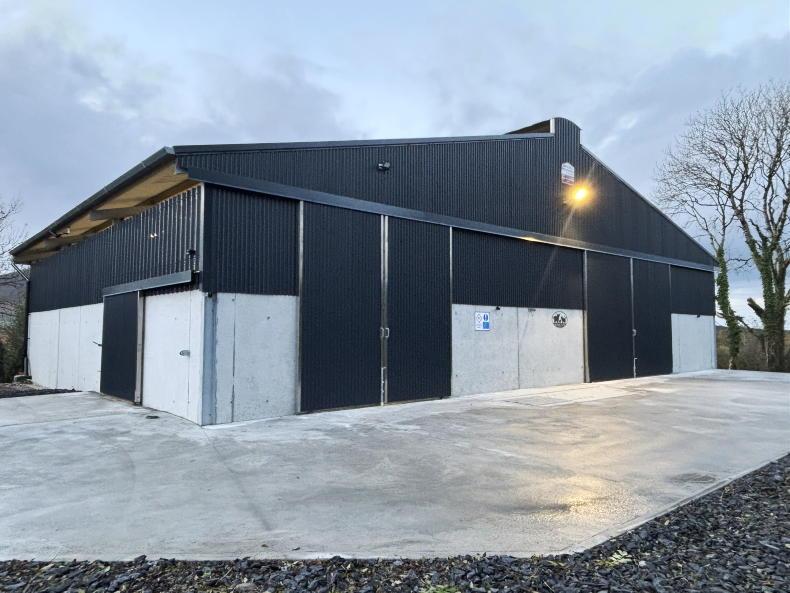
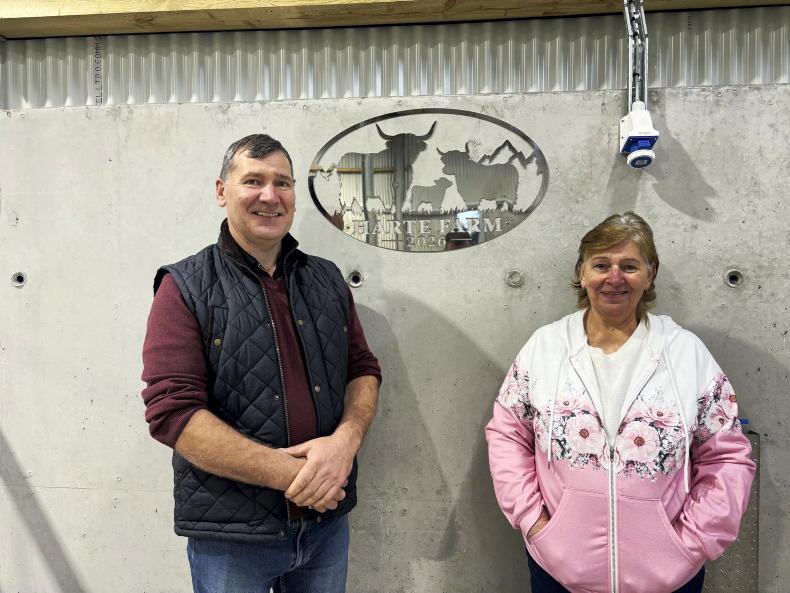
Thomas and his mother Mary Harte are farming together just outside the village of Boffenaun in north Co Mayo. “Mam is my eyes and ears,” explained Thomas, who works full-time off farm, completing stainless steel works as is seen when we look at the shed itself.
The duo operates a suckler-to-store system, with a small amount of cattle also finished.
A lack of accommodation meant that only some cattle could be housed with the majority having to be outwintered.
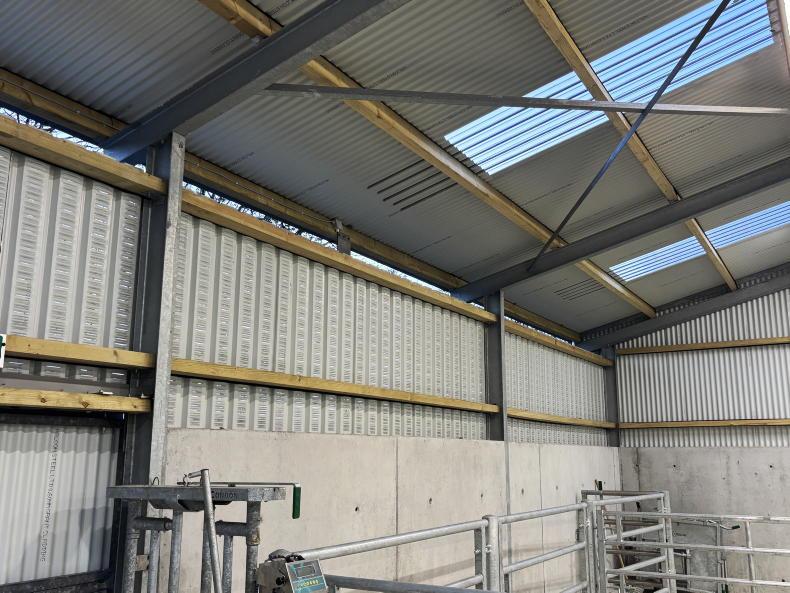
“The three things I wanted to tick with the shed was air flow, cow comfort and safety.
Planning
Planning actually took a significant length of time, with Thomas having first submitted plans in July 2023.
Thomas’ Teagasc adviser Enda Maloney referred him to Carroll Consultancy, with Andrew Kilduff designing the shed and submitting the planning permission and TAMS application.
“Andrew talked me through what was available [under TAMS] and we decided on a three-bay shed with slats, creep areas and calving pens, with an extra wide feed passage included.”
Full planning permission was sought as the build was over 300m2, with a habitat’s directive study having to be completed, which produced a 90-page document.
“It’s actually a very interesting read and it goes through how to protect the environment during construction.”
Planning permission was then granted in February 2025 with Thomas still seeing it as a relatively straight forward process, while the additional time line gave him greater time to plan out the layout.
Local contractor Sean O’Malley broke ground on the project to break out the rock, all of which was used for backfill.
Construction
Thomas struggled to get a contractor to complete the work due to the time frame in which it had to be completed under TAMS (with a six-month extension given) and after discussions with Emmett of E Mitchell Engineering, Athenry, the agreement came that Emmett would supply the shed in kit form for Thomas to erect himself.
Once the tank was dug out, Seamus Brett, Charlestown, poured the floors and walls, with slats from Liam Armstrong Concrete Products, Ballina, supplying and fitting the slats.
The ring beam was then poured and the shed was stood and sheeted by Thomas and some of his relations. Seamus Brett was then back in the yard again to pour the walls over ground.
Slatted pens
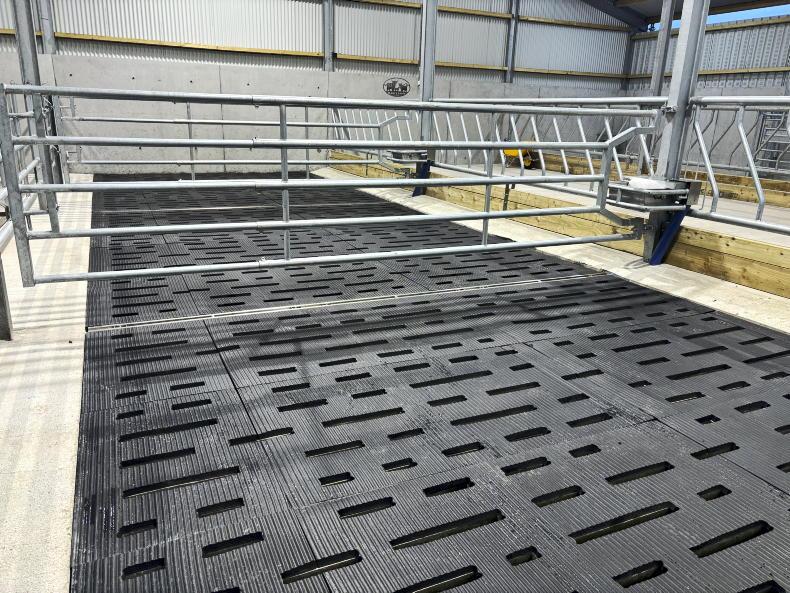
Thomas opted for a 14ft 6in slat, with an 8ft (2.4m) deep tank dug. This gives him a total storage capacity of 152m2 which is more than sufficient for his needs.
Toe space has been left at the front and back of the pens to give a total pens space of 23.5m2, ample lying room for even eight-strong suckler cows.
As mentioned, cow comfort was a big thing for Thomas when building the shed. As a result, slats were overlaid with rubber matting from Cow Comfort Mayo Mats Ltd, Belmullet.
“My uncle has them for years and they have worked very well for him. Space for expansion has been left at the front, while Mayo Mats would normally install a small concrete plinth in between pens to stop uneven expansion but I created a small stainless-steel spacer that still allows the dung to go down in between”.
Calving area
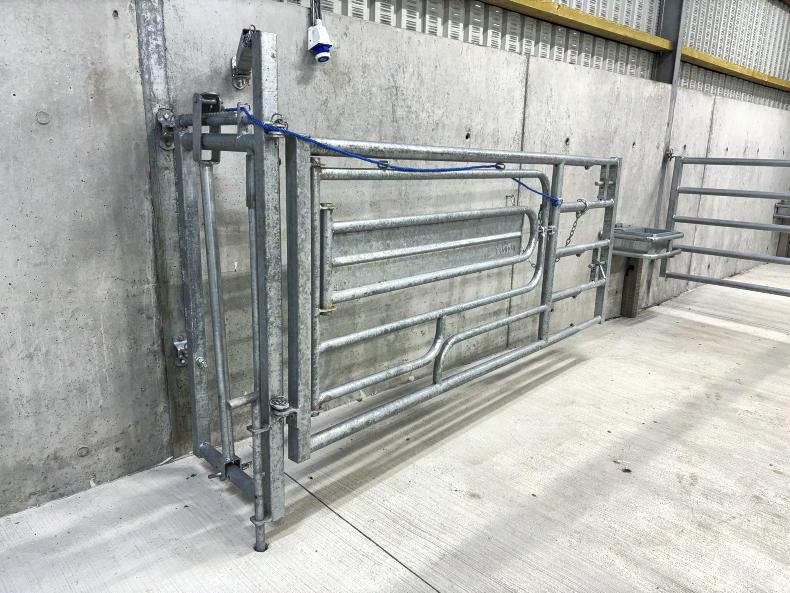
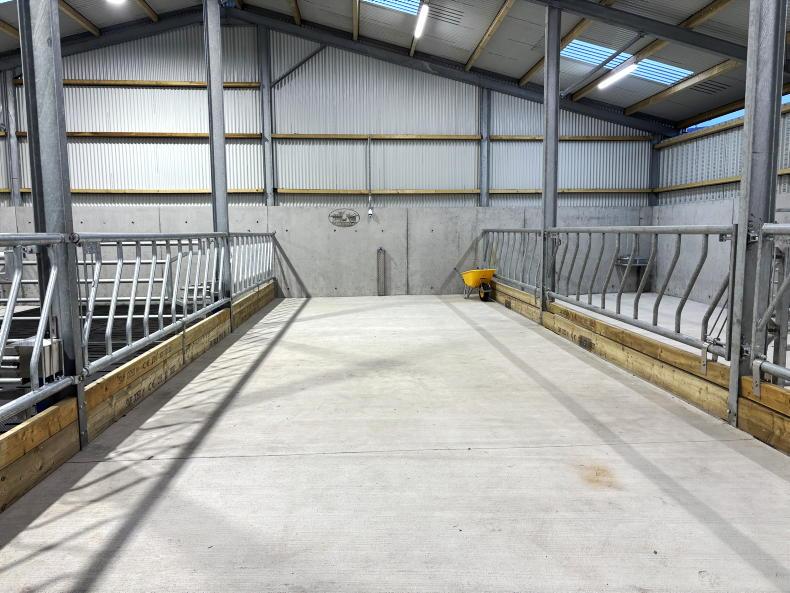
Three calving pens are located across from the slatted pens, each serviced by their own water trough while a calving gate is shared between two of the pens.
“The calving pens were initially supposed to be 1m deeper, but as Emmett rightly pointed out, you don’t need much room there [in the calving pens] as they have a full bay width for just one cow; you don’t need much depth.” Each pen measures 4.8m wide and 4.3m deep, with 5.5m of a feeding passage left as a working area.
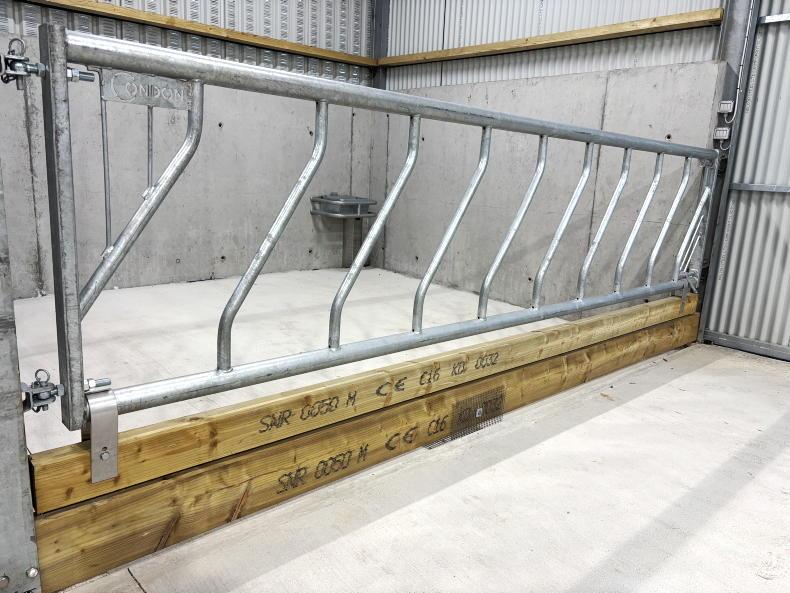
The barriers in to the calving pens are a hybrid design of Thomas’, with the diagonal barrier swinging alongside the top timber which has been affixed to the barrier with a stainless-steel bracket manufactured by Thomas. The bottom timber then sits in place permanently.
Thomas done the barriers like this to make it easier for heavily in-calf cows to get in to the pens.
Each individual pen has its floor cambered from each side and from the back to the front to a central gully situated under the barrier, with the barrier being higher than the pen floor. A 6in pipe then takes any effluent from these pens in to the slatted tank.
“Seamus [Brett] is exceptionally good at floors, but he was very busy so I asked him to look at the falls required”. The toe space along the barrier slopes up from the slat level to 4’’ height. The feed passage has 3in of a fall in towards the slatted pens themselves, with the piper taking the effluent from the calving pens having a fall of 3’’. The calf creep area has an 8in fall across its run in to the slatted pens to keep them dry.
Crush and handling facilities
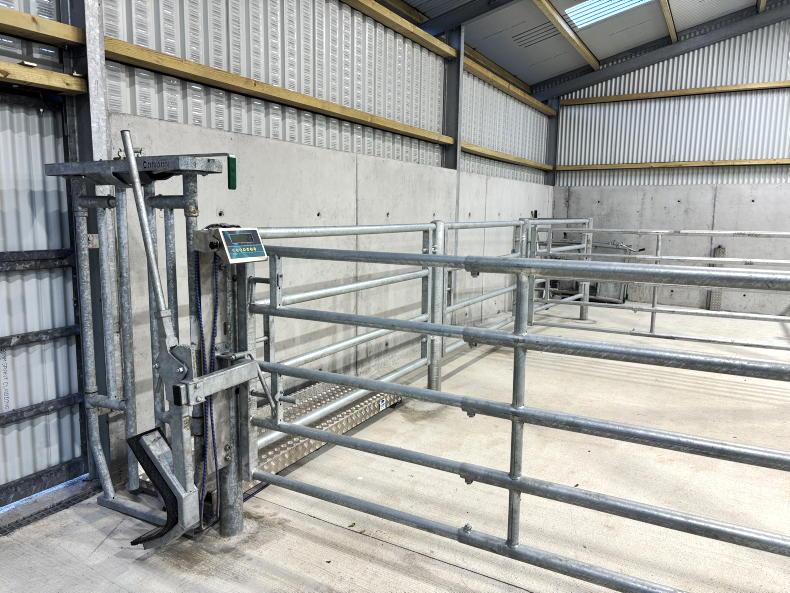
The Hartes availed of plenty of handling options under the Farm Safety Capital Investment Scheme, with the calving camera, calving gate, semi-automatic skulling gate, head scoop, weighing platform, crush and dehorning crate all purchased as part of the build.
“Initially I planned on keeping the crush further to the front of the shed and using the side door as access to the right-hand side of the animal, but reading up on TAMS specifications I soon realised the head of the crush must be 4m clear from the front wall. However, the layout works well in relation to a person escape.”
“The crush is tapered at the end. We have some big Charolais cows and space was an issue in our previous crush.
“It’s a rotational flow with the pens and the crush, with split gates in the two end pens allowing cattle to be funnelled in to the crush from one side and out the other end.”
The crush panels, headgate and scoop along with all the internal barriers, creep gates and solid gates were all sourced from Condon Engineering through Homeland Ballina, with manager Darragh Halligan being extremely knowledgeable and helpful.”
The crush and handling facilities sit inside the 4.8m deep creep area, which was left this deep to accommodate the handling facilities without compromising access.
Other points of note
The shed is well ventilated with a mixture of vented sheeting and a gap between the side and roof cladding left as an air inlet, while a covered central ridge outlet will allow any stale air to exit.
Thomas has added his own touches throughout, with stainless steel brackets for closing the dividing gates, conduit for water pipe, a bracket for holding the calving camera and for holding the safety cages in place.
Thomas even manufactured a stainless-steel flashing to go around the split sliding doors at the front of the shed, being unhappy with the bare cladding look. One of the highlights of the build is a unique stainless-steel sign created at the front of the shed with Cathy, the farm’s prized Highland cow, and Nephin mountain on which the farm sits at the base of, featured.
A second mirror finished sign sits inside the shed, with Thomas complimenting his work colleagues in Duffy Stainless Steel in Castlebar for designing the logo for him. These small touches set the build apart.
Pricing
The total cost of the build came to €98,000 + VAT, while the reference cost for it (pre-2025 increase levels) sits at €78,000.
This is despite Thomas and his family completing much of the work themselves, which he laughs “will have to be paid back to them [family]”. The cost of the FSCIS investments made totals €6,500 + VAT. Despite the difference in reference and actual costs, Thomas was still keen to highlight that the grant aid was of a huge benefit. Thomas was highly complimentary of all parties involved, including Andrew Kilduff, Sean O’Malley, Seamus Brett, Emmett Mitchell and Brendan Collins (wiring and cameras).