



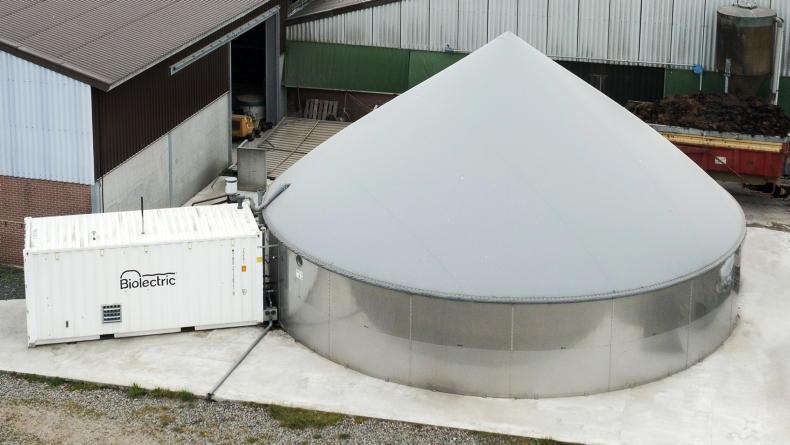
Anaerobic digestion (AD) supplier Biolectric, which manufactures turnkey small-scale biogas plants, is offering to split the planning costs for new farm-based plants in Ireland.
The supplier manufactures steel, single-tank AD plants designed to integrate into existing farm operations and run on slurry.
Until recently, the company focused on combined heat and power (CHP) plants, where biogas is produced and converted into electricity and heat. However, it now also supplies small-scale biomethane plants.
Planning permission is still required for farm-scale AD plants in Ireland. Despite previous indications that the planning requirements for small-scale AD would be reviewed, changes have yet to materialise.
How the system works
The Biolectric system uses a CHP unit to convert biogas produced from slurry into electricity and heat. Electricity can be used on the farm, with any surplus exported to the grid, while the heat can be used for applications such as heating homes or farm buildings. The system can also buffer biogas and use it when electricity or heat is required, effectively acting as a form of energy storage.
Biolectric says its technology can operate on farms with as few as 50 cows. On a typical 120-cow farm, the company estimates the system could generate around 176,000kWh of electricity annually, worth approximately €35,000 at an electricity value of €0.20/kWh.
The standardised system consists of a tank for the slurry, a 20-foot container housing the CHP unit and the associated automation.
Biolectric currently has one AD plant operating on the island of Ireland. However, questions remain over how easily a slurry-only system can integrate with Irish grass-based farms, where cattle spend a significant proportion of the year outdoors and slurry availability is therefore more seasonal. Alternative feedstocks may have to be explored to maximise plant utilisation throughout the year.
Planning costs
Securing planning permission for a farm-scale AD plant should, in theory, be relatively straightforward.
Under the Biolectric model, the AD plant is sized according to the amount of slurry produced on the farm and its energy requirements.
Therefore, in theory, no slurry from outside the farm is required. This can simplify the regulatory requirements for the plant, including potentially removing the need for pasteurisation. However, the actual planning experience can vary considerably from one county council to another.
In the absence of clear national planning guidelines specifically for AD plants, much depends on how individual local authority planners interpret the planning rules and what reports and assessments they require for a particular development.
This can result in significant differences in the planning process and associated costs between counties.
To help reduce this financial risk, Biolectric has told the Irish Farmers Journalthat it is willing to split the planning costs 50/50 with farmers for its first five projects.
While the final cost will depend on the individual project and planning requirements, the company understands that planning costs could be up to approximately €10,000.
Farmers interested in the offer should contact the company or the Lely Center Mullingar for further information.
Grants
While uncertainty remains around the structure of the new biomethane capital grant scheme, it is expected to open this year.
The Department of Climate, Energy and the Environment has said it is exploring ways of supporting small-scale AD plants, a commitment included in the National Biomethane Strategy.
This could potentially include higher grant rates for smaller, farm-scale developments.
Industry groups have been lobbying for grant support of up to 50% of the capital cost of farm-scale AD plants. The previous €40m Biomethane Capital Grant scheme provided a 20% capital grant for AD plants. Just seven successful projects, with the unspent €21m having to be sent back to Brussels.
The Department has said that the terms and conditions of the new grant likely won’t change significantly, meaning full planning permission for any AD plant will likely be required. It also remains unclear if farm-scale CHP plants will be eligible.
The author is currently involved in a family/community proposal for an anaerobic digestion facility in Co Donegal.



SHARING OPTIONS