
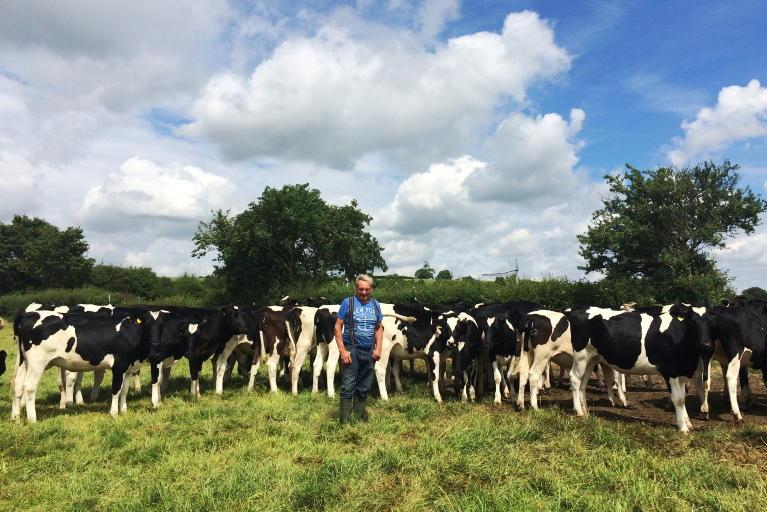
We have at last had a sensible amount of rain. This has been most welcome after four months of burning sunshine and looking at brown pastures.
It was necessary all this time to feed all the stock on the farm full winter rations.
This necessitated buying in 600t of silage from a clamp on a farm six miles away at a cost of £60/t.
This is double what I normally value silage at – sometimes difficult decisions have to be made if you want to stay in the game.
Last year was difficult, this year has been even more difficult. I am just hoping the financial budget will stretch to coping with a drought next year.
I am already making plans to buy another clamp of 300t of silage to feed the cows next spring. It seems that this valley, nestling between the Cotswolds and the Wiltshire Downs, has suffered far longer than the rest of the country, because I enviously hear reports of people in other areas considering another cut of silage, since they had rain a month ago.
The brown stubble in the paddocks is starting to turn green and I'm hoping that the seed we stitched in with a pasture aerator will do some good.
Hopefully, soil temperatures are still high enough, as there is some more I would like to do given time and sunshine.
Labour
We are half-way through the autumn-calving cows and it has been difficult, since we have lost several calves, but I think the problem was down to a lack of colostrum - some thing we are addressing by leaving the calves longer on the cows.
There is a debate going on within the family at the moment to change from three months calving, three months serving, three months calving, three months serving to year-round calving.
Because this would take the pressure off the calf housing and the workload, so that more individual attention can be given, but I do favour the current situation as we can concentrate on serving.
After all, who wants to go out spotting bulling cows on Christmas Eve? Although there is a strong case for considering something like new technology.
When I retired from milking age 70 and we put in a new parlour, an all-singing-and-dancing 20:20 with auto ID, auto cake, auto cluster remover, auto cluster flush, we had to find a team to employ to milk the cows.
It has been a torturous journey, but I think at last we found two girls who are ideally suited to the job of milking 150 cows.
I was considering advertising in the Irish Farmers Journal for a student to come over and milk and run the herd for 12 months, changing each year, but I think at last we are where we want to be.
Up until now, it would appear that non-family youngsters who milk cows have four main requirements from the money they earn.
They live with mum and dad and give them a few quid, the rest is spent on tattoos, takeaways delivered, glue-on fingernails, glue-on eyelashes and visits to the coffee shop.
They seem to be able to earn enough money to do this by doing a four-and-a-half-day week and very little weekend work.
The other problem with an ever-changing team is, firstly, you don’t know what they don’t know – sometimes they ignore the obvious.
We do encourage them to use an app to communicate with one another and this is quite useful, but it can be an excuse for passing responsibility ie "check cow 64 front right for mastitis", rather than tackling the problem themselves.
Fortunately, the current two seemed to have a desire to milk and a desire to learn to further their careers from what I call cluster jockeys to herd managers.