



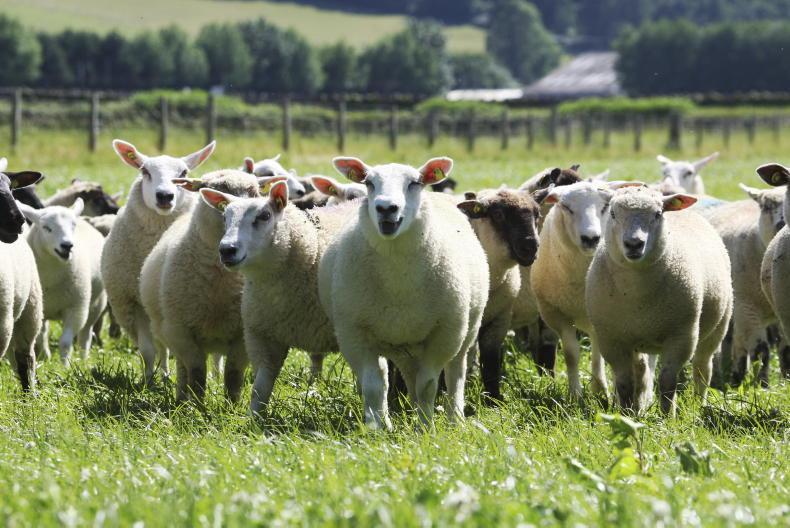
Realistic performance figures: This week’s sheep feature discusses last-minute preparations for breeding and reducing demand to help build autumn grass supplies.
Teagasc advised farmers that, when weighing up decisions on whether to finish or sell lambs, to use realistic performance targets in budgets.
It is advised that lambs on a grass-only diet in September will gain in the region of 1kg liveweight per week.
This reduces to 0.7kg/week in October and just 0.4kg/week in November. The latter figure is also dependent on relatively good levels of grass utilisation.
On brassica crops – of which there was very few sown this year – performance can be very variable depending on weather and can range anywhere from 0.6kg/week to 1.5kg/week. For farmers finishing lambs intensively, the food conversion efficiency will be in the region of 6:1 for hill lambs and 5:1 for lowland lambs.
Intake is typically in the region of 1kg to 1.1kg for hill lambs and 1.2kg to 1.3kg for crossbred and lowland lambs, while performance is in the region of 220g to 250g liveweight gain per day. Intake and performance can be much higher in individual lambs and as such it is vital to weigh lambs regularly and draft on a combination of weight and fat score.
Kill-out: Recent weeks’ management notes have touched on a lower kill-out in lambs, but significant issues remain based on conversations with farmers at the Ploughing.
The typical kill out reported by many farmers was in the region of 42% to 43% – lower than the norm of 44% to 45%.
But there was significant variation with some aged ram lambs with a poorer cover of flesh and finished on a diet of mainly grass killing back to 40% or lower for crossbred-type lambs.
Many farmers commented that they were drafting at a liveweight of 50kg upwards for such lambs. At a kill-out of 43%, such weight lambs will kill out in the region of 21.5kg. This increases to 22.5kg at 45% kill-out but falls back to 20kg at 40% kill-out.
Reference numbers: Questions on maintaining your flock reference number for the Sheep Improvement Scheme (SIS) or scheme payable number for the Sheep Welfare Scheme (SWS) were also commonplace at the Ploughing. For the SIS, the scheme reference number has to be maintained throughout the calendar year. In contrast, the payable number needs to be present for the selected actions in the SWS.
Fertiliser closing stocks: The Department of Agriculture is reminding farmers about the legal requirement to declare closing stocks if fertiliser on the National Fertiliser Database (NFD). A nil declaration needs to be made, even where there was no fertiliser on hand on 15 September – ie, the start of the prohibited period in Ireland for applying chemical fertiliser (excluding potassium).
The deadline for declaring closing stocks is 15 October 2026. The declaration must be recorded online via the MyAgfood.ie portal. The Department is also advising farmers and other fertiliser users to check that their fertiliser transaction records are accurate and up to date. Where fertiliser remains on farm the volume and type of fertiliser must be recorded. They advise that “farmers who have queries regarding purchases of fertilisers should raise concerns with their merchant directly in the first instance”.



SHARING OPTIONS