



Shaun Diver
Tullamore Farm, Co Offaly
There was a good amount of rain last week at Tullamore Farm, but the drier weather since the weekend has helped the land to soak. Shaun says that every week the cattle can be kept out at grass at this time of year is a huge help.
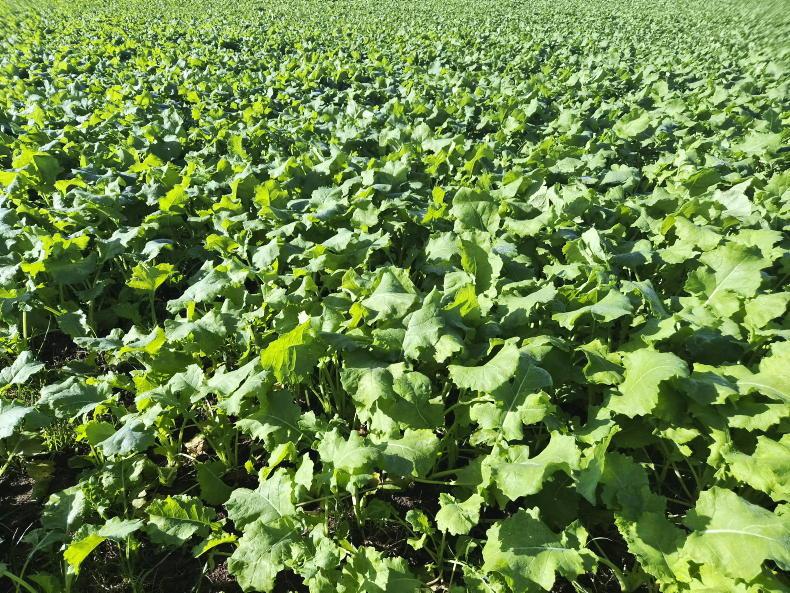
The forage rape that Shaun planted is doing really well. The warm temperatures in September helped the crop to grow strongly, despite the fact it was planted fairly late. Some of the rape was planted where the wholecrop of barley, oats and peas was. There are lots of volunteers coming through where the 30ft rows were after the crop was cut.
Some of the forage rape was planted into a grass paddock. It was not sprayed off; the field was only disced a couple of times before spreading the seed with a fertiliser spreader and rolling afterwards.
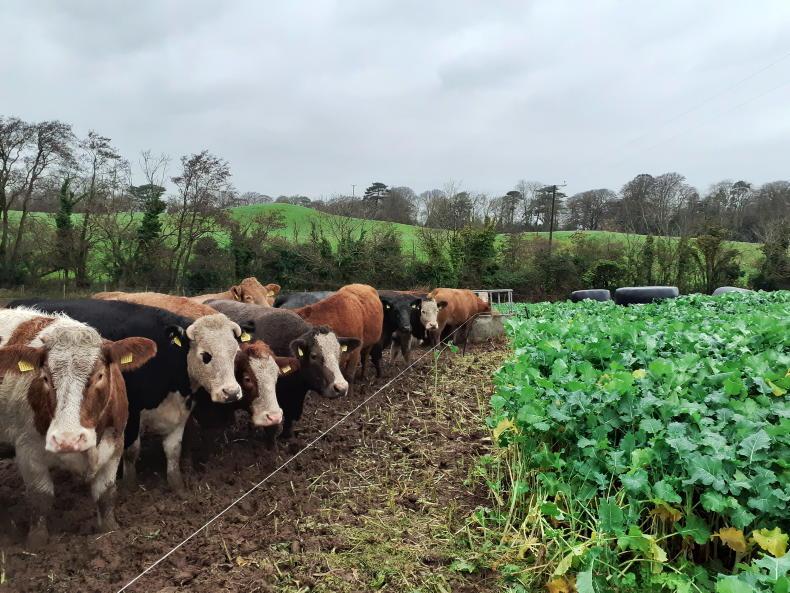
It wasn’t sprayed off as Shaun wanted to keep the costs down and it was very brown at sowing due to the summer drought. It will be sprayed off before spring barley is planted there in the spring anyway. Some grass is coming back through the crop, but it is not affecting the forage rape too much. Shaun plans to start grazing it in mid-November.
The forage rye has established very well. It was sown in the middle of September and has three leaves emerged already. The crop was sown after spring barley, so it was just disced once before sowing.
If the weather and ground conditions are suitable, Shaun plans to graze the crop with the ewes in November and then harvest and ensile the rye in April.
To hear more about the forage rape and forage rye on Tullamore Farm, watch the video below.
Stephen Wallace
Mountrath, Co Laois
There was plenty of rain in Laois last week, but happily for Stephen, he had a lot of his winter cereals planted by the time it arrived.
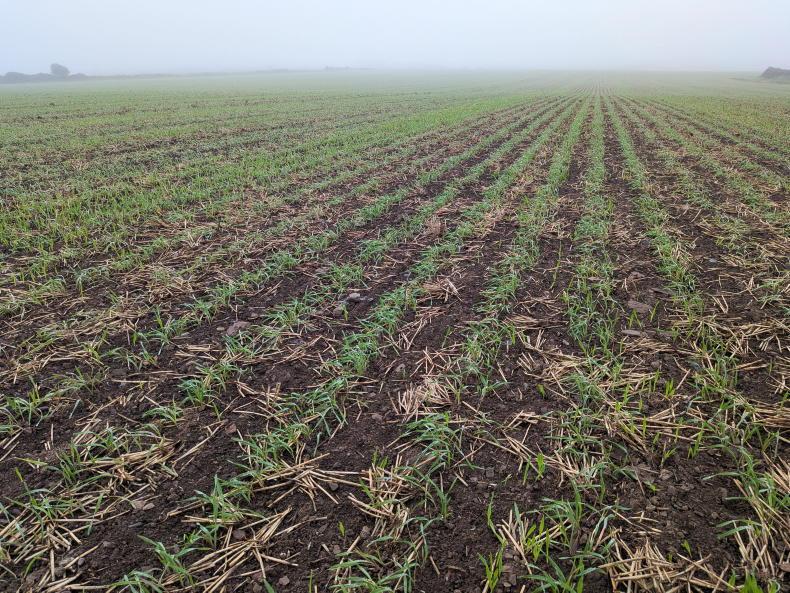
The winter rye was the first crop to be sown. There are about 35ac of it this year and it has already established well and currently has one tiller.

The winter wheat then went in on 26 September. It was sown early because of the heavy soil it was planted in. Stephen says it can get wet very quickly in the autumn.
The variety, RGT Hexton, is also quite a slow developer. It was planted at 190kg/ha. Heavy rain fell the day after Stephen finished sowing the wheat, so he left it another day before he applied the pre-emergence herbicide. Still, he says there were a few tracks left in the wet spots, but they weren’t too deep.
Stephen has no winter barley for the coming year because of the crop rotation on the farm.
Therefore, there are only winter oats left to be drilled. If the weather suits, Stephen says he will get the plough back out next week.
The field where the winter oats are going has a cover crop in it at the moment, which was sprayed off this week. There was a good amount of biomass on it, even if there were a lot of barley volunteers too. The winter oilseed rape on the farm has established well.
Stephen says there are a couple of thin spots, but they should be fine.
The crop received Katamaran Turbo as a pre-emergence herbicide and it seems to have provided good weed control.
Stephen has noticed that there is something nibbling on the roots of one or two oilseed rape plants, causing the plants to wither. They’re only a couple of plants in the field, so he isn’t too worried.
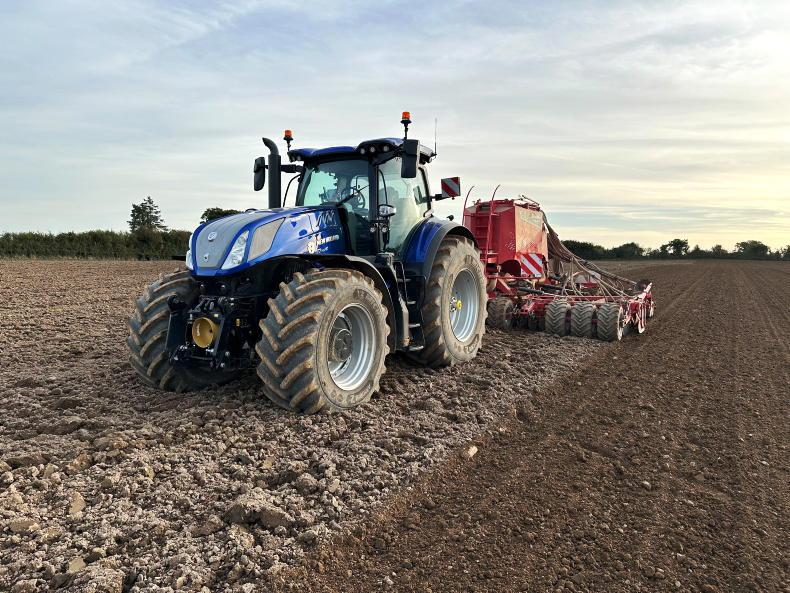
Stephen got his homemade RTK base station working recently. He was able to use it to plant the winter cereals and says it provided a great signal.
Conor Callan
Ardee, Co Louth
The cycle has started again in Co Louth, as Conor plants his winter cereals this week. There was a good amount of rain last week, but the ground has taken it well. Conor says there was half an inch of rain last Friday, but he was sowing on Saturday morning on dry land.
Conor would normally plant the winter barley first, but the wheat is getting priority this year.
Graham, LG Rebellion and Kubik are being planted at 200kg/ha.
Conor usually only plants one variety of wheat, but decided to spread the risk this year, as Graham did not do as well as he had hoped in 2026.
There are great conditions for sowing at the moment, according to Conor. He says some of the lighter ground hardly needs any tilling despite the rain last week.
Some of the heavier land was left for a few extra days to drain after this rain.
The soil is still very warm, so Conor hopes the crops can get a good start and establish well before the ground gets wet for the winter.
A pre-emergence herbicide, Tower, is being applied at 2l/ha soon after sowing.
Conor thinks it is essential to get this spray on, especially to control grassweeds like annual meadow grass.
The chosen winter barley variety is Organa and it has been treated with Latitude.
The barley is going in after barley, and it had winter wheat the year before that. Conor hopes to have most of the winter sowing done this week.
The maize was harvested two weeks ago. The weather was very good for the harvest; Conor says there was hardly a mark made, even on the heavy land.
He says it was great to get the crop out in a timely fashion and to get the fields planted with winter wheat already.
The maize did well overall, averaging 22t/ac.



SHARING OPTIONS