



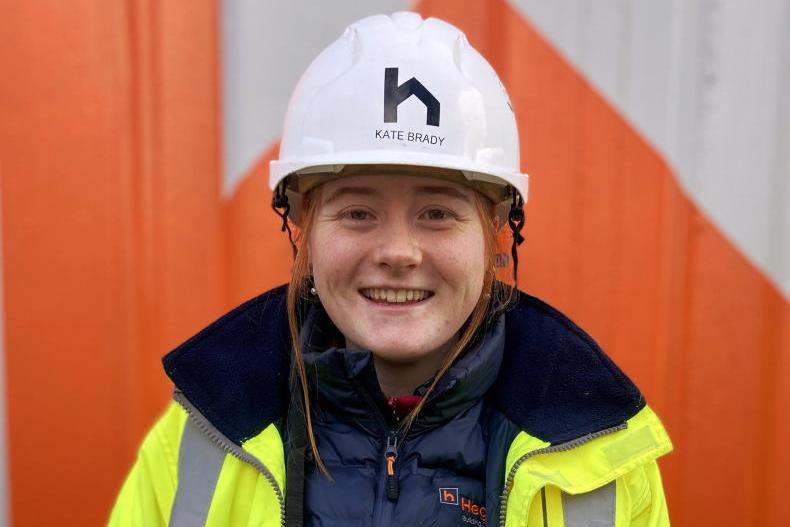
For Kate Brady (26), her interest in construction started long before she stepped onto a building site.
Growing up in Macroom, Co Cork, both her father and grandfather were involved in the industry. Her father is an engineer, meaning conversations about how buildings were put together were part of everyday life.
“I was always exposed to thinking about how buildings come together or pointing out the interesting details that make a project come together,” she says. “Unfortunately for my mom, I was always that child asking ‘why?’.”
Today, Kate is a site engineer with PJ Hegarty, working on a pharmaceutical project. Her route from school to site offers an example of the range of opportunities available within an industry where women remain underrepresented.
According to Women in Construction Ireland (WICI), women make up around 10% of the Irish construction workforce, fewer than 2% of site-based roles and just 15% of senior executive positions.
The organisation recently launched its first national mentoring initiative as part of a new three-year strategy, with a focus on mentoring, networking, education and sharing knowledge.
However, for young women considering their own careers, one of the first hurdles can come much earlier: simply knowing what opportunities exist.
Transition Year helped Kate turn an existing familiarity with construction into a clearer idea of what she might want to study. She attended the iWish and STEPS engineering programmes in conjunction with what was then Cork Institute of Technology, now Munster Technological University.
The week-long programmes introduced students to different types of engineering and gave them projects designed around solving real-world problems.
“It was a really good taster of the different branches of engineering and boiling it down into how to be a problem solver,” she says.
Even then, Kate was not certain that structural engineering was the route for her. Rather than committing immediately, she chose a general engineering degree.
“I was nervous that I was only choosing it because it was the one I was most familiar with after being exposed to the industry since I was young,” she says.
Finding a route
Once in college, however, she found herself drawn to the type of maths involved in static problems and particularly to the construction side of engineering.
She went on to complete a five-year integrated Master’s in Structural Engineering at MTU. Crucially, the course included a nine-month placement in fourth year, and Kate also completed another four months of work experience between third and fourth year.
For her, placement was one of the most valuable parts of the course.
“I couldn’t encourage placement more and feel every course should have some requirement for it,” she says.
The experience allowed her to work both on-site and in a design office before deciding where she wanted to begin her career.
“It was a lot more daunting coming in as a student than as a grad but you also have that security of being a student,” she says. “You’re eased into the role and people are more conscious to look out for you as a student than a grad, as it should be.”
She says the learning does not stop once college ends, with the first weeks in any new role bringing a steep learning curve. Kate’s job also demonstrates that a career in construction can involve considerably more than many students may imagine.
What happens on-site?
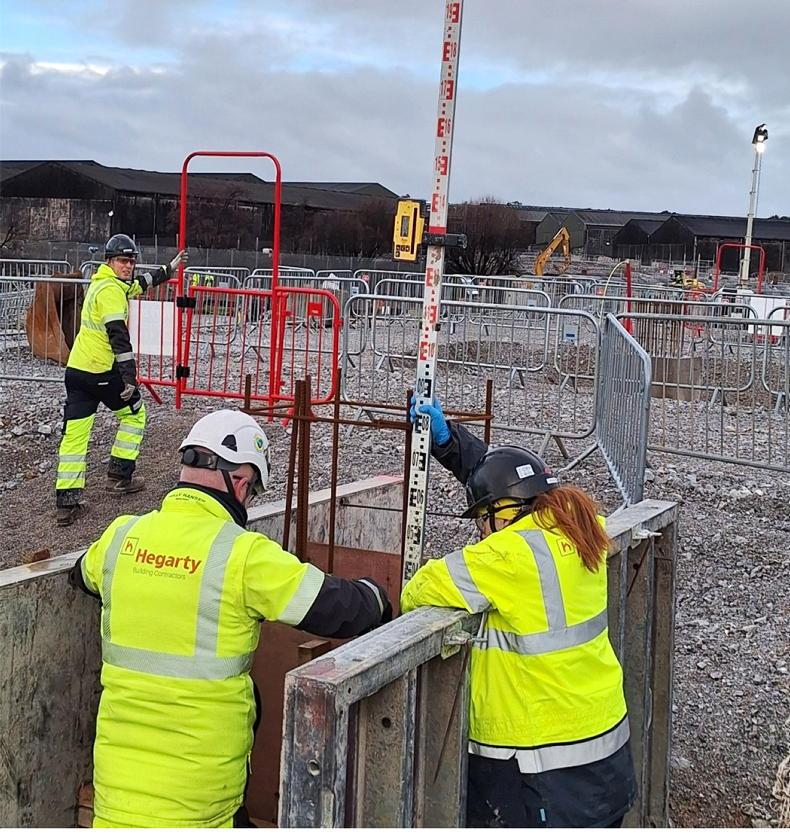
As a site engineer, she is responsible for helping ensure that what is constructed matches the drawings. That can include contacting subcontractors, ordering materials, setting out lines and levels and carrying out inspections before and after installation.
As her current project has progressed beyond much of the heavy groundworks and concrete work, her role has moved increasingly towards project management.
She coordinates access between different trades, helps facilitate scaffolding and groundworks, oversees steel installation and uses equipment including a total station and laser level to establish heights and coordinates.
She also prepares plans so subcontractors know what activity is planned for the coming week. Because the project is being carried out alongside a live operating plant, careful coordination around shutdowns and lockouts is particularly important for safety and the continued running of the facility.
Despite the technical side of the profession, Kate says one of the things she enjoys most is how people-focused the work can be.
“It’s a very personable job, on-site you’re speaking to people all day,” she says.
Engineers may be responsible for working through problems, but she believes being able to communicate the solution is just as important.
“If you can’t explain how to do the job, it won’t be done correctly.”
The role also allows her to see how different trades and individual elements of a project interact, giving engineers a broader view of how the finished development will come together.
Showing what is possible
The sector may be male-dominated but as a young woman, Kate says her experience has been largely positive.
“I don’t feel different and it’s rare that I have a feeling of ‘oh I’m the only woman here’,” she says.
She is more likely to notice being the youngest or least experienced person in a situation rather than the only woman.
There have been occasions where people assumed she was younger or less experienced, although she is unsure whether that is because of her appearance or gender.
“You have to back yourself in order to get the job done,” she recommends.
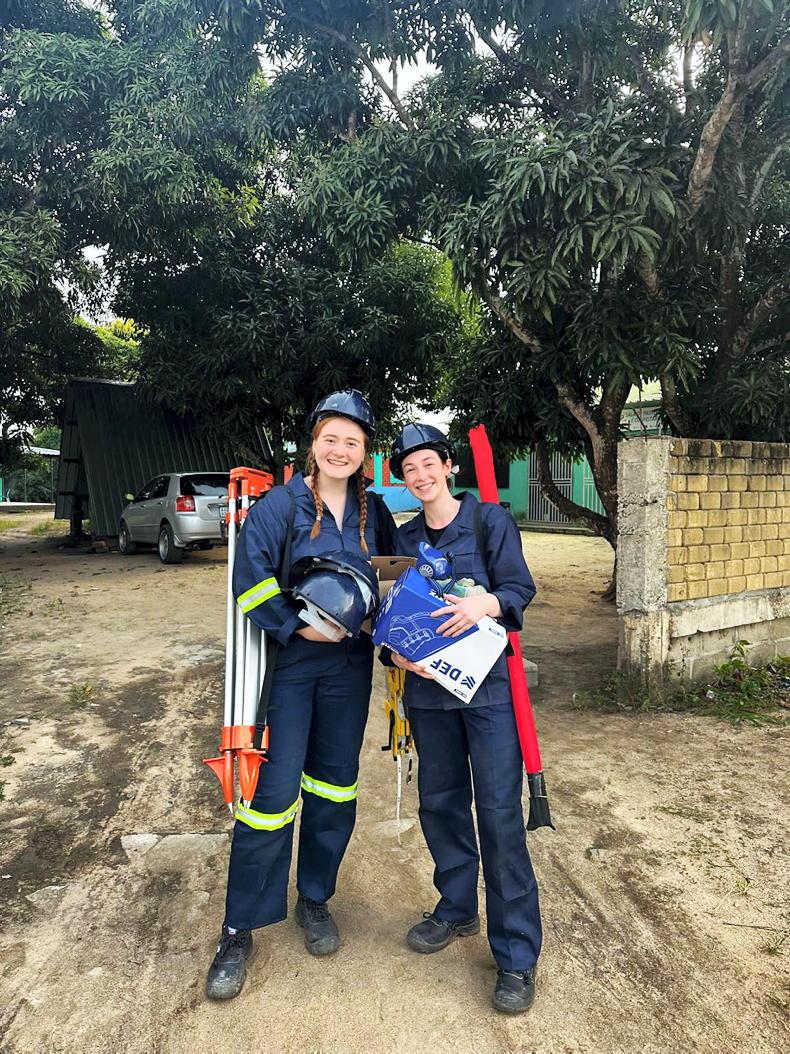
Kate has encountered a small number of situations where she felt she had to prove her ability, but says confidence and how someone carries themselves can help overcome those assumptions.
She has also noticed more women entering the industry since beginning her own career.
Support and visible role models have played an important part along the way. Kate says her lecturers at MTU were supportive, and seeing other women succeed in engineering helped reinforce that it’s a career she could pursue.
That visibility is particularly important at school level.
I was nervous that I was only choosing it because it was the one I was most familiar with after being exposed to the industry since I was young
Kate attended an all-girls school where subjects including construction, design and communication graphics and applied maths were not available.
She believes offering more construction-related subjects would help students develop relevant skills earlier, while schools should also encourage programmes like those she attended during Transition Year and provide more opportunities for work experience.
She would also like students to hear directly from those doing the jobs.
“We need to get engaging speakers from trades into schools to give more of an insight into the different careers,” she says, adding that prospective students often benefit more from hearing from somebody working in the role than from a company’s HR or marketing person.
With demand for engineers currently high, Kate also sees significant scope for progression and describes engineering as an adaptable career.
For students who remain unsure whether construction is for them, her advice is straightforward.
“Give it a go, there are so many different routes to explore within the industry, from major projects to bespoke homes or even specific solutions and subcontractors.
“You don’t have to be the brightest in the room and you’ll meet so many people who will try to help you and want to see you succeed.”
See wici.ie





SHARING OPTIONS