
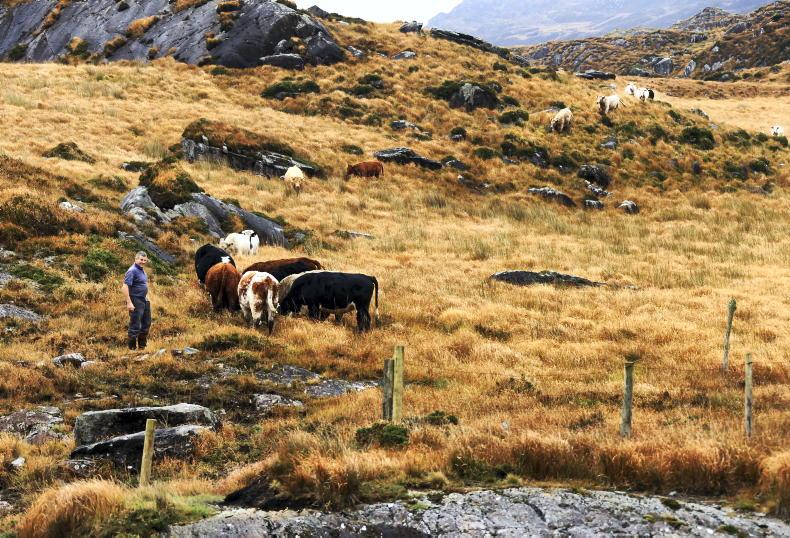
New figures released by the Department of Agriculture show that just over 28,000 non-tillage farmers who received an Areas of Natural Constraint (ANC) scheme payment in 2025 were stocked below 0.5 livestock units per hectare (LU/ha).
There was a total of 94,160 non-tillage farmers that claimed an ANC payment in 2025, some 70% of which had a stocking rate above 0.5 LU/ha – equivalent to two ewes/ac.
Some 375 of 2025 ANC farmers were stocked at below 0.1 LU/ha – the standard eligibility threshold for receiving payments.
These farmers were able to claim ANC funds due to “environmentally constrained parcels” on their farms that were granted lower stocking rates.
A further 8,297 farmers claimed the payment at a 0.1 to 0.2 LU/ha stocking rate, 7,269 were at 0.2 to 0.3LU/ha and another 12,165 at 0.3 to 0.5LU/ha.
The figures come after the latest draft of proposals for the next Common Agricultural Policy (CAP) – those setting out the collective position of EU member states – state that ANC should not be mandatory for each country to offer to its farmers.
The change sparked calls for Minister for Agriculture Martin Heydon to commit to ensuring the scheme continues.
Stocking rate CAP debate
The wider debate around stocking rates and payment eligibility criteria in the next CAP uncovered a divide between the Irish Creamery Milk Suppliers’ Association (ICMSA) and the Irish Natura and Hill Farmers’ Association (INHFA).
The ICMSA kicked off discussions by calling for the standard minimum stocking rate threshold for claiming area-based schemes such as ANC and the Basic Income Support for Sustainability (BISS) to be raised to 1 LU/ha – equal to four ewes/ac.
The ICMSA criticised the current minimum stocking rate as being “ridiculously low”.
These 1 LU/ha proposals were blasted by the INHFA as “way out of kilter with the reality on the ground” in areas of marginal land type, as it stated it was firmly committed to ensuring a 0.1 LU/ha rate remained.
Fine Gael MEP for Ireland south Seán Kelly had also chipped in on the active farmer debate by claiming that the current CAP allows some to receive payments for “throwing a few cattle or sheep or donkeys on a couple of hundred or a couple of thousand acres”.
In part, EU member states have said that for the next CAP, criteria including income tests and a farm's labour requirements should be used, with the option to draw up a negative list of factors that would rule a farmer ineligible.